 |
 |
Login to Your Account |  |
|
PubSub: Science
Last updated: 2026-11-08T08:40:11+00:00
Listed below are the 32 most recent matches to your subscription.
|
Title: How to Ask Your Child About AI Chatbots Without Panic
[
Link
]
Source: Privacy NeedlePublished: 2026-11-08T06:58:17+00:00 Modified: 2026-11-08T06:58:17+00:00 In a bustling tech hub like Lagos, where the next generation of developers and digital entrepreneurs is growing up with a smartphone in hand, the conversation around digital safety is shifting. It is no longer just about blocking inappropriate websites or monitoring social media comments. The new frontier is generative AI. For many parents, seeing a child interact with an LLM (Large Language Model) like ChatGPT or Gemini feels like watching them talk to a stranger in a digital dark alley. The instinct is often to ban, restrict, or react with alarm. However, banning these tools rarely works in a hyper-connected world. Instead, the goal is to build digital literacy. Learning how to ask child chatbots without panic is the first step in moving from a reactive parent to a proactive digital mentor. The Core Risks: What Are You Actually Protecting Them From?Before you can have a productive conversation, you must understand the three primary risks associated with children using AI chatbots. These are not just “tech issues”; they are fundamental data protection and psychological concerns.
As noted by researchers at various global AI ethics forums, the challenge lies in the “black box” nature of these models—we often do not know exactly how the data is being processed once it enters the system.
Search Engines vs. AI Chatbots: A ComparisonOne reason parents struggle to ask child chatbots without panic is that they confuse AI with traditional search engines like Google. Understanding the difference is crucial for setting boundaries.
A Practical Framework to Ask Child Chatbots Without PanicTo avoid a confrontation that shuts down communication, use a curiosity-first approach. Instead of an interrogation, try a collaborative exploration. Here is a three-step method to navigate these waters. 1. The Observation PhaseDon’t jump straight into a lecture. Watch how they use it. Are they using it to brainstorm ideas for a science project, or are they asking it personal questions about their feelings? This context determines the level of intervention required. 2. The “Co-Pilot” ConversationSit down with them and ask to see how it works. Use phrases like, “I’ve been hearing a lot about these AI tools. Can you show me how you use it for your schoolwork?” This positions you as a student of their world rather than a critic of it. 3. Setting the “Privacy Guardrails”Once the rapport is built, introduce the concept of digital hygiene. Explain that the chatbot is like a public bulletin board: once you post something, you can’t really take it back. Frame it as a compliance issue for their own personal data. Teach them the “No PII” rule: Never give the bot Personal Identifiable Information (names, addresses, phone numbers, or school names). Case Study: Amina and the AI Homework HelperAmina, a 14-year-old student in Abuja, began using an AI chatbot to help her write essays. Initially, her parents were concerned she was “cheating.” However, instead of banning the app, they sat down to discuss it. They discovered Amina was using it to explain complex math concepts she didn’t understand in class. During their talk, they established a rule: Amina could use the AI to explain concepts, but she could never copy-paste the text directly, and she was strictly forbidden from telling the bot her real name or location. By treating the AI as a tool rather than a threat, Amina learned to use it effectively while maintaining her digital safety. Quick Checklist for Parents
Frequently Asked QuestionsIs it safe to let my child use ChatGPT?It depends on age and supervision. While technically available to teenagers, it requires strict guidance on what information is shared and how to verify the accuracy of the output. Should I block all AI apps on my child’s phone?Blocking may prevent them from learning essential future skills. A better approach is to move from total restriction to supervised usage, focusing on digital literacy and ethical AI use. ConclusionThe rise of generative AI is not a passing trend; it is a fundamental shift in how humans interact with information. While the risks regarding data privacy and misinformation are real, they are not insurmountable. By learning how to ask child chatbots without panic, you are doing more than just protecting them from a single app—you are equipping them with the critical thinking skills necessary to thrive in an AI-driven world. The goal is not to keep them away from the technology, but to ensure they are the ones in control of it. The post How to Ask Your Child About AI Chatbots Without Panic appeared first on Privacy Needle. |
Title: APOD: 2026 November 8 – Major Fireball Meteor
[
Link
]
Source: NASA Press ReleasesPublished: 2026-11-08T05:05:00+00:00 Modified: 2026-11-08T05:05:00+00:00 APOD Science APOD APOD: 2026 November 8 –… Today’s APOD Archive Submissions Index Search Calendar RSS Education About Discuss APOD Astronomy Picture of the Day Discover the cosmos! Each day a different image or photograph of our fascinating universe is featured, along with a brief explanation written by a professional astronomer. Major Fireball Meteor […]
Source: NASA. https://science.nasa.gov/image-article/apod-2026-november-8-major-fireball-meteor/
|
Title: GE Healthcare Recruitment 2026 – IT Development Program
[
Link
]
Source: OffCampusJobs4u.Com – Off Campus Jobs | Off Campus Drives | Freshers Jobs- Apply NowPublished: 2026-11-07T16:39:38+00:00 Modified: 2026-11-07T16:39:38+00:00 GE Healthcare Recruitment 2026: Information Technology Development Program | Bangalore GE HealthCare is inviting applications for its Information Technology Development Program (ITDP) in Bengaluru, Karnataka. This opportunity is designed for technology graduates who want to develop their careers in information technology, software engineering, data science, artificial intelligence and other emerging technology domains. The Information Technology […]
|
Title: Zebra Recruitment 2026 – Software Engineer I, Bangalore
[
Link
]
Source: OffCampusJobs4u.Com – Off Campus Jobs | Off Campus Drives | Freshers Jobs- Apply NowPublished: 2026-11-07T16:58:12+00:00 Modified: 2026-11-07T16:58:12+00:00 Zebra Recruitment 2026: Software Engineer I Job Opening in Bangalore Zebra Technologies is inviting applications for the position of Software Engineer I in Bangalore (Bengaluru), India. The opportunity is suitable for candidates with a background in Computer Science, Software Engineering or a related technical discipline and experience in software development. The role description includes general […]
|
Title: Booker or bust: M John Harrison, lifelong weird old sci-fi bloke, eyes literature’s biggest prize.
[
Link
]
Source: SFcrowsnestPublished: 2026-11-07T17:53:14+00:00 Modified: 2026-11-07T17:53:14+00:00 On Monday night at Old Billingsgate in London, the Booker Prize judges will open their envelope, and there’s a decent chance the name inside belongs to a man who started out in the pages of New Worlds in the late 1960s. If M John Harrison wins with The End of Everything, he’ll be the oldest winner in the prize’s history at 81. That would beat Margaret Atwood, who was 79 when she shared the 2019 award with Bernardine Evaristo. It would also be a rare night when a novel about gelatinous alien things in the sky takes £50,000 off the literary establishment. The road to the shortlist ran, unusually, through a coronary ward. In an interview with the Telegraph’s Josiah Gogarty, Harrison describes a 2015 heart attack that began in the middle of a reading in an East London loft. He put it down to red wine and pizza until, a couple of days later, he realised it was time to ring for an ambulance. He came out with six stents and a sudden sense that time was short. He went home and wrote The Sunken Land Begins to Rise Again, which won the Goldsmiths Prize in 2020 and finally got the literary world to look up from its latest novel about a novelist. There’s a neat touch, too: the story he was reading that night belonged to the same haunted world as the new book. The End of Everything follows Phillip Tennent, a beachcomber on a ruined Kent coast. He makes a living selling the strange things the Channel washes up and keeps an eye on his elderly aunt Marnie. Some crisis has happened. Government barely works, the sea is full of new life, and Europe, according to the publisher’s blurb, has been “mislaid”, which any Remainer could have told you. Hanging over all of it are the iGhetti, vast and unexplained presences, and Harrison has no intention of explaining them. Then Tennent finds a shapeshifting object that unsettles everything he thought he knew. The Booker judges called it “slyly satirical” and admitted to laughing out loud. That suggests a panel chaired by Mary Beard, with Jarvis Cocker on it, has a darker sense of humour than most. Not everyone has given in to it. Michel Faber in the Guardian found it “dreamlike and baffling”, and meant that as praise. One genre blogger gave it three stars and admitted he’d finished it and still couldn’t say what it was about. Harrison would probably take that as a job well done. This is the man who wrote The Centauri Device partly out of irritation with space opera, then took apart heroic fantasy in the Viriconium books, and rarely lets his readers keep their footing. He won the Arthur C Clarke Award for Nova Swing and the Boardman Tasker Prize for mountain literature for Climbers, so he has already been the best thing on two very different shelves. His short fiction has been through these pages before, too, with the ghost stories of You Should Come With Me Now. Asked by the Take Four Books podcast to pick three touchstones for the new novel, he chose The Day of the Triffids, Ballard’s The Drought and Robert Aickman’s story “The Same Dog”. That’s about as respectable a lineage for English catastrophe fiction as you’ll find. He also knows the prize from the inside, having judged the Booker himself in 2022, so he knows exactly what goes on in the deliberating room. The Telegraph interview also lets Harrison have a go at the tech-bro sci-fi fan club. He finds it alarming that Elon Musk and Sam Altman grew up on mid-century “the galaxy is ours” colonisation SF. Asked whether he’d suggest some better reading, he declined, because he didn’t want to arm their “rather petty and boyish imagination” any further. That rules out posting Elon a copy of Light for Christmas, then. Here at SFcrowsnest, we’ve always counted Harrison as one of ours. He may find that awkward, since he now keeps the words “science fiction” off his book jackets so they don’t confine him to one readership. Fair enough. He was treated as a hack for long enough to be allowed some suspicion of labels, and the New Worlds crowd he came up with (Michael Moorcock still talks a good game about those days) never had much patience for them either. He’s up against strong company. Marlon James and Douglas Stuart could each become only the fifth person to win the Booker twice, and Elizabeth Strout has a Pulitzer. But if the envelope says Harrison on Monday, expect a lot of breathless broadsheet coverage announcing that science fiction can be literature after all. Anyone who read New Worlds in 1968 knew that already. They just didn’t have the stents to show for it. The post Booker or bust: M John Harrison, lifelong weird old sci-fi bloke, eyes literature’s biggest prize. appeared first on SFcrowsnest. |
Title: A Guide to Proxy Servers for School Networks and Restricted Websites
[
Link
]
Source: Theme CirclePublished: 2026-11-07T19:49:00+00:00 Modified: 2026-11-07T19:49:00+00:00 Use proxy servers on school networks only when they are approved, logged, and tied to a clear rule. They can help with safety, speed, and access to learning tools. They can also cause trouble fast. Many schools use filters because U.S. schools that get E-rate support must block certain harmful content, and E-rate discounts can range from 20% to 90% [source: FCC]. TLDR: A proxy server sits between a student device and the internet. It can block bad sites, cache common pages, and help staff manage web access. For example, if 800 students all open the same science video, a school proxy may serve cached data and reduce repeated traffic. Do not use random proxy sites to get around school rules, because it can expose passwords, logs, and personal data. What Is a Proxy Server?A proxy server is like a school office pass for the internet. Your laptop asks for a website. The proxy gets the request first. Then it decides what happens next.
Think of it as a helpful gatekeeper. A strict one. Sometimes too strict. Honestly, it feels like the internet has to ask for a hall pass. Image not found in postmeta
Why Schools Use ProxiesSchools do not use proxies just to annoy students. Though yes, it can feel that way when a harmless page gets blocked. They use them for a few big reasons:
This matters because one infected device can cause a mess. A fake login page can steal a student password in seconds. A proxy can block many of these tricks before anyone clicks. How It Works in Simple TermsHere is the basic path:
If the site is blocked, you may see a message. It may say the page is not allowed. It may also say which rule was triggered. The annoying part? Some filters are clumsy. A page about breast cancer research might get blocked because of one word. A history article might get flagged because it mentions violence. Expect to waste time asking for access if the filter is poorly tuned. Proxy Types You May Hear AboutNot all proxies do the same job. Here are the common ones.
A large school may use more than one. For example, students might use a forward proxy, while the school portal sits behind a reverse proxy. Image not found in postmeta
What About Restricted Websites?This is where people get curious. A restricted website is not always “bad.” It may be blocked for time, age, safety, copyright, or bandwidth reasons. Examples include:
Do not use random public proxies to dodge school filters. That can break school policy. It can also be unsafe. Some free proxy sites record traffic. Some inject ads. Some are packed with malware. That “free unblocker” may cost you your login. If a site is blocked by mistake, ask for a review. Send the link, the class name, and why you need it. Keep it boring and clear. Tech staff like clear tickets. Nobody likes “it does not work” with no details. Good School Use CasesProxies are useful when they are planned well.
Some schools also inspect encrypted traffic. That should be handled with care. Students and parents should know what is monitored. Staff should protect private data. Logs should not sit around forever. Best Practices for SchoolsA proxy should be helpful, not a digital brick wall.
A good setup blocks real risks. It also lets learning happen without making every click feel like a fight. Image not found in postmeta
Simple Advice for StudentsIf a site is blocked, do not panic. Do not grab the first proxy link from a search result. That is how people lose accounts. Try this instead:
Proxy servers are tools. They are not magic. They are not villains. Used well, they keep school networks safer and faster. Used badly, they block learning and make everyone grumpy. The best school proxy setup is simple: clear rules, safe access, quick fixes, and no shady shortcuts. The post A Guide to Proxy Servers for School Networks and Restricted Websites appeared first on Theme Circle. |
Title: Учёные показали способ повысить теоретический КПД панелей до 43%
[
Link
]
Source: itzine.ruPublished: 2026-11-07T17:01:37+00:00 Modified: 2026-11-07T17:01:37+00:00 Исследователи из Института фотонных наук (ICFO) разработали конструкцию солнечной ячейки, которая уменьшает потери энергии при излучении света. Эксперимент пока не означает, что более эффективные панели появятся в продаже: речь идёт о лабораторной работе и возможном пределе для фотогальванических элементов. Обычно исследования солнечных элементов сосредоточены на снижении тепловых потерь. Команда ICFO изучала другую проблему: часть энергии теряется, когда ячейка сама испускает свет. Этот процесс называют потерями Болцмана. Работа опубликована в журнале Energy & Environmental Science. Для эксперимента исследователи взяли органическую солнечную ячейку. Передний электрод из оксида индия-олова заменили тонким слоем серебра, а сам элемент превратили в оптический резонатор. Такая конструкция пропускает солнечный свет внутрь, но сокращает излучение под большими углами. Эффективность испытанной ячейки выросла примерно на 0,85%. По оценке ICFO, ограничение Шокли — Квайссера, теоретический предел эффективности существующих элементов, составляет 33,16%. Новый подход, если его удастся развить, может приблизить этот показатель к 43%. Для сравнения, эффективность потребительских солнечных панелей обычно находится в диапазоне от 20 до 23%. Авторы считают, что принцип можно применять к разным типам фотоэлектрических элементов, а не только к материалам, используемым в лабораториях. Первый автор исследования Франсиско Берналь Текса пояснил, что сужение углового диапазона излучения позволяет приблизить его к диапазону поглощения солнечного света. |
Title: Want to fly to the moon? NASA is looking for new astronauts to help grow its Artemis program
[
Link
]
Source: CityNews VancouverPublished: 2026-11-07T18:02:32+00:00 Modified: 2026-11-07T18:02:32+00:00 CAPE CANAVERAL, Fla. (AP) — Want to fly to the moon and help build a permanent lunar base? NASA is accepting applications for a new astronaut class that will help grow the Artemis program. Officials announced the news Saturday during a Kennedy Space Center air show promoting lunar exploration as well as advances in aviation and technology. NASA’s last call for new astronauts was two years ago. More than 8,000 applied, with 10 making the final cut in September 2025. With only 32 active astronauts, the space agency needs more recruits as it looks to expand humanity’s presence beyond low-Earth orbit as quickly as possible. April’s lunar flyaround by the Artemis II crew kicked off the lunar campaign. “We have far more work than we have astronauts,” Artemis III commander Randy Bresnik told The Associated Press on Saturday. Aspiring astronauts have between now and Dec. 3 to submit their applications. NASA expects to make its final selection by late 2027, with the new candidates beginning their training by early 2028 — the same year that NASA intends to return astronauts to the lunar surface after an absence of more than half a century. By then “we’re going to have people on the moon — so don’t delay,” Bresnik urged potential candidates. Bresnik and his three crewmates will blast into orbit next summer to practice docking their capsule with a pair of lunar landers, one built by Elon Musk’s SpaceX and the other by Jeff Bezos’ Blue Origin. Their mission will stick close to Earth — no lunar flyby — and serve as a dress rehearsal for the following year’s Artemis IV mission that will attempt to land two astronauts near the lunar south pole. The moon base will materialize as more rovers, robots, structures and power grids are launched. Patience is essential for becoming an astronaut, noted Artemis III’s Frank Rubio, whose 371 consecutive days in space is a U.S. endurance record. Candidates must also be U.S. citizens with college degrees and professional work experience. The two years of mandatory training can be grueling, and it could take another several years on top of that before finally rocketing into space. “It’s important for them to realize most of that work is not going to the moon, right?” Rubio told the AP. “That will be about 1% of your experience. What you’re doing is contributing to the mission of going to the moon.” This will be NASA’s 25th astronaut class since the original Mercury Seven in 1959. ___ The Associated Press’ health and science coverage receives financial support from the AP Fund for Journalism and private foundations. AP is solely responsible for all content. Find AP’s standards for working with philanthropies, a list of supporters and funded coverage areas at AP.org. Marcia Dunn, The Associated Press |
Title: Art, philosophy, and science blend in beautiful wildlife photography
[
Link
]
Source: WDC TV NEWSPublished: 2026-11-07T22:01:00+00:00 Modified: 2026-11-07T22:01:00+00:00
Excerpted from UNITED NATURE by Andrew Zuckerman. Copyright © 2026 by Andrew Zuckerman. Published in the United States by Crown, an imprint of the Crown Publishing Group, a division of Penguin Random House LLC. For as long as I can remember, I have made images. Much of my childhood was spent in the darkroom in my parents’ basement, surrounded by the smell of chemicals and the magic of forms slowly appearing on paper. Of all the things I’ve pursued in my life, the camera has been the one constant. It has shaped how I see: a device that slows me down, compels me to look more deeply and to understand the subjects on an essential level. And for me, the subject has always been other forms of life. In that sense, I am part of a long tradition. The very first images humans made were not of themselves, but of other beings. Almost forty thousand years ago, in the caves of Chauvet in France, someone painted lions, rhinoceroses, mammoths, and bears with striking naturalism, allowing the animals to emerge from the contours and relief of the stone walls. Nearly twenty thousand years later, in the caves of Lascaux, we find more painted walls: herds of horses in motion and bison colliding, painted with sophisticated perspective and composition. Humans have never stopped depicting other beings. In Egypt, cats and jackals accompanied the dead into eternity. Dolphins appear again and again on Greek pottery. In medieval manuscripts, we find lions and owls used to represent human virtues and vices. Enlightenment engravers focused on the natural world, seeking order through detail. A generation later, John James Audubon’s The Birds of America presented perhaps the most realistic natural history illustration: life-size depictions of herons, warblers, and owls, rendered with exquisite precision. With the arrival of photography two centuries ago, the human act of depicting the natural world shifted profoundly. This was not just a new tool, it was a rupture: the first time nature could enact itself with a fidelity and presence previously unseen. The world’s first published book of photographs arrived in 1843: Photographs of British Algae: Cyanotype Impressions by Anna Atkins. Atkins treated paper with a chemical solution, added specimens onto the treated paper, and left them under sunlight. This produced a white silhouette against a blue background. Atkins created these pictures of algae at the height of botanical illustration. While her peers were exhibiting artistic mastery over nature, she was removing herself. Here, the algae left its own impression directly on the paper. The plant depicted itself. The plant had agency. One year after Atkins’s algae cyanotypes, William Henry Fox Talbot published The Pencil of Nature, a book containing twenty-four calotypes, the first paper negative, which allowed multiple positive prints to be made from a single negative. Photography was so new that Talbot felt required to include a notice: “The plates of the present work are impressed by the agency of Light alone, without any aid whatsoever from the artist’s pencil. They are the sun-pictures themselves, and not, as some persons have imagined, engravings in imitation.” Like Atkins, Talbot emphasized that the image was not mediated by the hand of the artist but drawn directly by nature itself—“sun-pictures” made by light. These early inventors of photography were introducing a new way of observing and recording the living world—one in which nature was no longer simply depicted, but allowed to speak for itself. Only a few years later, in 1859, Charles Darwin published On the Origin of Species, advancing the radical idea that all life was in flux and that variation, adaptation, and transformation were the fundamental conditions of existence. In this light, Atkins’s cyanotypes seem almost prophetic: life depicted not as a fixed emblem to be mastered, but as a living process. Skipping forward to the late nineteenth century, Cherry Kearton was pioneering what is now considered wildlife photography by hiding in hollowed-out ox carcasses or building bird-shaped blinds to get close to subjects. In the early twentieth century, photography extended into motion. Eadweard Muybridge’s studies of horses and birds revealed the invisible mechanics of gait and flight, moments too fast for the human eye to clock. Jacques Cousteau created ocean documentaries that gave the general population access to and intimacy with distant species. By the late twentieth century, nature photography and film had become not only a way of seeing, but also a way of caring—shaping public consciousness about endangered species, vanishing habitats, and the fragility of ecosystems. This notion of the image as a tool to influence our thinking found perhaps its most profound expression in the late 1960s, when Stewart Brand lobbied NASA to release the first photographs of the whole Earth seen from space. When those images finally appeared on the cover of his Whole Earth Catalog, they offered a new planetary perspective: not a map or an illustration, but the living sphere itself. For the first time, humanity could see Earth as a singular organism. That one image—blue oceans swirling with white clouds, landmasses without borders—reshaped the cultural imagination. It gave rise to the environmental movement, inspired new sciences of systems and ecology, and embedded the idea that the planet itself is alive into the culture. In the decades that followed, technology expanded the reach of our seeing. Satellite imagery made the whole Earth continuously observable: forests shrinking, glaciers collapsing, storms forming in real time. Microscopy revealed networks of neurons firing, cells dividing, viruses mutating. Telescopes peered to the edges of the universe, returning images of galaxies colliding and stars being born. Today, cameras can show bacteria and galaxies with equal fidelity.  Each age has found its own surface, its own technique, but the effort has always been an attempt at understanding both the lives of others and our own experience. Across this long arc, from the walls of Chauvet to the cyanotypes of Atkins, from Muybridge’s horses to Brand’s Whole Earth, images of the living world have not only recorded what is here, but affected how we think and feel about it. They remind us that seeing is never neutral: It is always an act of framing, and an invitation to imagine our place within the larger weave of existence. The frame itself is an extraordinary tool of delineation. As an editor, it decides what belongs and what does not. The power of the frame lies in its capacity to determine which information matters. My focus then started to come out in how I made pictures. The subject itself mattered less to me than resolving how to present it. Eventually, I found the pure white background, where the image becomes an encounter: a relation between two living beings shaped by a shared evolutionary history. The white background was never an aesthetic choice. It’s purely functional. We never look at something singularly, but rather are simultaneously looking at the subject in relation to ourselves. I’ve often felt that our sense of ourselves is not a figure, it’s an abstraction. We don’t think of ourselves as a figure in relation to the ground. And so when wanting to provide the opportunity of connection to the subject—the other—that subject presented on white creates a shared plane for it and us. White space isn’t empty. It’s a condition that allows perception to happen. It lets the image reach the body before it’s interpreted by the mind. In that space, assumptions can fall away and the subject can be encountered in a preconceptual field, before meaning has settled.
 2026 Popular Science Home of the Future Awards 39 products that will improve your everyday life.
Source link The post Art, philosophy, and science blend in beautiful wildlife photography appeared first on WDC TV NEWS. |
Title: Chocolate Fans Swear This Hershey Attraction Is The Sweetest Free Day Out In Pennsylvania
[
Link
]
Source: Family Vacations USPublished: 2026-11-07T21:02:00+00:00 Modified: 2026-11-07T21:02:00+00:00 Singing cows. A free ride through the whole chocolate-making process. A wrapped candy sample waiting at the end, and no ticket required to climb aboard. That ride runs all day long, every day the doors are open. The building itself costs nothing to enter, and the store inside claims a world record. I like how a place built around candy still manages to teach you something along the way. This spot sits in central Pennsylvania, right next to one of the state’s best-known theme parks. Real cacao trees grow inside, in a jungle setting about 40 feet tall. I can’t imagine a better rainy-day plan for a chocolate lover. So how much sweetness can you squeeze into a day without opening your wallet? More than you’d guess, honestly. The tricky part is walking past the milkshake counter. The Free Ride With Singing Cows Is Worth Every Second Three singing cows named Gabby, Harmony, and Olympia steal the show on the HERSHEY’S Chocolate Tour ride. They joined the attraction in 2006, and they’ve been crooning about milk ever since. The ride is the heart of HERSHEY’S CHOCOLATE WORLD. It carries you from a tropical cocoa bean all the way to a finished, wrapped HERSHEY’S bar. Along the way, you see each step of the process in a fun, animated style. Best of all, it costs nothing. No ticket is needed, and the ride runs nonstop during operating hours. That makes it easy to hop on whenever the mood strikes. Kids love the bright scenes and catchy songs. Grown-ups usually enjoy the peek at how a candy bar actually comes together. It’s short, sweet, and surprisingly informative. Then comes the best part. A free chocolate sample waits for you at the end of the ride. It’s a small reward, sure, but it tastes extra good after watching the whole process. A smart move is to ride early in your visit. That way, you’ll understand the chocolate story before shopping or tasting anything else. Plus, you’ll have that sample to snack on while you explore. Factory Tours Paved The Way For Today’s Fun Back in 1910, curious visitors could tour the actual Hershey factory. Those public tours became so popular that the company eventually needed a better way to welcome guests. In 1973, a new visitor center opened to give people a closer look at the world of chocolate. Today, that visitor center is known as HERSHEY’S CHOCOLATE WORLD. Its free ride takes inspiration from the original factory tours. As you roll past the scenes, you’re becoming part of a tradition that stretches back more than a century. The attraction continued to grow over the years. In 1978, a heritage area expanded into 2,500 square feet of retail space. Cookies arrived in 1979, followed by milkshakes in 1988. That timeline tells a fun story. Each decade brought something new and tasty to the experience. It’s like watching a candy shop gradually turn into a full-fledged attraction. Knowing this history makes a visit feel richer. You’re not just buying candy in a big building. You’re exploring a place shaped by generations of chocolate-making history in Pennsylvania. History fans can learn even more nearby. The Hershey Story Museum, also in Hershey, explores the life and legacy of Milton S. Hershey. It pairs nicely with a morning at HERSHEY’S CHOCOLATE WORLD. You Could Lose Track Of Time In The World’s Largest Hershey’s Store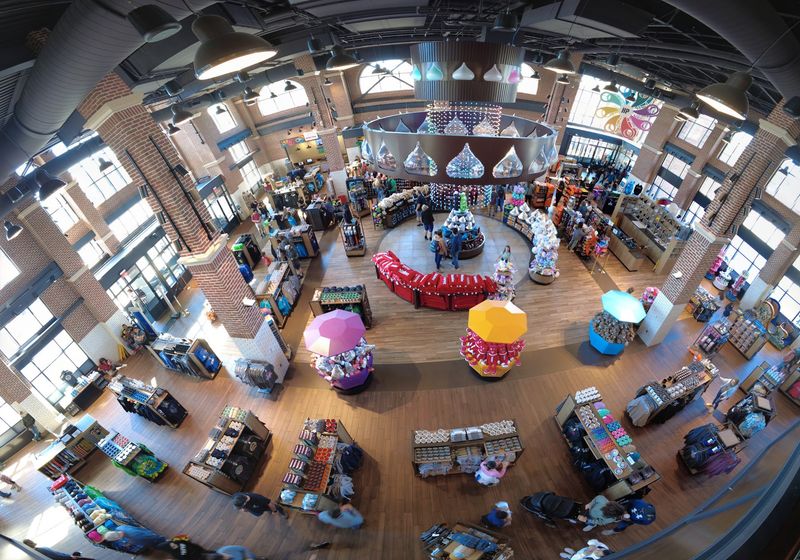 World record holders don’t usually sell candy, but this one does. The World’s Largest HERSHEY’S Store fills a big part of the building. And yes, browsing it is completely free. Shelves overflow with HERSHEY’S products you know and love. You’ll also find exclusive merchandise and unique candies that aren’t sold elsewhere. That makes it a fun stop for souvenir hunters. Gift shopping gets a lot easier here. Need something for a chocolate-loving friend back home? You’ll have plenty of options to pick from. Here’s a friendly tip about your wallet. Looking is free, but resisting is harder than it sounds. Setting a small budget before you walk the aisles can save some regret later. Families can turn shopping into a game. Let each kid pick one special treat they’ve never tried before. It keeps things fun and keeps the cart from overflowing. The store also makes a great end to your visit. Saving it for last means you won’t carry heavy bags around all day. Your arms will thank you, and your candy won’t melt in your hands while you explore. Real Cacao Trees Grow Right Inside The Building Chocolate starts on a tree, and you can see one without a plane ticket. Inside the World’s Largest HERSHEY’S Store, a 40-foot tropical jungle display holds real cacao trees. They even bear fruit twice a year. That’s a pretty wild thing to find in a store. Most of us never think about where chocolate begins. Seeing the pods up close makes the whole story click. This display pairs perfectly with the free ride. The ride shows you how beans become bars. The trees show you where those beans actually come from. Kids especially enjoy this part. It feels like a mini rainforest dropped into central Pennsylvania. Encourage them to spot the pods hanging from the branches. It also makes a great spot to slow down. After a busy round of shopping, a few quiet minutes among the leaves feel nice. Think of it as a green break in a very brown day. Bring your camera for this one. The jungle setting makes for colorful family photos that look nothing like a typical store snapshot. Your friends might ask where on earth you went. Save Room For Milkshakes, Cookies, And S’mores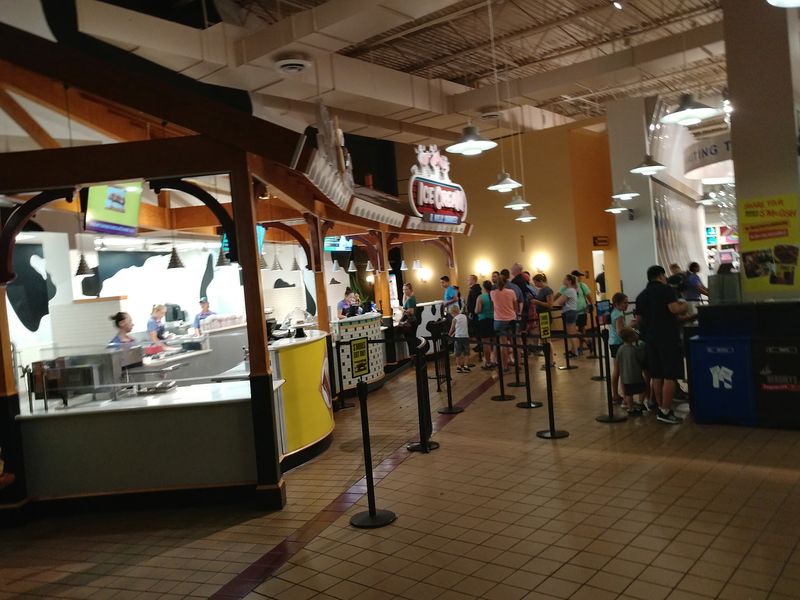 Milkshakes have been part of the fun here since 1988. They’re even described as world-famous, which is a big promise for a drink. Chocolate fans will probably want to test that claim themselves. The dessert lineup doesn’t stop there. You’ll find ice cream treats, freshly baked cookies, cupcakes, and build-your-own s’mores. It’s basically a sweet tooth’s dream lineup. Seasonal specials keep things fresh, too. Peppermint-flavored treats and rich hot chocolate appear at certain times of the year, making winter visits feel extra cozy. Need real food first? The Food Hall serves breakfast, lunch, and dinner. Options include pizza, meatball subs, deli sandwiches, chicken tenders, tacos, rice bowls, salads, and mac and cheese. Loaded baked potatoes are on the menu as well. That variety helps picky eaters find something they like and makes it easy to enjoy a full meal without leaving the building. Online ordering makes life easier on busy days. You can place an order when you arrive and choose pickup or table service. The Food Hall also provides allergen information and alternative menu options for guests with dietary needs, although it cannot guarantee an allergen-free meal. Food here isn’t free, but it’s a tasty part of the day. Splurge-Worthy Extras For Bigger Chocolate Dreams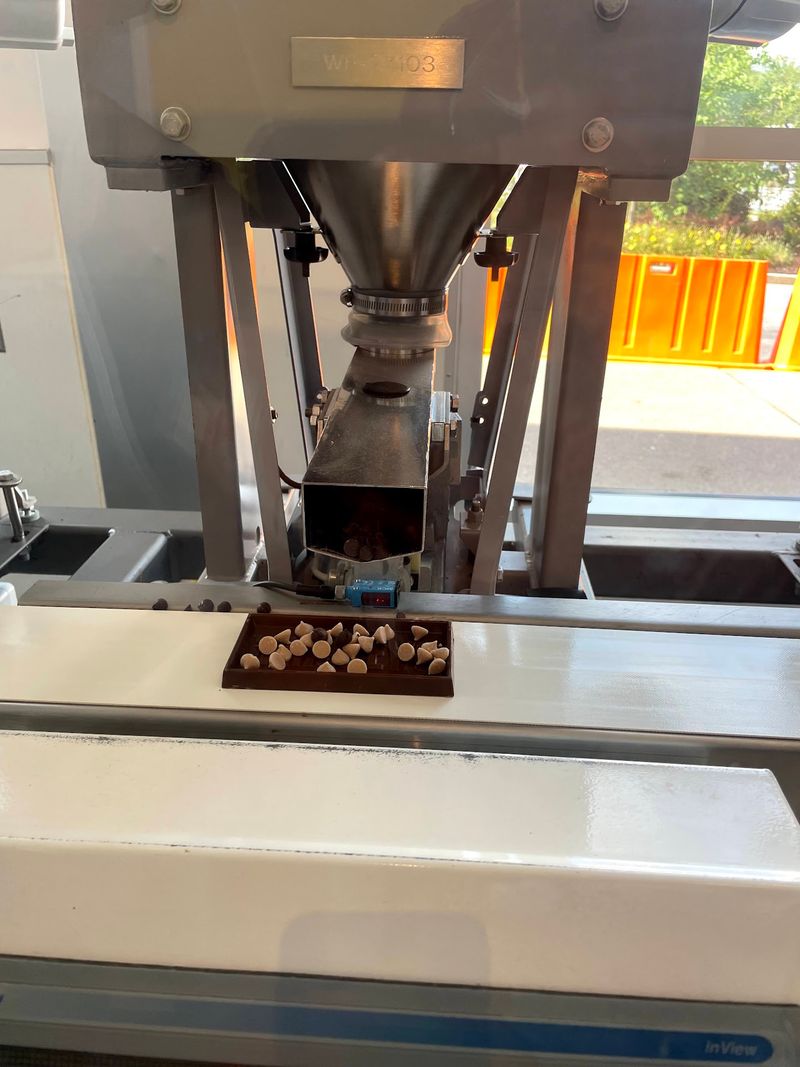 Ever wanted to design your own candy bar? Create Your Own Candy Bar lets you choose ingredients and a wrapper design. Then you watch your bar get made right in front of you. This experience started in 2010 and needs a timed ticket. It’s one of several paid extras at HERSHEY’S CHOCOLATE WORLD. None are required, but they can stretch your visit nicely. REESE’S Stuff Your Cup is another sweet option. You customize a one-pound peanut butter cup with mix-ins and fresh peanut butter. A ticket gives you preferred access. Movie lovers might enjoy HERSHEY’S Great Candy Expedition. It’s a train-themed cinematic adventure with interactive special effects. You travel through colorful candy worlds without leaving your seat. HERSHEY’S Unwrapped takes a different approach. This theatrical show teaches the art and science of chocolate tasting. You even get a tasting kit to try along the way. Pick one or two extras if your budget allows. The free stuff alone makes a great day, so the add-ons are truly optional. Think of them as sprinkles on an already sweet visit. Hop On A Trolley To Meet The Town Behind The Chocolate A chocolate company built an entire town. That’s the story Hershey Trolley Works tells, and it’s a fun one. Guided tours roll through Hershey with lively conductors leading the way. You’ll learn about Milton S. Hershey and the community he created. Chocolate samples come along for the ride too. History tastes better that way. These tours start from HERSHEY’S CHOCOLATE WORLD and need a timed ticket. Some run year-round, while others are seasonal. Check the schedule before you go so you don’t miss your favorite. The trolley offers a nice change of pace. After hours indoors, seeing the town from a window feels refreshing. It also helps you understand why this place matters so much. Older kids and adults tend to get the most out of the history. Younger children may prefer the seasonal themed options. Choose the tour that fits your group best. The trolley helps you see Hershey, Pennsylvania as more than candy. It’s a real town with a remarkable story. By the end, those chocolate bars might mean a little more to you. Special Events And Character Hugs Make Return Trips Tempting A giant walking candy bar waving hello? It happens here more often than you’d think. HERSHEY’S characters pop up for free meet and greets throughout the year. Schedules change daily, so it’s smart to check before you arrive. Kids light up when they spot their favorite treat in costume form. Have your camera ready for those big hugs. Seasonal events add even more reasons to visit. Holiday celebrations and themed photo spots change the look of the building. Many of these events are free to enjoy. Halloween brings a Trick-or-Treat Trail. It’s a sweet way to celebrate in a place built for candy. Costumes feel right at home here. Families with sensory needs have options too. Sensory-friendly nights offer a calmer way to explore. The building also has wheelchair access and accessible restrooms. Because events shift through the year, every trip can feel a little different. You might come in spring and return for the holidays. That variety keeps HERSHEY’S CHOCOLATE WORLD fresh for repeat visitors across the area. Watch The Clock When You Park And Plan Your Day Timing matters more than you might expect at HERSHEY’S CHOCOLATE WORLD. The first two hours of parking are free, but if you stay longer while Hersheypark is open, the all-day parking fee is $60. Guests who purchase a Chocolate World Adventure Bundle receive complimentary all-day parking. Two hours might sound like plenty. But between the ride, shopping, and sweet treats, time can fly. Set a phone alarm if you’re visiting without a bundle so you don’t get caught off guard at the exit. Planning a longer visit? An Adventure Bundle can be a smart choice if you want to enjoy several paid attractions. It also takes the parking fee out of the equation. You’ll find the attraction at 101 Chocolate World Way, Hershey, PA 17033, right next to Hersheypark. HERSHEY’S CHOCOLATE WORLD opens daily at 9 AM, while closing times vary by date and season. Nearby attractions can make your trip even sweeter. The Hershey Story Museum, ZooAmerica, Hershey Gardens, and Tanger Outlets are all in the Hershey area, giving you plenty of ways to fill the rest of your day. Before setting out, check the official online calendar for current hours and special events. A little planning means more time enjoying the chocolate and less time worrying about parking. |
Title: NASA Awards Moon Base Transportation, Technology, Science Projects
[
Link
]
Source: NASA Press ReleasesPublished: 2026-11-07T22:47:03+00:00 Modified: 2026-11-07T22:47:03+00:00 NASA announced a suite of awards and mission updates on Saturday to expand the agency’s Moon Base exploration, science, and infrastructure capabilities. The investments will advance commercial robotic deliveries, a nuclear-powered rover named PROMISE, launch and orbital transfer services, and surface infrastructure as the agency works with American industry to establish a sustained presence on […]
Source: NASA. https://www.nasa.gov/news-release/nasa-awards-moon-base-transportation-technology-science-projects/
|
Title: PubSub Weblogs
[
Link
]
Source: LA REVUE GAUCHE - Left CommentPublished: 2026-11-07T21:23:29+00:00 Modified: 2026-11-07T21:23:29+00:00
http://plawiuk.blogspot.com/atom.xml
LA REVUE GAUCHE - Left Comment
Blogger
en
http://plawiuk.blogspot.com/
<p style="text-align: center;"><b><span style="font-family: verdana; font-size: x-large;"><span style="color: #38761d;">SCIENCE</span></span></b><b><span style="font-family: verdana; font-size: x-large;"> <span style="color: #38761d;">SATURN'S DAY</span></span></b></p><div class="separator" style="clear: both; text-align: center;"><a href="https://blogger.googleusercontent.com/img/b/R29vZ2xl/AVvXsEhDuFZZIwM7VHKQbPphcpQL8leg4IVmeGa4CmELrbVRtU-SXHWGtSt3hHrFGdytCCjFBOtrQdHbQLD92XaJlYAdyKWaK0H_kJQiNwQuWL-f5VMsS48O_2vd6aMIhcGzSQdmEe1fZHMlV5GKKBpyHSs8MSMiv27zBKBOXNBBuStjlQBk9IuQ66pa/s700/Low-Res_DSC00716.JPG" style="margin-left: 1em; margin-right: 1em;"><img border="0" data-original-height="525" data-original-width="700" height="358" src="https://blogger.googleusercontent.com/img/b/R29vZ2xl/AVvXsEhDuFZZIwM7VHKQbPphcpQL8leg4IVmeGa4CmELrbVRtU-SXHWGtSt3hHrFGdytCCjFBOtrQdHbQLD92XaJlYAdyKWaK0H_kJQiNwQuWL-f5VMsS48O_2vd6aMIhcGzSQdmEe1fZHMlV5GKKBpyHSs8MSMiv27zBKBOXNBBuStjlQBk9IuQ66pa/w477-h358/Low-Res_DSC00716.JPG" width="477" /></a></div><br /><p></p>
<blockquote style="border-color: currentcolor; border-image: none; border-style: none; border-width: medium; margin: 0px 0px 0px 40px; padding: 0px; text-align: left;"><iframe allow="accelerometer; autoplay; clipboard-write; encrypted-media; gyroscope; picture-in-picture; web-share" allowfullscreen="" frameborder="0" height="449" referrerpolicy="strict-origin-when-cross-origin" src="https://www.youtube.com/embed/USGZ-yCc4f8?list=RDUSGZ-yCc4f8" title="Holst: The Planets - Saturn, the Bringer of Old Age // Danish National Symphony Orchestra (LIVE)" width="531"></iframe></blockquote>
http://plawiuk.blogspot.com/2026/11/holst-planets-saturn-bringer-of-old-age_0811127590.html
http://plawiuk.blogspot.com/atom.xml
http://plawiuk.blogspot.com/atom.xml
tag:blogger.com,1999:blog-9311998.post-1919084366889791167
Sat, 07 Nov 2026 21:23:29 +0000
https://blogger.googleusercontent.com/img/b/R29vZ2xl/AVvXsEhDuFZZIwM7VHKQbPphcpQL8leg4IVmeGa4CmELrbVRtU-SXHWGtSt3hHrFGdytCCjFBOtrQdHbQLD92XaJlYAdyKWaK0H_kJQiNwQuWL-f5VMsS48O_2vd6aMIhcGzSQdmEe1fZHMlV5GKKBpyHSs8MSMiv27zBKBOXNBBuStjlQBk9IuQ66pa/s700/Low-Res_DSC00716.JPG
https://blogger.googleusercontent.com/img/b/R29vZ2xl/AVvXsEhDuFZZIwM7VHKQbPphcpQL8leg4IVmeGa4CmELrbVRtU-SXHWGtSt3hHrFGdytCCjFBOtrQdHbQLD92XaJlYAdyKWaK0H_kJQiNwQuWL-f5VMsS48O_2vd6aMIhcGzSQdmEe1fZHMlV5GKKBpyHSs8MSMiv27zBKBOXNBBuStjlQBk9IuQ66pa/w477-h358/Low-Res_DSC00716.JPG
https://www.youtube.com/embed/USGZ-yCc4f8?list=RDUSGZ-yCc4f8
5075 0
|
Title: PubSub Weblogs
[
Link
]
Source: LA REVUE GAUCHE - Left CommentPublished: 2026-11-07T21:23:29+00:00 Modified: 2026-11-07T21:23:29+00:00
http://plawiuk.blogspot.com/atom.xml
LA REVUE GAUCHE - Left Comment
Blogger
en
http://plawiuk.blogspot.com/
<p> </p><header style="background-color: white; box-sizing: border-box; color: #333333; font-family: "Open Sans", "Helvetica Neue", Helvetica, Arial, sans-serif; font-size: 14px;"><h1 class="page_title" style="box-sizing: border-box; color: #2b2b2b; font-family: inherit; font-size: 34px; letter-spacing: -0.34px; line-height: 1.1; margin: 25px 0px 0px;">China’s tighter PM₂.₅ limit could sharply cut deaths and advance WHO 2040 target</h1><div><b><br /></b></div><div><br /></div><br /><p class="meta_institute" style="box-sizing: border-box; color: #2b2b2b; margin: 2px 0px 20px; text-transform: uppercase; transition: 0.2s ease-in-out;">Chinese Society for Environmental Sciences</p><div class="toolbar hidden-print hidden-search" style="box-sizing: border-box; margin: 0px;"><div class="col-xs-6" style="box-sizing: border-box; float: left; min-height: 1px; padding: 15px; position: relative; width: 305.656px;"><a class="a2a_button_facebook" href="https://www.eurekalert.org/#facebook" rel="nofollow noopener" style="background: transparent; box-sizing: border-box; color: #0088cc; cursor: pointer; display: inline !important; line-height: 16px; padding: 0px 2px; text-decoration: none; transition: none;" target="_blank"><span class="a2a_label" style="box-sizing: border-box; clip-path: polygon(0px 0px, 0px 0px, 0px 0px); display: inline !important; height: 1px; overflow: hidden; position: absolute !important; width: 1px;">Facebook</span></a><div class="addthis_inline_share_toolbox_pnaa" style="box-sizing: border-box;"></div></div><div class="col-xs-6" style="box-sizing: border-box; float: left; min-height: 1px; padding: 0px; position: relative; width: 305.656px;"><div class="article-tools pull-right" style="box-sizing: border-box; float: right; margin-bottom: 20px;"><div class="a2a_kit a2a_kit_size_32 a2a_default_style" style="box-sizing: border-box; line-height: 32px; outline: 0px; touch-action: manipulation;"><br /><a class="a2a_button_linkedin" href="https://www.eurekalert.org/#linkedin" rel="nofollow noopener" style="background: transparent; box-sizing: border-box; color: #0088cc; cursor: pointer; float: left; line-height: 16px; padding: 0px 2px; text-decoration: none; transition: none;" target="_blank"><span class="a2a_label" style="box-sizing: border-box; clip-path: polygon(0px 0px, 0px 0px, 0px 0px); height: 1px; overflow: hidden; position: absolute !important; width: 1px;"></span></a><a class="a2a_button_wechat" href="https://www.eurekalert.org/#wechat" rel="nofollow noopener" style="background: transparent; box-sizing: border-box; color: #0088cc; cursor: pointer; display: inline !important; line-height: 16px; padding: 0px 2px; text-decoration: none; transition: none;" target="_blank"><span class="a2a_label" style="box-sizing: border-box; clip-path: polygon(0px 0px, 0px 0px, 0px 0px); display: inline !important; height: 1px; overflow: hidden; position: absolute !important; width: 1px;">WeChat</span></a><a class="a2a_button_wechat" href="https://www.eurekalert.org/#wechat" rel="nofollow noopener" style="background: transparent; box-sizing: border-box; color: #0088cc; cursor: pointer; float: left; line-height: 16px; padding: 0px 2px; text-decoration: none; transition: none;" target="_blank"><span class="a2a_label" style="box-sizing: border-box; clip-path: polygon(0px 0px, 0px 0px, 0px 0px); height: 1px; overflow: hidden; position: absolute !important; width: 1px;"></span></a><a class="a2a_button_bluesky" href="https://www.eurekalert.org/#bluesky" rel="nofollow noopener" style="background: transparent; box-sizing: border-box; color: #0088cc; cursor: pointer; display: inline !important; line-height: 16px; padding: 0px 2px; text-decoration: none; transition: none;" target="_blank"><span class="a2a_label" style="box-sizing: border-box; clip-path: polygon(0px 0px, 0px 0px, 0px 0px); display: inline !important; height: 1px; overflow: hidden; position: absolute !important; width: 1px;">Bluesky</span></a><br /><a class="a2a_button_whatsapp" href="https://www.eurekalert.org/#whatsapp" rel="nofollow noopener" style="background: transparent; box-sizing: border-box; color: #0088cc; cursor: pointer; float: left; line-height: 16px; padding: 0px 2px; text-decoration: none; transition: none;" target="_blank"><span class="a2a_label" style="box-sizing: border-box; clip-path: polygon(0px 0px, 0px 0px, 0px 0px); height: 1px; overflow: hidden; position: absolute !important; width: 1px;"></span></a><a class="a2a_button_email" href="https://www.eurekalert.org/#email" rel="nofollow noopener" style="background: transparent; box-sizing: border-box; color: #0088cc; cursor: pointer; display: inline !important; line-height: 16px; padding: 0px 2px; text-decoration: none; transition: none;" target="_blank"><span class="a2a_label" style="box-sizing: border-box; clip-path: polygon(0px 0px, 0px 0px, 0px 0px); display: inline !important; height: 1px; overflow: hidden; position: absolute !important; width: 1px;">Email</span></a><div style="box-sizing: border-box; clear: both;"></div></div></div></div></div></header><div class="entry" style="background-color: white; box-sizing: border-box; color: #333333; font-family: "Open Sans", "Helvetica Neue", Helvetica, Arial, sans-serif; font-size: 14px; line-height: 23px;"><figure class="thumbnail pull-right" style="border-color: currentcolor; border-image: none; border-radius: 0px; border-style: none; border-width: medium; box-sizing: border-box; float: right; line-height: 1.42857; margin: 0px 0px 20px 34px; padding: 0px; position: relative; transition: 0.2s ease-in-out; width: 288px; z-index: 9999;"><figcaption class="caption" style="box-sizing: border-box; font-size: 12px; line-height: 1.4; margin-top: 10px; padding: 0px; text-transform: uppercase;"><p style="box-sizing: border-box; line-height: 1.4; margin: 0px 0px 10px;"><br /></p></figcaption></figure><p style="box-sizing: border-box; margin: 5px 0px 15px;"><br /></p><p style="box-sizing: border-box; margin: 5px 0px 15px;"><br /></p><p style="box-sizing: border-box; margin: 5px 0px 15px;"><br /></p><p style="box-sizing: border-box; margin: 5px 0px 15px;"><br /></p><p style="box-sizing: border-box; margin: 5px 0px 15px;">A new health impact assessment shows that China's tightened annual fine particulate matter (PM<span style="bottom: -0.25em; box-sizing: border-box; font-size: 10.5px; line-height: 0; position: relative; vertical-align: baseline;">2.5</span>) standard could substantially reduce premature deaths and move the country closer to the World Health Organization (WHO) 2040 goal of halving air-pollution-related mortality. The study estimates PM<span style="bottom: -0.25em; box-sizing: border-box; font-size: 10.5px; line-height: 0; position: relative; vertical-align: baseline;">2.5</span>-attributable mortality in mainland China from 2013 to 2024 and compares full compliance with annual limits of 35, 30 and 25 micrograms per cubic meter (µg m⁻³). It finds that the 25 µg m⁻³ limit would avert about 4.3 times as many deaths as the former 35 µg m⁻³ limit in 2024 and could achieve roughly 83% of the PM<span style="bottom: -0.25em; box-sizing: border-box; font-size: 10.5px; line-height: 0; position: relative; vertical-align: baseline;">2.5</span>-specific progress needed for the WHO halving target, while benefits vary widely by disease.<br style="box-sizing: border-box;" /><br style="box-sizing: border-box;" />China introduced a 35 µg m⁻³ annual PM₂.₅ limit in 2012 and later cut population-weighted exposure from 62.8 to 29.7 µg m⁻³ between 2013 and 2024 through clean air actions. Yet major economies and the World Health Organization (WHO) have adopted stricter guidelines, and China's “Beautiful China Initiative” targets below 25 µg m⁻³ by 2035. In 2026, China revised its National Ambient Air Quality Standards (NAAQS) to 25 µg m⁻³, with an interim 30 micrograms per cubic meter (µg m⁻³) phase from 2026 to 2030. Questions remain about how much this revision improves health, which diseases gain most, and how far it advances the WHO 2040 halving target. Given these challenges, deeper research is needed into the disease-specific health benefits and residual burdens of stricter particulate matter (PM<span style="bottom: -0.25em; box-sizing: border-box; font-size: 10.5px; line-height: 0; position: relative; vertical-align: baseline;">2.5</span>) standards.<br style="box-sizing: border-box;" /><br style="box-sizing: border-box;" />A <a href="https://www.sciencedirect.com/science/article/pii/S2666498426001262" style="background: transparent; box-sizing: border-box; color: #0088cc; text-decoration: none; transition: 0.1s linear;">study (DOI: 10.1016/j.ese.2026.100781)</a> by researchers at Peking University Health Science Center and the Chinese Academy of Environmental Planning was published online 23 October 2026 in <a href="https://www.sciencedirect.com/journal/environmental-science-and-ecotechnology/vol/34/suppl/C" style="background: transparent; box-sizing: border-box; color: #0088cc; text-decoration: none; transition: 0.1s linear;"><em style="box-sizing: border-box;">Environmental Science and Ecotechnology</em></a>. The team integrated high-resolution PM<span style="bottom: -0.25em; box-sizing: border-box; font-size: 10.5px; line-height: 0; position: relative; vertical-align: baseline;">2.5</span> data, gridded population estimates and disease-specific exposure–response functions to quantify PM<span style="bottom: -0.25em; box-sizing: border-box; font-size: 10.5px; line-height: 0; position: relative; vertical-align: baseline;">2.5</span>-attributable deaths across mainland China from 2013 to 2024 and under full-compliance scenarios for 35, 30 and 25 µg m⁻³. The analysis covered seven disease outcomes in the Global Burden of Disease (GBD) 2023 risk set.<br style="box-sizing: border-box;" /><br style="box-sizing: border-box;" />In 2024, full compliance with the 25 µg m⁻³ standard would have averted an estimated 233,668 premature deaths (95% uncertainty interval [UI]: 198,354–270,734), a 16.1% reduction from observed levels, compared with 53,985 avoided deaths (95% UI: 45,992–62,021) under the 35 µg m⁻³ standard. The stricter limit would expand the population above the regulatory threshold from 33% to 65%. Health gains were strongly disease-specific: under the 25 µg m⁻³ scenario, mortality fell by 22.8% for chronic obstructive pulmonary disease (COPD), 18.4% for stroke, 18.4% for lung cancer, 18.0% for lower respiratory infections (LRI) and 16.0% for ischemic heart disease (IHD). Reductions were only 1.4% for dementia and 1.1% for type 2 diabetes mellitus (T2DM); the dementia estimate requires caution because evidence is weaker. Nationally, the PM<span style="bottom: -0.25em; box-sizing: border-box; font-size: 10.5px; line-height: 0; position: relative; vertical-align: baseline;">2.5</span>-attributable fraction of mortality fell from 32.5% in 2015 to 22.6% in 2024. Full compliance with 35, 30 and 25 µg m⁻³ would increase PM<span style="bottom: -0.25em; box-sizing: border-box; font-size: 10.5px; line-height: 0; position: relative; vertical-align: baseline;">2.5</span>-specific progress toward the WHO halving target to 66.2%, 72.6% and 83.4%, respectively. COPD would exceed the 50% halving benchmark under the 25 µg m⁻³ scenario, whereas dementia and T2DM would remain far behind. A sensitivity analysis using the Global Exposure Mortality Model (GEMM) for non-communicable diseases and LRI showed a similar pattern, with 3.9 times more deaths averted under 25 than 35 µg m⁻³.<br style="box-sizing: border-box;" /><br style="box-sizing: border-box;" />The results support health-oriented implementation of China's revised NAAQS. Policymakers could prioritize regions with large populations and high PM<span style="bottom: -0.25em; box-sizing: border-box; font-size: 10.5px; line-height: 0; position: relative; vertical-align: baseline;">2.5</span> exposure, where compliance with 25 µg m⁻³ would yield the largest gains, and pair air-quality control with older-adult protection, clinical prevention and chronic-disease management. Because abatement costs are rising and population aging can offset exposure-related gains, future standards should be evaluated by disease-specific health returns, not compliance rates alone. The framework could inform other developing countries seeking to tighten PM₂.₅ limits while tracking progress toward the WHO 2040 halving target.</p><p style="box-sizing: border-box; margin: 5px 0px 15px;">###</p><p style="box-sizing: border-box; margin: 5px 0px 15px;">References</p><p style="box-sizing: border-box; margin: 5px 0px 15px;"><span style="box-sizing: border-box; font-weight: 600;">DOI</span></p><p style="box-sizing: border-box; margin: 5px 0px 15px;"><a href="https://doi.org/10.1016/j.ese.2026.100781" style="background: transparent; box-sizing: border-box; color: #0088cc; text-decoration: none; transition: 0.1s linear;">10.1016/j.ese.2026.100781</a></p><p style="box-sizing: border-box; margin: 5px 0px 15px;"><span style="box-sizing: border-box; font-weight: 600;">Original Source URL</span></p><p style="box-sizing: border-box; margin: 5px 0px 15px;"><a href="https://doi.org/10.1016/j.ese.2026.100781" style="background: transparent; box-sizing: border-box; color: #0088cc; text-decoration: none; transition: 0.1s linear;">https://doi.org/10.1016/j.ese.2026.100781</a></p><p style="box-sizing: border-box; margin: 5px 0px 15px;"><span style="box-sizing: border-box; font-weight: 600;">Funding information</span></p><p style="box-sizing: border-box; margin: 5px 0px 15px;">This work was supported by the National Natural Science Foundation of China (42422507, 42375191), the Beijing Natural Science Foundation (JQ24052), and the Science and Technology Projects of Xizang Autonomous Region, China (XZ202501ZY0072).</p><p style="box-sizing: border-box; margin: 5px 0px 15px;"><span style="box-sizing: border-box; font-weight: 600;">About <em style="box-sizing: border-box;"><a href="https://www.sciencedirect.com/journal/environmental-science-and-ecotechnology" style="background: transparent; box-sizing: border-box; color: #0088cc; text-decoration: none; transition: 0.1s linear;">Environmental Science and Ecotechnology</a></em></span></p><p style="box-sizing: border-box; margin: 5px 0px 15px;"><em style="box-sizing: border-box;"><a href="https://www.sciencedirect.com/journal/environmental-science-and-ecotechnology" style="background: transparent; box-sizing: border-box; color: #0088cc; text-decoration: none; transition: 0.1s linear;">Environmental Science and Ecotechnology</a></em> (ISSN 2666-4984) is an international, peer-reviewed, and open-access journal published by Elsevier. The journal publishes significant views and research across the full spectrum of ecology and environmental sciences, such as climate change, sustainability, biodiversity conservation, environment & health, green catalysis/processing for pollution control, and AI-driven environmental engineering. The latest impact factor of ESE is 14.3, according to the Journal Citation ReportsTM 2024.</p><hr class="hidden-xs hidden-sm" style="border-color: rgb(238, 238, 238) currentcolor currentcolor; border-image: none; border-style: solid none none; border-width: 1px 0px 0px; box-sizing: content-box; height: 0px; margin-bottom: 20px; margin-top: 20px;" /><div class="featured_image" style="box-sizing: border-box; margin-bottom: 20px; margin-left: 0px; margin-right: 0px; position: relative;"><div class="details" style="box-sizing: border-box; margin: 0px;"><div class="well" style="background: none; border-color: currentcolor currentcolor currentcolor rgb(221, 221, 221); border-image: none; border-radius: 0px; border-style: none none none solid; border-width: medium medium medium 2px; box-shadow: none; box-sizing: border-box; margin: 20px 0px 40px; min-height: 20px; padding: 0px 0px 0px 10px;"><h4 style="box-sizing: border-box; font-family: inherit; font-size: 13.5px; line-height: 23px; margin: 0px; text-transform: uppercase;">Journal</h4><p style="box-sizing: border-box; font-size: 13.5px; line-height: 23px; margin: 5px 0px 0px;">Environmental Science and Ecotechnology</p></div><div class="well" style="background: none; border-color: currentcolor currentcolor currentcolor rgb(221, 221, 221); border-image: none; border-radius: 0px; border-style: none none none solid; border-width: medium medium medium 2px; box-shadow: none; box-sizing: border-box; margin: 20px 0px 40px; min-height: 20px; padding: 0px 0px 0px 10px;"><h4 style="box-sizing: border-box; font-family: inherit; font-size: 13.5px; line-height: 23px; margin: 0px; text-transform: uppercase;">DOI</h4><p style="box-sizing: border-box; font-size: 13.5px; line-height: 23px; margin: 5px 0px 0px;"><a href="http://dx.doi.org/10.1016/j.ese.2026.100781" style="background: transparent; box-sizing: border-box; color: #0088cc; text-decoration: none; transition: 0.1s linear;" target="_blank">10.1016/j.ese.2026.100781 <span class="fa fa-sign-out" style="-webkit-font-smoothing: antialiased; box-sizing: border-box; display: inline-block; font-family: FontAwesome; font-feature-settings: normal; font-kerning: auto; font-language-override: normal; font-optical-sizing: auto; font-size-adjust: none; font-size: inherit; font-stretch: normal; font-variant: normal; font-variation-settings: normal; line-height: 1; text-rendering: auto;"></span></a></p></div><div class="well" style="background: none; border-color: currentcolor currentcolor currentcolor rgb(221, 221, 221); border-image: none; border-radius: 0px; border-style: none none none solid; border-width: medium medium medium 2px; box-shadow: none; box-sizing: border-box; margin: 20px 0px 40px; min-height: 20px; padding: 0px 0px 0px 10px;"><h4 style="box-sizing: border-box; font-family: inherit; font-size: 13.5px; line-height: 23px; margin: 0px; text-transform: uppercase;">Subject of Research</h4><p style="box-sizing: border-box; font-size: 13.5px; line-height: 23px; margin: 5px 0px 0px;">Not applicable</p></div><div class="well" style="background: none; border-color: currentcolor currentcolor currentcolor rgb(221, 221, 221); border-image: none; border-radius: 0px; border-style: none none none solid; border-width: medium medium medium 2px; box-shadow: none; box-sizing: border-box; margin: 20px 0px 40px; min-height: 20px; padding: 0px 0px 0px 10px;"><h4 style="box-sizing: border-box; font-family: inherit; font-size: 13.5px; line-height: 23px; margin: 0px; text-transform: uppercase;">Article Title</h4><p style="box-sizing: border-box; font-size: 13.5px; line-height: 23px; margin: 5px 0px 0px;">Halving PM2.5 mortality by 2040: China’s tightened air quality standard and residual disease burdens</p></div></div></div></div>
http://plawiuk.blogspot.com/2026/11/chinas-tighter-pm.html
http://plawiuk.blogspot.com/atom.xml
http://plawiuk.blogspot.com/atom.xml
tag:blogger.com,1999:blog-9311998.post-2438295685167213354
Sat, 07 Nov 2026 21:23:29 +0000
http://dx.doi.org/10.1016/j.ese.2026.100781
https://doi.org/10.1016/j.ese.2026.100781
https://doi.org/10.1016/j.ese.2026.100781</a></p><p
https://www.eurekalert.org/#bluesky
https://www.eurekalert.org/#email
https://www.eurekalert.org/#facebook
https://www.eurekalert.org/#linkedin
https://www.eurekalert.org/#wechat
https://www.eurekalert.org/#whatsapp
https://www.sciencedirect.com/journal/environmental-science-and-ecotechnology
https://www.sciencedirect.com/journal/environmental-science-and-ecotechnology/vol/34/suppl/C
https://www.sciencedirect.com/science/article/pii/S2666498426001262
5075 0
|
Title: PubSub Weblogs
[
Link
]
Source: LA REVUE GAUCHE - Left CommentPublished: 2026-11-07T21:23:29+00:00 Modified: 2026-11-07T21:23:29+00:00
http://plawiuk.blogspot.com/atom.xml
LA REVUE GAUCHE - Left Comment
Blogger
en
http://plawiuk.blogspot.com/
<p> </p><header style="background-color: white; box-sizing: border-box; color: #333333; font-family: "Open Sans", "Helvetica Neue", Helvetica, Arial, sans-serif; font-size: 14px;"><h1 class="page_title" style="box-sizing: border-box; color: #2b2b2b; font-family: inherit; font-size: 34px; letter-spacing: -0.34px; line-height: 1.1; margin: 25px 0px 0px;">A tunable molecular fuse helps high-nickel lithium batteries respond to overheating</h1><div><b><br /></b></div><div><br /></div><br /><p class="meta_institute" style="box-sizing: border-box; color: #2b2b2b; margin: 2px 0px 20px; text-transform: uppercase; transition: 0.2s ease-in-out;">Science China Press</p><div class="toolbar hidden-print hidden-search" style="box-sizing: border-box; margin: 0px;"><div class="col-xs-6" style="box-sizing: border-box; float: left; min-height: 1px; padding: 15px; position: relative; width: 305.656px;"><a class="a2a_button_facebook" href="https://www.eurekalert.org/#facebook" rel="nofollow noopener" style="background: transparent; box-sizing: border-box; color: #0088cc; cursor: pointer; display: inline !important; line-height: 16px; padding: 0px 2px; text-decoration: none; transition: none;" target="_blank"><span class="a2a_label" style="box-sizing: border-box; clip-path: polygon(0px 0px, 0px 0px, 0px 0px); display: inline !important; height: 1px; overflow: hidden; position: absolute !important; width: 1px;">Facebook</span></a><div class="addthis_inline_share_toolbox_pnaa" style="box-sizing: border-box;"></div></div><div class="col-xs-6" style="box-sizing: border-box; float: left; min-height: 1px; padding: 0px; position: relative; width: 305.656px;"><div class="article-tools pull-right" style="box-sizing: border-box; float: right; margin-bottom: 20px;"><div class="a2a_kit a2a_kit_size_32 a2a_default_style" style="box-sizing: border-box; line-height: 32px; outline: 0px; touch-action: manipulation;"><a class="a2a_button_wechat" href="https://www.eurekalert.org/#wechat" rel="nofollow noopener" style="background: transparent; box-sizing: border-box; color: #0088cc; cursor: pointer; float: left; line-height: 16px; padding: 0px 2px; text-decoration: none; transition: none;" target="_blank"><span class="a2a_label" style="box-sizing: border-box; clip-path: polygon(0px 0px, 0px 0px, 0px 0px); height: 1px; overflow: hidden; position: absolute !important; width: 1px;"></span></a><a class="a2a_button_bluesky" href="https://www.eurekalert.org/#bluesky" rel="nofollow noopener" style="background: transparent; box-sizing: border-box; color: #0088cc; cursor: pointer; display: inline !important; line-height: 16px; padding: 0px 2px; text-decoration: none; transition: none;" target="_blank"><span class="a2a_label" style="box-sizing: border-box; clip-path: polygon(0px 0px, 0px 0px, 0px 0px); display: inline !important; height: 1px; overflow: hidden; position: absolute !important; width: 1px;">Bluesky</span></a><a class="a2a_button_bluesky" href="https://www.eurekalert.org/#bluesky" rel="nofollow noopener" style="background: transparent; box-sizing: border-box; color: #0088cc; cursor: pointer; float: left; line-height: 16px; padding: 0px 2px; text-decoration: none; transition: none;" target="_blank"><span class="a2a_label" style="box-sizing: border-box; clip-path: polygon(0px 0px, 0px 0px, 0px 0px); height: 1px; overflow: hidden; position: absolute !important; width: 1px;"></span></a><a class="a2a_button_sms" href="https://www.eurekalert.org/#sms" rel="nofollow noopener" style="background: transparent; box-sizing: border-box; color: #0088cc; cursor: pointer; display: inline !important; line-height: 16px; padding: 0px 2px; text-decoration: none; transition: none;" target="_blank"><span class="a2a_label" style="box-sizing: border-box; clip-path: polygon(0px 0px, 0px 0px, 0px 0px); display: inline !important; height: 1px; overflow: hidden; position: absolute !important; width: 1px;">Message</span></a><a class="a2a_button_sms" href="https://www.eurekalert.org/#sms" rel="nofollow noopener" style="background: transparent; box-sizing: border-box; color: #0088cc; cursor: pointer; float: left; line-height: 16px; padding: 0px 2px; text-decoration: none; transition: none;" target="_blank"><span class="a2a_label" style="box-sizing: border-box; clip-path: polygon(0px 0px, 0px 0px, 0px 0px); height: 1px; overflow: hidden; position: absolute !important; width: 1px;"></span></a><a class="a2a_button_whatsapp" href="https://www.eurekalert.org/#whatsapp" rel="nofollow noopener" style="background: transparent; box-sizing: border-box; color: #0088cc; cursor: pointer; display: inline !important; line-height: 16px; padding: 0px 2px; text-decoration: none; transition: none;" target="_blank"><span class="a2a_label" style="box-sizing: border-box; clip-path: polygon(0px 0px, 0px 0px, 0px 0px); display: inline !important; height: 1px; overflow: hidden; position: absolute !important; width: 1px;">WhatsApp</span></a><a class="a2a_button_whatsapp" href="https://www.eurekalert.org/#whatsapp" rel="nofollow noopener" style="background: transparent; box-sizing: border-box; color: #0088cc; cursor: pointer; float: left; line-height: 16px; padding: 0px 2px; text-decoration: none; transition: none;" target="_blank"><span class="a2a_label" style="box-sizing: border-box; clip-path: polygon(0px 0px, 0px 0px, 0px 0px); height: 1px; overflow: hidden; position: absolute !important; width: 1px;"></span></a><a class="a2a_button_email" href="https://www.eurekalert.org/#email" rel="nofollow noopener" style="background: transparent; box-sizing: border-box; color: #0088cc; cursor: pointer; display: inline !important; line-height: 16px; padding: 0px 2px; text-decoration: none; transition: none;" target="_blank"><span class="a2a_label" style="box-sizing: border-box; clip-path: polygon(0px 0px, 0px 0px, 0px 0px); display: inline !important; height: 1px; overflow: hidden; position: absolute !important; width: 1px;">Email</span></a><div style="box-sizing: border-box; clear: both;"></div></div></div></div></div></header><div class="entry" style="background-color: white; box-sizing: border-box; color: #333333; font-family: "Open Sans", "Helvetica Neue", Helvetica, Arial, sans-serif; font-size: 14px; line-height: 23px;"><figure class="thumbnail pull-right" style="border-color: currentcolor; border-image: none; border-radius: 0px; border-style: none; border-width: medium; box-sizing: border-box; float: right; line-height: 1.42857; margin: 0px 0px 20px 34px; padding: 0px; position: relative; transition: 0.2s ease-in-out; width: 288px; z-index: 9999;"><a href="https://www.eurekalert.org/multimedia/1160861" style="background: transparent; box-sizing: border-box; color: #0088cc; text-decoration: none; transition: 0.1s linear;"><div class="img-wrapper" style="background: rgb(241, 241, 241); border: 1px solid rgb(170, 170, 170); box-sizing: border-box; display: inline-block; height: 288px; text-align: center; white-space: nowrap; width: 288px;"><img alt="Polymer-embedded molecular fuse mechanism for thermally responsive safety in Li batteries." src="https://mediasvc.eurekalert.org/Api/v1/Multimedia/9ee3be84-5b31-4cfc-af0f-90dfb58aff18/Rendition/low-res/Content/Public" style="border: 0px; box-sizing: border-box; display: inline-block; height: auto; max-height: 272px; max-width: 272px; vertical-align: middle; width: auto;" /> </div></a><figcaption class="caption" style="box-sizing: border-box; font-size: 12px; line-height: 1.4; margin-top: 10px; padding: 0px; text-transform: uppercase;"><p style="box-sizing: border-box; line-height: 1.4; margin: 0px 0px 10px;"><span style="box-sizing: border-box; font-weight: 600;">image: </span></p><p style="box-sizing: border-box; line-height: 1.4; margin: 0px 0px 10px; text-align: justify;"><span style="box-sizing: border-box; font-weight: 600;">Polymer-embedded molecular fuse mechanism for thermally responsive safety in Li batteries.</span></p><span style="box-sizing: border-box; font-weight: 600;"></span><a href="https://www.eurekalert.org/multimedia/1160861" style="background: transparent; box-sizing: border-box; color: #0088cc; font-weight: 600; text-decoration: none; text-transform: none; transition: 0.1s linear;">view <span class="no-break-text" style="box-sizing: border-box; white-space: nowrap;">more <span class="fa fa-angle-right" style="-webkit-font-smoothing: antialiased; box-sizing: border-box; display: inline-block; font-family: FontAwesome; font-feature-settings: normal; font-kerning: auto; font-language-override: normal; font-optical-sizing: auto; font-size-adjust: none; font-size: inherit; font-stretch: normal; font-variant: normal; font-variation-settings: normal; font-weight: normal; line-height: 1; text-rendering: auto;"></span></span></a><p style="box-sizing: border-box; line-height: 1.4; margin: 0px 0px 10px;"></p><p class="credit" style="box-sizing: border-box; color: #aaaaaa; line-height: 1.4; margin: 0px 0px 10px;">Credit: Ying Zhang, Yu-Guo Guo, Chunli Bai / Institute of Chemistry, Chinese Academy of Sciences</p></figcaption></figure><p style="box-sizing: border-box; margin: 5px 0px 15px; text-align: justify;"><br /></p><p style="box-sizing: border-box; margin: 5px 0px 15px; text-align: justify;"><br /></p><p style="box-sizing: border-box; margin: 5px 0px 15px; text-align: justify;"><br /></p><p style="box-sizing: border-box; margin: 5px 0px 15px; text-align: justify;"><br /></p><p style="box-sizing: border-box; margin: 5px 0px 15px; text-align: justify;"><br /></p><p style="box-sizing: border-box; margin: 5px 0px 15px; text-align: justify;">An electrical fuse protects a circuit by cutting off the current when something goes wrong. But could a similar safeguard work inside a lithium battery, intervening in dangerous chemical reactions before they spiral out of control?</p><p style="box-sizing: border-box; margin: 5px 0px 15px; text-align: justify;">Researchers at the Institute of Chemistry, Chinese Academy of Sciences, have developed a polymer "molecular fuse" designed to do just that. Integrated directly into high-nickel battery cathodes, it aims to suppress the heat-producing reactions that drive thermal runaway. The findings were published online in <em style="box-sizing: border-box;">National Science Review</em>.</p><p style="box-sizing: border-box; margin: 5px 0px 15px; text-align: justify;">Such protection is particularly important for high-nickel lithium batteries, which offer high energy density for applications such as electric vehicles but face significant thermal safety challenges. When these batteries overheat, oxygen released from the cathode can react with the electrolyte, generating heat and flammable gases. Like falling dominoes, these reactions can reinforce one another, eventually driving the battery into thermal runaway.</p><p style="box-sizing: border-box; margin: 5px 0px 15px; text-align: justify;">The molecular fuse works through temperature-sensitive phosphorus-carbon (P–C) bonds within the polymer. Under normal conditions, the polymer remains stable and supports lithium-ion transport. During abnormal heating, these bonds begin to break, generating phosphorus-centered radicals that can interfere with the reactive species responsible for heat-producing chain reactions.</p><p style="box-sizing: border-box; margin: 5px 0px 15px; text-align: justify;">Importantly, the temperature at which the polymer responds can be adjusted through molecular design. By modifying its phosphonate side chains, the researchers raised the onset of thermal decomposition from approximately 102°C to 112°C. This adjustment allows the polymer to better withstand typical cathode drying temperatures of around 100°C without premature activation, while retaining its ability to respond during the early stages of thermal runaway.</p><p style="box-sizing: border-box; margin: 5px 0px 15px; text-align: justify;">Laboratory tests demonstrated the protective effect. Fully charged high-nickel cathodes containing the molecular fuse released 76% less heat than unmodified cathodes, while gas generation was also reduced. Structural measurements further revealed less lattice expansion during early heating and delayed structural degradation, indicating improved thermal stability of the cathode.</p><p style="box-sizing: border-box; margin: 5px 0px 15px; text-align: justify;">The researchers also tested the approach in 0.6 Ah lithium-metal pouch cells. Under external heating, the modified cells exhibited a lower peak surface temperature near the cathode, while the temperature at which abrupt voltage collapse occurred increased from 144.7°C to 196.9°C. These results demonstrated that the molecular fuse could delay severe electrical failure and moderate thermal runaway at the cell level. Electrochemical tests also showed favorable lithium-ion transport and improved cycling performance.</p><p style="box-sizing: border-box; margin: 5px 0px 15px; text-align: justify;">Beyond developing a new protective material, the study introduces a broader design strategy: using tunable chemical bonds to actively intervene in hazardous reactions during the early stages of thermal runaway. Rather than relying solely on passive thermal barriers or flame suppression, this approach offers a new direction for improving the safety of high-energy lithium batteries.</p><hr class="hidden-xs hidden-sm" style="border-color: rgb(238, 238, 238) currentcolor currentcolor; border-image: none; border-style: solid none none; border-width: 1px 0px 0px; box-sizing: content-box; height: 0px; margin-bottom: 20px; margin-top: 20px;" /><div class="featured_image" style="box-sizing: border-box; margin-bottom: 20px; margin-left: 0px; margin-right: 0px; position: relative;"><div class="details" style="box-sizing: border-box; margin: 0px;"><div class="well" style="background: none; border-color: currentcolor currentcolor currentcolor rgb(221, 221, 221); border-image: none; border-radius: 0px; border-style: none none none solid; border-width: medium medium medium 2px; box-shadow: none; box-sizing: border-box; margin: 20px 0px 40px; min-height: 20px; padding: 0px 0px 0px 10px;"><h4 style="box-sizing: border-box; font-family: inherit; font-size: 13.5px; line-height: 23px; margin: 0px; text-transform: uppercase;">Journal</h4><p style="box-sizing: border-box; font-size: 13.5px; line-height: 23px; margin: 5px 0px 0px;">National Science Review</p></div><div class="well" style="background: none; border-color: currentcolor currentcolor currentcolor rgb(221, 221, 221); border-image: none; border-radius: 0px; border-style: none none none solid; border-width: medium medium medium 2px; box-shadow: none; box-sizing: border-box; margin: 20px 0px 40px; min-height: 20px; padding: 0px 0px 0px 10px;"><h4 style="box-sizing: border-box; font-family: inherit; font-size: 13.5px; line-height: 23px; margin: 0px; text-transform: uppercase;">DOI</h4><p style="box-sizing: border-box; font-size: 13.5px; line-height: 23px; margin: 5px 0px 0px;"><a href="http://dx.doi.org/10.1093/nsr/nwag679" style="background: transparent; box-sizing: border-box; color: #0088cc; text-decoration: none; transition: 0.1s linear;" target="_blank">10.1093/nsr/nwag679 <span class="fa fa-sign-out" style="-webkit-font-smoothing: antialiased; box-sizing: border-box; display: inline-block; font-family: FontAwesome; font-feature-settings: normal; font-kerning: auto; font-language-override: normal; font-optical-sizing: auto; font-size-adjust: none; font-size: inherit; font-stretch: normal; font-variant: normal; font-variation-settings: normal; line-height: 1; text-rendering: auto;"></span></a></p></div><div class="well" style="background: none; border-color: currentcolor currentcolor currentcolor rgb(221, 221, 221); border-image: none; border-radius: 0px; border-style: none none none solid; border-width: medium medium medium 2px; box-shadow: none; box-sizing: border-box; margin: 20px 0px 40px; min-height: 20px; padding: 0px 0px 0px 10px;"><h4 style="box-sizing: border-box; font-family: inherit; font-size: 13.5px; line-height: 23px; margin: 0px; text-transform: uppercase;">Method of Research</h4><p style="box-sizing: border-box; font-size: 13.5px; line-height: 23px; margin: 5px 0px 0px;">Experimental study</p></div></div></div></div>
http://plawiuk.blogspot.com/2026/11/a-tunable-molecular-fuse-helps-high.html
http://plawiuk.blogspot.com/atom.xml
http://plawiuk.blogspot.com/atom.xml
tag:blogger.com,1999:blog-9311998.post-2160055524060441461
Sat, 07 Nov 2026 21:23:29 +0000
http://dx.doi.org/10.1093/nsr/nwag679
https://mediasvc.eurekalert.org/Api/v1/Multimedia/9ee3be84-5b31-4cfc-af0f-90dfb58aff18/Rendition/low-res/Content/Public
https://www.eurekalert.org/#bluesky
https://www.eurekalert.org/#email
https://www.eurekalert.org/#facebook
https://www.eurekalert.org/#sms
https://www.eurekalert.org/#wechat
https://www.eurekalert.org/#whatsapp
https://www.eurekalert.org/multimedia/1160861
5075 0
|
Title: PubSub Weblogs
[
Link
]
Source: LA REVUE GAUCHE - Left CommentPublished: 2026-11-07T21:23:29+00:00 Modified: 2026-11-07T21:23:29+00:00
http://plawiuk.blogspot.com/atom.xml
LA REVUE GAUCHE - Left Comment
Blogger
en
http://plawiuk.blogspot.com/
<p><span style="color: #b45f06; font-family: courier; font-size: x-large;"><b><a href="https://en.wikipedia.org/wiki/Ferengi">FERENGI</a> SCIENCE</b></span></p><header style="background-color: white; box-sizing: border-box; color: #333333; font-family: "Open Sans", "Helvetica Neue", Helvetica, Arial, sans-serif;"><h1 class="page_title" style="box-sizing: border-box; color: #2b2b2b; font-family: inherit; font-size: 34px; letter-spacing: -0.34px; line-height: 1.1; margin: 25px 0px 0px;">Our ears reveal our feelings: The path to machines with super-emotional intelligence?</h1><div style="font-size: 14px;"><b><br /></b></div><div style="font-size: 14px;"><b><br /></b></div><p class="subtitle" style="box-sizing: border-box; margin: 0px 0px 10px;"><b><span style="font-size: medium;">The discovery could have important implications for the debate surrounding artificial intelligence</span></b></p><p class="subtitle" style="box-sizing: border-box; font-size: 14px; margin: 0px 0px 10px;"><br /></p><p class="subtitle" style="box-sizing: border-box; font-size: 14px; margin: 0px 0px 10px;"><span style="color: #2b2b2b; text-transform: uppercase;"><br />Saarland University</span></p><div class="toolbar hidden-print hidden-search" style="box-sizing: border-box; font-size: 14px; margin: 0px;"><div class="col-xs-6" style="box-sizing: border-box; float: left; min-height: 1px; padding: 15px; position: relative; width: 305.656px;"><div class="addthis_inline_share_toolbox_pnaa" style="box-sizing: border-box;"></div></div><div class="col-xs-6" style="box-sizing: border-box; float: left; min-height: 1px; padding: 0px; position: relative; width: 305.656px;"><div class="article-tools pull-right" style="box-sizing: border-box; float: right; margin-bottom: 20px;"><div class="a2a_kit a2a_kit_size_32 a2a_default_style" style="box-sizing: border-box; line-height: 32px; outline: 0px; touch-action: manipulation;"><br /><a class="a2a_button_x" href="https://www.eurekalert.org/#x" rel="nofollow noopener" style="background: transparent; box-sizing: border-box; color: #0088cc; cursor: pointer; float: left; line-height: 16px; padding: 0px 2px; text-decoration: none; transition: none;" target="_blank"><span class="a2a_label" style="box-sizing: border-box; clip-path: polygon(0px 0px, 0px 0px, 0px 0px); height: 1px; overflow: hidden; position: absolute; width: 1px;"></span></a><a class="a2a_button_linkedin" href="https://www.eurekalert.org/#linkedin" rel="nofollow noopener" style="background: transparent; box-sizing: border-box; color: #0088cc; cursor: pointer; display: inline; line-height: 16px; padding: 0px 2px; text-decoration: none; transition: none;" target="_blank"><span class="a2a_label" style="box-sizing: border-box; clip-path: polygon(0px 0px, 0px 0px, 0px 0px); display: inline; height: 1px; overflow: hidden; position: absolute; width: 1px;">LinkedIn</span></a><a class="a2a_button_linkedin" href="https://www.eurekalert.org/#linkedin" rel="nofollow noopener" style="background: transparent; box-sizing: border-box; color: #0088cc; cursor: pointer; float: left; line-height: 16px; padding: 0px 2px; text-decoration: none; transition: none;" target="_blank"><span class="a2a_label" style="box-sizing: border-box; clip-path: polygon(0px 0px, 0px 0px, 0px 0px); height: 1px; overflow: hidden; position: absolute; width: 1px;"></span></a><a class="a2a_button_wechat" href="https://www.eurekalert.org/#wechat" rel="nofollow noopener" style="background: transparent; box-sizing: border-box; color: #0088cc; cursor: pointer; display: inline; line-height: 16px; padding: 0px 2px; text-decoration: none; transition: none;" target="_blank"><span class="a2a_label" style="box-sizing: border-box; clip-path: polygon(0px 0px, 0px 0px, 0px 0px); display: inline; height: 1px; overflow: hidden; position: absolute; width: 1px;">WeChat</span></a><br /><a class="a2a_button_sms" href="https://www.eurekalert.org/#sms" rel="nofollow noopener" style="background: transparent; box-sizing: border-box; color: #0088cc; cursor: pointer; float: left; line-height: 16px; padding: 0px 2px; text-decoration: none; transition: none;" target="_blank"><span class="a2a_label" style="box-sizing: border-box; clip-path: polygon(0px 0px, 0px 0px, 0px 0px); height: 1px; overflow: hidden; position: absolute; width: 1px;"></span></a><a class="a2a_button_whatsapp" href="https://www.eurekalert.org/#whatsapp" rel="nofollow noopener" style="background: transparent; box-sizing: border-box; color: #0088cc; cursor: pointer; display: inline; line-height: 16px; padding: 0px 2px; text-decoration: none; transition: none;" target="_blank"><span class="a2a_label" style="box-sizing: border-box; clip-path: polygon(0px 0px, 0px 0px, 0px 0px); display: inline; height: 1px; overflow: hidden; position: absolute; width: 1px;">WhatsApp</span></a><a class="a2a_button_whatsapp" href="https://www.eurekalert.org/#whatsapp" rel="nofollow noopener" style="background: transparent; box-sizing: border-box; color: #0088cc; cursor: pointer; float: left; line-height: 16px; padding: 0px 2px; text-decoration: none; transition: none;" target="_blank"><span class="a2a_label" style="box-sizing: border-box; clip-path: polygon(0px 0px, 0px 0px, 0px 0px); height: 1px; overflow: hidden; position: absolute; width: 1px;"></span></a><a class="a2a_button_email" href="https://www.eurekalert.org/#email" rel="nofollow noopener" style="background: transparent; box-sizing: border-box; color: #0088cc; cursor: pointer; display: inline; line-height: 16px; padding: 0px 2px; text-decoration: none; transition: none;" target="_blank"><span class="a2a_label" style="box-sizing: border-box; clip-path: polygon(0px 0px, 0px 0px, 0px 0px); display: inline; height: 1px; overflow: hidden; position: absolute; width: 1px;">Email</span></a><div style="box-sizing: border-box; clear: both;"></div></div></div></div></div></header><div class="entry" style="background-color: white; box-sizing: border-box; color: #333333; font-family: "Open Sans", "Helvetica Neue", Helvetica, Arial, sans-serif; font-size: 14px; line-height: 23px;"><figure class="thumbnail pull-right" style="border-color: currentcolor; border-image: none; border-radius: 0px; border-style: none; border-width: medium; box-sizing: border-box; float: right; line-height: 1.42857; margin: 0px 0px 20px 34px; padding: 0px; position: relative; transition: 0.2s ease-in-out; width: 288px; z-index: 9999;"><a href="https://www.eurekalert.org/multimedia/1160900" style="background: transparent; box-sizing: border-box; color: #0088cc; text-decoration: none; transition: 0.1s linear;"><div class="img-wrapper" style="background: rgb(241, 241, 241); border: 1px solid rgb(170, 170, 170); box-sizing: border-box; display: inline-block; height: 288px; text-align: center; white-space: nowrap; width: 288px;"><img alt="Our ears reveal our feelings" src="https://mediasvc.eurekalert.org/Api/v1/Multimedia/31f8df4a-6646-4f29-a211-cf176e55b991/Rendition/low-res/Content/Public" style="border: 0px; box-sizing: border-box; display: inline-block; height: auto; max-height: 272px; max-width: 272px; vertical-align: middle; width: auto;" /> </div></a><figcaption class="caption" style="box-sizing: border-box; font-size: 12px; line-height: 1.4; margin-top: 10px; padding: 0px; text-transform: uppercase;"><p style="box-sizing: border-box; line-height: 1.4; margin: 0px 0px 10px;"><span style="box-sizing: border-box; font-weight: 600;">image: </span></p><p style="box-sizing: border-box; line-height: 1.4; margin: 0px 0px 10px;"><span style="box-sizing: border-box; font-weight: 600;">Neurotechnologist Sophie Bonnaire conducts research at the 'Systems Neuroscience & Neurotechnology Unit' in Saarbrücken and Homburg.</span></p><span style="box-sizing: border-box; font-weight: 600;"></span><a href="https://www.eurekalert.org/multimedia/1160900" style="background: transparent; box-sizing: border-box; color: #0088cc; font-weight: 600; text-decoration: none; text-transform: none; transition: 0.1s linear;">view <span class="no-break-text" style="box-sizing: border-box; white-space: nowrap;">more <span class="fa fa-angle-right" style="-webkit-font-smoothing: antialiased; box-sizing: border-box; display: inline-block; font-family: FontAwesome; font-feature-settings: normal; font-kerning: auto; font-language-override: normal; font-optical-sizing: auto; font-size-adjust: none; font-size: inherit; font-stretch: normal; font-variant: normal; font-variation-settings: normal; font-weight: normal; line-height: 1; text-rendering: auto;"></span></span></a><p style="box-sizing: border-box; line-height: 1.4; margin: 0px 0px 10px;"></p><p class="credit" style="box-sizing: border-box; color: #aaaaaa; line-height: 1.4; margin: 0px 0px 10px;">Credit: Hans-Peter Bonnaire</p></figcaption></figure><p style="box-sizing: border-box; margin: 5px 0px 15px;"><span style="box-sizing: border-box; font-weight: 600;"><br /></span></p><p style="box-sizing: border-box; margin: 5px 0px 15px;"><span style="box-sizing: border-box; font-weight: 600;"><br /></span></p><p style="box-sizing: border-box; margin: 5px 0px 15px;"><span style="box-sizing: border-box; font-weight: 600;"><br /></span></p><p style="box-sizing: border-box; margin: 5px 0px 15px;"><span style="box-sizing: border-box; font-weight: 600;"><br /></span></p><p style="box-sizing: border-box; margin: 5px 0px 15px;"><span style="box-sizing: border-box; font-weight: 600;"><br /></span></p><p style="box-sizing: border-box; margin: 5px 0px 15px;"><span style="box-sizing: border-box; font-weight: 600;">The muscles of the human ear reveal what and how we feel. This is the finding of Dr. Farah Corona-Strauss and Sophie Bonnaire, researchers at the Systems Neuroscience & Neurotechnology Unit in Saarbrücken and Homburg. Their research shows that activity in our ear muscles indicates not only who we are listening to and how attentively, but also the intensity of our emotional response, all within a fraction of a second. The discovery could have important implications for the debate surrounding artificial intelligence, raising the question of what a machine should be permitted to do if it can recognize emotions more accurately than any human.</span></p><p style="box-sizing: border-box; margin: 5px 0px 15px;"><span style="box-sizing: border-box; font-weight: 600;">The work has now been presented in two publications by the team led by Professor Daniel J. Strauss. The research findings appear in the <em style="box-sizing: border-box;">IEEE Transactions on Affective Computing</em>, while a ‘Perspective’ article in <em style="box-sizing: border-box;">Frontiers in Artificial Intelligence</em> introduces and defines the term ‘super-emotional intelligence’.</span></p><p style="box-sizing: border-box; margin: 5px 0px 15px;">‘Our ear muscles respond immediately when an individual event moves us emotionally, such as hearing a sound or a face appearing briefly in a scene. This happens within a fraction of a second and it’s not something we can perceive visually,’ says Professor Daniel J. Strauss, explaining his group’s new findings. What makes this particularly remarkable is that in 1871 Charles Darwin described the human ear muscles as vestigial, and a year later, he concluded that humans, unlike animals, had lost the ability to express emotions through their ears. In animals, he described such responses in precise detail: ears flattened in fear or anger and pricked up in attention, as will be familiar to anyone who lives with a dog or cat.</p><p style="box-sizing: border-box; margin: 5px 0px 15px;">‘We have now been able to show that this evolutionary remnant in our heads, the neural control of the ear muscles, reveals not only who we are listening to but also how we feel while listening,’ says Strauss, a neuroscientist and computer scientist, adding: ‘Although we can no longer point our ears towards a sound, the muscle signal remains. What Darwin believed had been lost is actually still there – it has merely grown quieter.’</p><p style="box-sizing: border-box; margin: 5px 0px 15px;">Back in 2020, Strauss’s neurotechnology research group reported in the journal <em style="box-sizing: border-box;">eLife</em> that the muscles around the human ear become active whenever a new or significant sound occurs. In those experiments, participants unconsciously made minute ear movements in precisely the direction in which they were focusing their attention. The researchers demonstrated this, among other things, by recording electrical signals from the ear’s vestigial motor system (see the press release ‘<a href="https://idw-online.de/de/news750695" style="background: transparent; box-sizing: border-box; color: #0088cc; text-decoration: none; transition: 0.1s linear;">Our animal inheritance: Humans perk up their ears, too, when they hear interesting sounds</a>’). In subsequent studies, the group showed that activity in the ear muscles can also indicate how much effort listening requires, including in people who wear hearing aids.</p><p style="box-sizing: border-box; margin: 5px 0px 15px;"><span style="box-sizing: border-box; font-weight: 600;">Laughter leads to a new line of research</span></p><p style="box-sizing: border-box; margin: 5px 0px 15px;">During the 2020 experiments, Farah Corona-Strauss noticed that the tiny intrinsic muscles of the outer ear also became active when participants laughed, with the onset of muscle activity occurring shortly before the laughter began. This observation led the neurotechnologist to ask a new question: If the ear responds to sounds that matter to us, does it also respond to things that affect us emotionally? Together with research associate Sophie Bonnaire, she set out to investigate. Bonnaire made the question the subject of her doctoral research at Saarland University and conducted a thorough, systematic examination. The research involved showing participants short film clips, some pleasant, some unpleasant, while surface electrodes recorded activity in their intrinsic auricular muscles. The participants were asked to rate the degree of emotional arousal evoked by each clip. ‘As the emotional arousal elicited by a scene increases, the muscles become more active within a fraction of a second – irrespective of whether the scene is pleasant or unpleasant. And we also find that the muscular response corresponds to the participants’ own reports,’ Sophie Bonnaire explains. What’s particularly striking is the speed with which the muscles respond to an individual stimulus, whether it’s a sound, a face flashing up briefly on screen or, as in the group’s latest research, even a single word encountered while reading.</p><p style="box-sizing: border-box; margin: 5px 0px 15px;"><span style="box-sizing: border-box; font-weight: 600;">Could bodily signals pave the way for super-emotional intelligence?</span></p><p style="box-sizing: border-box; margin: 5px 0px 15px;">For Daniel Strauss, the discovery that a person’s ear muscles spontaneously and unconsciously reveal their emotional response has important implications for the current debate surrounding artificial intelligence. ‘Until now, debate has focused almost exclusively on “superintelligence”, in other words, on the question of how much more intelligent than us machines might become.’ Strauss believes that a new concept can now be placed alongside it: ‘super-emotional intelligence’ – an attribute ascribed to technical systems capable of interpreting emotions more accurately than any human being, including physiological signals that no human can perceive directly in others. ‘What we definitely do not mean here is a machine that experiences feelings,’ he clarifies. ‘Super-emotional intelligence describes a system that can recognize, understand and respond to a person’s emotions more effectively than trained human experts.’</p><p style="box-sizing: border-box; margin: 5px 0px 15px;">In a Perspective article published in <em style="box-sizing: border-box;">Frontiers in Artificial Intelligence</em>, Strauss’s doctoral researcher Sophie Bonnaire provides the first definition of Super-Emotional Intelligence (SEI). She describes the capabilities that such a super-emotionally intelligent system would need to display, explains why today’s AI systems are still a long way from achieving them and considers how clearly defined rules could aid the development of technology that works for people rather than against them. ‘Unlike today’s “empathetic” chatbots, which appear compassionate without really monitoring the state of the person they are interacting with, a super-emotionally intelligent system would need to be capable of self-regulation. The SEI system would select the response most likely to help the person reach their desired objective, while also learning from the effects of its own responses,’ Bonnaire explains. </p><p style="box-sizing: border-box; margin: 5px 0px 15px;"><span style="box-sizing: border-box; font-weight: 600;">Care, not control: Safeguards against misuse are essential</span></p><p style="box-sizing: border-box; margin: 5px 0px 15px;">Caution is nevertheless essential. ‘If directed towards a different objective, the same technology could become a “hypermanipulative machine”, detecting states that we ourselves are unaware of and steering us towards goals we have never chosen,’ warns Daniel Strauss. The EU AI Act, which prohibits emotion-recognition systems in schools and workplaces, underscores the contemporary relevance of the issue. ‘We argue that human beings must set the objectives and determine what such a machine should and should not be permitted to do. The guiding principle must be care, not control.’</p><p style="box-sizing: border-box; margin: 5px 0px 15px;"><span style="box-sizing: border-box; font-weight: 600;">From hearing aids and earbuds to smart glasses</span></p><p style="box-sizing: border-box; margin: 5px 0px 15px;">Farah Corona-Strauss and her lab team are already working on a practical technological application. ‘Hearing aids, earbuds and the arms of smart glasses are positioned exactly where the ear-muscle signals originate. The ear is therefore a natural interface between humans and machines. That’s why we are working with hearing-aid manufacturers and international technology partners. An empathetic AI system that detects when listening fatigue sets in or when something triggers an emotional response could adapt accordingly, without requiring either a camera or a questionnaire,’ explains the neurotechnologist.</p><p style="box-sizing: border-box; margin: 5px 0px 15px;"><span style="box-sizing: border-box; font-weight: 600;">Background: The research unit</span></p><p style="box-sizing: border-box; margin: 5px 0px 15px;">The Systems Neuroscience & Neurotechnology Unit (SNNU) is jointly affiliated with the Faculty of Medicine at Saarland University and the Faculty of Engineering at Saarland University of Applied Sciences (htw saar). Dr. Farah Corona-Strauss heads the unit’s MINDSCAN Lab, where Sophie Bonnaire also conducts her research. The SNNU currently leads a wide range of national and international research projects at the interface of neuroscience, medicine and technology.<br style="box-sizing: border-box;" />Further information: <a href="http://www.snnu.uni-saarland.de/" style="background: transparent; box-sizing: border-box; color: #0088cc; text-decoration: none; transition: 0.1s linear;">www.snnu.uni-saarland.de</a></p><p style="box-sizing: border-box; margin: 5px 0px 15px;"><span style="box-sizing: border-box; font-weight: 600;">The two publications:</span></p><ul style="box-sizing: border-box; margin-bottom: 10px; margin-top: 0px;"><li style="box-sizing: border-box;">Sophie Bonnaire, Mayur J. Bhamborae, Daniel J. Strauss, Farah I. Corona-Strauss: Unraveling Affective States from the Auriculomotor System. IEEE Transactions on Affective Computing. <a href="https://doi.org/10.1109/TAFFC.2026.3717435" style="background: transparent; box-sizing: border-box; color: #0088cc; text-decoration: none; transition: 0.1s linear;">DOI: 10.1109/taffc.2026.3717435</a></li><li style="box-sizing: border-box;">Sophie Bonnaire, Farah I. Corona-Strauss, Daniel J. Strauss: The Rise of Super-Emotional Intelligence (Perspective). Frontiers in Artificial Intelligence. DOI: 10.3389/frai.2026.1975692</li></ul><div><br /></div><p style="box-sizing: border-box; margin: 5px 0px 15px;"><span style="box-sizing: border-box; font-weight: 600;">Questions can be addressed to:</span></p><p style="box-sizing: border-box; margin: 5px 0px 15px;">Prof. Dr. Dr. Daniel J. Strauss</p><p style="box-sizing: border-box; margin: 5px 0px 15px;"><a href="http://www.snnu.uni-saarland.de/" style="background: transparent; box-sizing: border-box; color: #0088cc; text-decoration: none; transition: 0.1s linear;">www.snnu.uni-saarland.de</a></p><p style="box-sizing: border-box; margin: 5px 0px 15px;">Sophie Bonnaire, the lead author of both publications, is also available for press interviews. Please send interview requests using the contact details shown above.</p><hr class="hidden-xs hidden-sm" style="border-color: rgb(238, 238, 238) currentcolor currentcolor; border-image: none; border-style: solid none none; border-width: 1px 0px 0px; box-sizing: content-box; height: 0px; margin-bottom: 20px; margin-top: 20px;" /><div class="featured_image" style="box-sizing: border-box; margin-bottom: 20px; margin-left: 0px; margin-right: 0px; position: relative;"><div class="details" style="box-sizing: border-box; margin: 0px;"><div class="well" style="background: none; border-color: currentcolor currentcolor currentcolor rgb(221, 221, 221); border-image: none; border-radius: 0px; border-style: none none none solid; border-width: medium medium medium 2px; box-shadow: none; box-sizing: border-box; margin: 20px 0px 40px; min-height: 20px; padding: 0px 0px 0px 10px;"><h4 style="box-sizing: border-box; font-family: inherit; font-size: 13.5px; line-height: 23px; margin: 0px; text-transform: uppercase;">Journal</h4><p style="box-sizing: border-box; font-size: 13.5px; line-height: 23px; margin: 5px 0px 0px;">Frontiers in Artificial Intelligence</p></div><div class="well" style="background: none; border-color: currentcolor currentcolor currentcolor rgb(221, 221, 221); border-image: none; border-radius: 0px; border-style: none none none solid; border-width: medium medium medium 2px; box-shadow: none; box-sizing: border-box; margin: 20px 0px 40px; min-height: 20px; padding: 0px 0px 0px 10px;"><h4 style="box-sizing: border-box; font-family: inherit; font-size: 13.5px; line-height: 23px; margin: 0px; text-transform: uppercase;">DOI</h4><p style="box-sizing: border-box; font-size: 13.5px; line-height: 23px; margin: 5px 0px 0px;"><a href="http://dx.doi.org/10.3389/frai.2026.1975692" style="background: transparent; box-sizing: border-box; color: #0088cc; text-decoration: none; transition: 0.1s linear;" target="_blank">10.3389/frai.2026.1975692 <span class="fa fa-sign-out" style="-webkit-font-smoothing: antialiased; box-sizing: border-box; display: inline-block; font-family: FontAwesome; font-feature-settings: normal; font-kerning: auto; font-language-override: normal; font-optical-sizing: auto; font-size-adjust: none; font-size: inherit; font-stretch: normal; font-variant: normal; font-variation-settings: normal; line-height: 1; text-rendering: auto;"></span></a></p></div><div class="well" style="background: none; border-color: currentcolor currentcolor currentcolor rgb(221, 221, 221); border-image: none; border-radius: 0px; border-style: none none none solid; border-width: medium medium medium 2px; box-shadow: none; box-sizing: border-box; margin: 20px 0px 40px; min-height: 20px; padding: 0px 0px 0px 10px;"><h4 style="box-sizing: border-box; font-family: inherit; font-size: 13.5px; line-height: 23px; margin: 0px; text-transform: uppercase;">Method of Research</h4><p style="box-sizing: border-box; font-size: 13.5px; line-height: 23px; margin: 5px 0px 0px;">Experimental study</p></div><div class="well" style="background: none; border-color: currentcolor currentcolor currentcolor rgb(221, 221, 221); border-image: none; border-radius: 0px; border-style: none none none solid; border-width: medium medium medium 2px; box-shadow: none; box-sizing: border-box; margin: 20px 0px 40px; min-height: 20px; padding: 0px 0px 0px 10px;"><h4 style="box-sizing: border-box; font-family: inherit; font-size: 13.5px; line-height: 23px; margin: 0px; text-transform: uppercase;">Subject of Research</h4><p style="box-sizing: border-box; font-size: 13.5px; line-height: 23px; margin: 5px 0px 0px;">People</p></div><div class="well" style="background: none; border-color: currentcolor currentcolor currentcolor rgb(221, 221, 221); border-image: none; border-radius: 0px; border-style: none none none solid; border-width: medium medium medium 2px; box-shadow: none; box-sizing: border-box; margin: 20px 0px 40px; min-height: 20px; padding: 0px 0px 0px 10px;"><h4 style="box-sizing: border-box; font-family: inherit; font-size: 13.5px; line-height: 23px; margin: 0px; text-transform: uppercase;">Article Title</h4><p style="box-sizing: border-box; font-size: 13.5px; line-height: 23px; margin: 5px 0px 0px;">The rise of super-emotional intelligence</p><p style="box-sizing: border-box; font-size: 13.5px; line-height: 23px; margin: 5px 0px 0px;"><br /></p><div class="separator" style="clear: both; text-align: center;"><a href="https://blogger.googleusercontent.com/img/b/R29vZ2xl/AVvXsEjT-Y4oBk13XXSnzQaQRcoSHd-ipuiTX28HF-N6ju9G7yeBIvrxOtoxj8PWNNQISg36MPPNKEcIf7rvd4JDNfzg5pzMuhrjUhHeCeAnhw9SWWOZ2VxnsX5PiZvMviwbZ4vIu-SqaNNeRtgy9z2CJWFgbm-y9bAh__XCLF2Fctl6dQAqrdSEMZSk/s310/ODL.jpg" imageanchor="1" style="clear: left; float: left; margin-bottom: 1em; margin-right: 1em;"><img border="0" data-original-height="198" data-original-width="310" height="255" src="https://blogger.googleusercontent.com/img/b/R29vZ2xl/AVvXsEjT-Y4oBk13XXSnzQaQRcoSHd-ipuiTX28HF-N6ju9G7yeBIvrxOtoxj8PWNNQISg36MPPNKEcIf7rvd4JDNfzg5pzMuhrjUhHeCeAnhw9SWWOZ2VxnsX5PiZvMviwbZ4vIu-SqaNNeRtgy9z2CJWFgbm-y9bAh__XCLF2Fctl6dQAqrdSEMZSk/w400-h255/ODL.jpg" width="400" /></a></div><br /><p style="box-sizing: border-box; font-size: 13.5px; line-height: 23px; margin: 5px 0px 0px;"><br /></p></div></div></div></div>
http://plawiuk.blogspot.com/2026/11/ferengi-science-our-ears-reveal-our.html
http://plawiuk.blogspot.com/atom.xml
http://plawiuk.blogspot.com/atom.xml
tag:blogger.com,1999:blog-9311998.post-2424449924298585460
Sat, 07 Nov 2026 21:23:29 +0000
http://dx.doi.org/10.3389/frai.2026.1975692
http://www.snnu.uni-saarland.de/
https://blogger.googleusercontent.com/img/b/R29vZ2xl/AVvXsEjT-Y4oBk13XXSnzQaQRcoSHd-ipuiTX28HF-N6ju9G7yeBIvrxOtoxj8PWNNQISg36MPPNKEcIf7rvd4JDNfzg5pzMuhrjUhHeCeAnhw9SWWOZ2VxnsX5PiZvMviwbZ4vIu-SqaNNeRtgy9z2CJWFgbm-y9bAh__XCLF2Fctl6dQAqrdSEMZSk/s310/ODL.jpg
https://blogger.googleusercontent.com/img/b/R29vZ2xl/AVvXsEjT-Y4oBk13XXSnzQaQRcoSHd-ipuiTX28HF-N6ju9G7yeBIvrxOtoxj8PWNNQISg36MPPNKEcIf7rvd4JDNfzg5pzMuhrjUhHeCeAnhw9SWWOZ2VxnsX5PiZvMviwbZ4vIu-SqaNNeRtgy9z2CJWFgbm-y9bAh__XCLF2Fctl6dQAqrdSEMZSk/w400-h255/ODL.jpg
https://doi.org/10.1109/TAFFC.2026.3717435
https://en.wikipedia.org/wiki/Ferengi
https://idw-online.de/de/news750695
https://mediasvc.eurekalert.org/Api/v1/Multimedia/31f8df4a-6646-4f29-a211-cf176e55b991/Rendition/low-res/Content/Public
https://www.eurekalert.org/#email
https://www.eurekalert.org/#linkedin
https://www.eurekalert.org/#sms
https://www.eurekalert.org/#wechat
https://www.eurekalert.org/#whatsapp
https://www.eurekalert.org/#x
https://www.eurekalert.org/multimedia/1160900
5075 0
|
Title: PubSub Weblogs
[
Link
]
Source: LA REVUE GAUCHE - Left CommentPublished: 2026-11-07T21:23:29+00:00 Modified: 2026-11-07T21:23:29+00:00
http://plawiuk.blogspot.com/atom.xml
LA REVUE GAUCHE - Left Comment
Blogger
en
http://plawiuk.blogspot.com/
<p> </p><header style="background-color: white; box-sizing: border-box; color: #333333; font-family: "Open Sans", "Helvetica Neue", Helvetica, Arial, sans-serif; font-size: 14px;"><h1 class="page_title" style="box-sizing: border-box; color: #2b2b2b; font-family: inherit; font-size: 34px; letter-spacing: -0.34px; line-height: 1.1; margin: 25px 0px 0px;">Interface engineering for organic solar cells: Progress toward real-world viability</h1><div><b><br /></b></div><div><br /></div><div><br /></div><div><span style="color: #2b2b2b; text-transform: uppercase;"><br />KeAi Communications Co., Ltd.</span></div><div class="toolbar hidden-print hidden-search" style="box-sizing: border-box; margin: 0px;"><div class="col-xs-6" style="box-sizing: border-box; float: left; min-height: 1px; padding: 15px; position: relative; width: 305.656px;"><a class="a2a_button_facebook" href="https://www.eurekalert.org/#facebook" rel="nofollow noopener" style="background: transparent; box-sizing: border-box; color: #0088cc; cursor: pointer; display: inline !important; line-height: 16px; padding: 0px 2px; text-decoration: none; transition: none;" target="_blank"><span class="a2a_label" style="box-sizing: border-box; clip-path: polygon(0px 0px, 0px 0px, 0px 0px); display: inline !important; height: 1px; overflow: hidden; position: absolute !important; width: 1px;">Facebook</span></a><div class="addthis_inline_share_toolbox_pnaa" style="box-sizing: border-box;"></div></div><div class="col-xs-6" style="box-sizing: border-box; float: left; min-height: 1px; padding: 0px; position: relative; width: 305.656px;"><div class="article-tools pull-right" style="box-sizing: border-box; float: right; margin-bottom: 20px;"><div class="a2a_kit a2a_kit_size_32 a2a_default_style" style="box-sizing: border-box; line-height: 32px; outline: 0px; touch-action: manipulation;"><a class="a2a_button_facebook" href="https://www.eurekalert.org/#facebook" rel="nofollow noopener" style="background: transparent; box-sizing: border-box; color: #0088cc; cursor: pointer; float: left; line-height: 16px; padding: 0px 2px; text-decoration: none; transition: none;" target="_blank"><span class="a2a_label" style="box-sizing: border-box; clip-path: polygon(0px 0px, 0px 0px, 0px 0px); height: 1px; overflow: hidden; position: absolute !important; width: 1px;"></span></a><a class="a2a_button_x" href="https://www.eurekalert.org/#x" rel="nofollow noopener" style="background: transparent; box-sizing: border-box; color: #0088cc; cursor: pointer; display: inline !important; line-height: 16px; padding: 0px 2px; text-decoration: none; transition: none;" target="_blank"><span class="a2a_label" style="box-sizing: border-box; clip-path: polygon(0px 0px, 0px 0px, 0px 0px); display: inline !important; height: 1px; overflow: hidden; position: absolute !important; width: 1px;">X</span></a><a class="a2a_button_x" href="https://www.eurekalert.org/#x" rel="nofollow noopener" style="background: transparent; box-sizing: border-box; color: #0088cc; cursor: pointer; float: left; line-height: 16px; padding: 0px 2px; text-decoration: none; transition: none;" target="_blank"><span class="a2a_label" style="box-sizing: border-box; clip-path: polygon(0px 0px, 0px 0px, 0px 0px); height: 1px; overflow: hidden; position: absolute !important; width: 1px;"></span></a><a class="a2a_button_linkedin" href="https://www.eurekalert.org/#linkedin" rel="nofollow noopener" style="background: transparent; box-sizing: border-box; color: #0088cc; cursor: pointer; display: inline !important; line-height: 16px; padding: 0px 2px; text-decoration: none; transition: none;" target="_blank"><span class="a2a_label" style="box-sizing: border-box; clip-path: polygon(0px 0px, 0px 0px, 0px 0px); display: inline !important; height: 1px; overflow: hidden; position: absolute !important; width: 1px;">LinkedIn</span></a><a class="a2a_button_linkedin" href="https://www.eurekalert.org/#linkedin" rel="nofollow noopener" style="background: transparent; box-sizing: border-box; color: #0088cc; cursor: pointer; float: left; line-height: 16px; padding: 0px 2px; text-decoration: none; transition: none;" target="_blank"><span class="a2a_label" style="box-sizing: border-box; clip-path: polygon(0px 0px, 0px 0px, 0px 0px); height: 1px; overflow: hidden; position: absolute !important; width: 1px;"></span></a><a class="a2a_button_wechat" href="https://www.eurekalert.org/#wechat" rel="nofollow noopener" style="background: transparent; box-sizing: border-box; color: #0088cc; cursor: pointer; display: inline !important; line-height: 16px; padding: 0px 2px; text-decoration: none; transition: none;" target="_blank"><span class="a2a_label" style="box-sizing: border-box; clip-path: polygon(0px 0px, 0px 0px, 0px 0px); display: inline !important; height: 1px; overflow: hidden; position: absolute !important; width: 1px;">WeChat</span></a><a class="a2a_button_wechat" href="https://www.eurekalert.org/#wechat" rel="nofollow noopener" style="background: transparent; box-sizing: border-box; color: #0088cc; cursor: pointer; float: left; line-height: 16px; padding: 0px 2px; text-decoration: none; transition: none;" target="_blank"><span class="a2a_label" style="box-sizing: border-box; clip-path: polygon(0px 0px, 0px 0px, 0px 0px); height: 1px; overflow: hidden; position: absolute !important; width: 1px;"></span></a><a class="a2a_button_bluesky" href="https://www.eurekalert.org/#bluesky" rel="nofollow noopener" style="background: transparent; box-sizing: border-box; color: #0088cc; cursor: pointer; display: inline !important; line-height: 16px; padding: 0px 2px; text-decoration: none; transition: none;" target="_blank"><span class="a2a_label" style="box-sizing: border-box; clip-path: polygon(0px 0px, 0px 0px, 0px 0px); display: inline !important; height: 1px; overflow: hidden; position: absolute !important; width: 1px;">Bluesky</span></a><a class="a2a_button_bluesky" href="https://www.eurekalert.org/#bluesky" rel="nofollow noopener" style="background: transparent; box-sizing: border-box; color: #0088cc; cursor: pointer; float: left; line-height: 16px; padding: 0px 2px; text-decoration: none; transition: none;" target="_blank"><span class="a2a_label" style="box-sizing: border-box; clip-path: polygon(0px 0px, 0px 0px, 0px 0px); height: 1px; overflow: hidden; position: absolute !important; width: 1px;"></span></a><a class="a2a_button_sms" href="https://www.eurekalert.org/#sms" rel="nofollow noopener" style="background: transparent; box-sizing: border-box; color: #0088cc; cursor: pointer; display: inline !important; line-height: 16px; padding: 0px 2px; text-decoration: none; transition: none;" target="_blank"><span class="a2a_label" style="box-sizing: border-box; clip-path: polygon(0px 0px, 0px 0px, 0px 0px); display: inline !important; height: 1px; overflow: hidden; position: absolute !important; width: 1px;">Message</span></a><a class="a2a_button_sms" href="https://www.eurekalert.org/#sms" rel="nofollow noopener" style="background: transparent; box-sizing: border-box; color: #0088cc; cursor: pointer; float: left; line-height: 16px; padding: 0px 2px; text-decoration: none; transition: none;" target="_blank"><span class="a2a_label" style="box-sizing: border-box; clip-path: polygon(0px 0px, 0px 0px, 0px 0px); height: 1px; overflow: hidden; position: absolute !important; width: 1px;"></span></a><a class="a2a_button_whatsapp" href="https://www.eurekalert.org/#whatsapp" rel="nofollow noopener" style="background: transparent; box-sizing: border-box; color: #0088cc; cursor: pointer; display: inline !important; line-height: 16px; padding: 0px 2px; text-decoration: none; transition: none;" target="_blank"><span class="a2a_label" style="box-sizing: border-box; clip-path: polygon(0px 0px, 0px 0px, 0px 0px); display: inline !important; height: 1px; overflow: hidden; position: absolute !important; width: 1px;">WhatsApp</span></a><a class="a2a_button_whatsapp" href="https://www.eurekalert.org/#whatsapp" rel="nofollow noopener" style="background: transparent; box-sizing: border-box; color: #0088cc; cursor: pointer; float: left; line-height: 16px; padding: 0px 2px; text-decoration: none; transition: none;" target="_blank"><span class="a2a_label" style="box-sizing: border-box; clip-path: polygon(0px 0px, 0px 0px, 0px 0px); height: 1px; overflow: hidden; position: absolute !important; width: 1px;"></span></a><a class="a2a_button_email" href="https://www.eurekalert.org/#email" rel="nofollow noopener" style="background: transparent; box-sizing: border-box; color: #0088cc; cursor: pointer; display: inline !important; line-height: 16px; padding: 0px 2px; text-decoration: none; transition: none;" target="_blank"><span class="a2a_label" style="box-sizing: border-box; clip-path: polygon(0px 0px, 0px 0px, 0px 0px); display: inline !important; height: 1px; overflow: hidden; position: absolute !important; width: 1px;">Email</span></a><div style="box-sizing: border-box; clear: both;"></div></div></div></div></div></header><div class="entry" style="background-color: white; box-sizing: border-box; color: #333333; font-family: "Open Sans", "Helvetica Neue", Helvetica, Arial, sans-serif; font-size: 14px; line-height: 23px;"><figure class="thumbnail pull-right" style="border-color: currentcolor; border-image: none; border-radius: 0px; border-style: none; border-width: medium; box-sizing: border-box; float: right; line-height: 1.42857; margin: 0px 0px 20px 34px; padding: 0px; position: relative; transition: 0.2s ease-in-out; width: 288px; z-index: 9999;"><a href="https://www.eurekalert.org/multimedia/1160898" style="background: transparent; box-sizing: border-box; color: #0088cc; text-decoration: none; transition: 0.1s linear;"><div class="img-wrapper" style="background: rgb(241, 241, 241); border: 1px solid rgb(170, 170, 170); box-sizing: border-box; display: inline-block; height: 288px; text-align: center; white-space: nowrap; width: 288px;"><img alt="SCHEMATIC SUMMARY OF TYPICAL ORGANIC INORGANIC HYBRID HOLE TRANSPORT LAYER STRUCTURES FOR ORGANIC SOLAR CELLS." src="https://mediasvc.eurekalert.org/Api/v1/Multimedia/b5c4ac27-7fa2-49a8-b174-6a0241126dcb/Rendition/low-res/Content/Public" style="border: 0px; box-sizing: border-box; display: inline-block; height: auto; max-height: 272px; max-width: 272px; vertical-align: middle; width: auto;" /> </div></a><figcaption class="caption" style="box-sizing: border-box; font-size: 12px; line-height: 1.4; margin-top: 10px; padding: 0px; text-transform: uppercase;"><p style="box-sizing: border-box; line-height: 1.4; margin: 0px 0px 10px;"><span style="box-sizing: border-box; font-weight: 600;">image: </span></p><p style="box-sizing: border-box; line-height: 1.4; margin: 0px 0px 10px;"><span style="box-sizing: border-box; font-weight: 600;">Schematic summary of typical organic‑inorganic hybrid hole‑transport‑layer structures for organic solar cells.</span></p><span style="box-sizing: border-box; font-weight: 600;"></span><a href="https://www.eurekalert.org/multimedia/1160898" style="background: transparent; box-sizing: border-box; color: #0088cc; font-weight: 600; text-decoration: none; text-transform: none; transition: 0.1s linear;">view <span class="no-break-text" style="box-sizing: border-box; white-space: nowrap;">more <span class="fa fa-angle-right" style="-webkit-font-smoothing: antialiased; box-sizing: border-box; display: inline-block; font-family: FontAwesome; font-feature-settings: normal; font-kerning: auto; font-language-override: normal; font-optical-sizing: auto; font-size-adjust: none; font-size: inherit; font-stretch: normal; font-variant: normal; font-variation-settings: normal; font-weight: normal; line-height: 1; text-rendering: auto;"></span></span></a><p style="box-sizing: border-box; line-height: 1.4; margin: 0px 0px 10px;"></p><p class="credit" style="box-sizing: border-box; color: #aaaaaa; line-height: 1.4; margin: 0px 0px 10px;">Credit: Xiaoke Zhang, Baobing Fan, Alex K.-Y. Jen</p></figcaption></figure><p style="box-sizing: border-box; margin: 5px 0px 15px;"><br /></p><p style="box-sizing: border-box; margin: 5px 0px 15px;"><br /></p><p style="box-sizing: border-box; margin: 5px 0px 15px;"><br /></p><p style="box-sizing: border-box; margin: 5px 0px 15px;"><br /></p><p style="box-sizing: border-box; margin: 5px 0px 15px;">Organic solar cells offer a promising low-cost route for renewable energy, yet single-component interfacial layers frequently cannot satisfy all practical demands simultaneously. Many standalone hole-transporting or electron-transporting materials suffer from low conductivity, abundant defects, poor film-forming capability or strict processing constraints, which hold back device efficiency, long-term stability and large-area printed manufacturing.</p><p style="box-sizing: border-box; margin: 5px 0px 15px;">In a review article published in <em style="box-sizing: border-box;">Advanced Nanocomposites</em>, researchers from South China University of Technology and City University of Hong Kong examined composite nanocomposite interlayer strategies for organic solar cells.</p><p style="box-sizing: border-box; margin: 5px 0px 15px;">The team placed reported composite interlayers into three categories: inorganic composite, organic composite, and organic-inorganic hybrid systems. “Mixing different functional components together enables synergistic effects,” explains corresponding author Prof Baobing Fan. “These composite designs can tune energy-level alignment, passivate harmful interface defects, improve thin-film quality, and optimise the morphology of the light-harvesting active layer.”</p><p style="box-sizing: border-box; margin: 5px 0px 15px;">As a result, solar-cell devices obtain both higher power‑conversion efficiency and greatly improved operational durability. Many of these composite materials also show better compatibility with scalable printing techniques.</p><p style="box-sizing: border-box; margin: 5px 0px 15px;">“Single‑component interfacial materials can hardly meet the full set of requirements for high photovoltaic efficiency, robust long-term operational stability and low-cost large-area fabrication all at once,” says Fan. “Each standalone material is shackled by inherent drawbacks that hinder practical deployment.”</p><p style="box-sizing: border-box; margin: 5px 0px 15px;">Notably, composite strategies integrate the respective merits from diverse functional constituents, offset their intrinsic weaknesses, and deliver a viable pathway to translate promising lab-scale organic solar-cell technology into scalable, real-world industrial manufacturing.</p><p style="box-sizing: border-box; margin: 5px 0px 15px;">“Our classification framework can help the community quickly navigate abundant interfacial material reports,” co-author Prof Alex K.-Y. Jen. “We hope this overview inspires more rational design of composite interlayers, accelerating the commercialization of printable organic solar cells.”</p><hr style="border-color: rgb(238, 238, 238) currentcolor currentcolor; border-image: none; border-style: solid none none; border-width: 1px 0px 0px; box-sizing: content-box; height: 0px; margin-bottom: 20px; margin-top: 20px;" /><p style="box-sizing: border-box; margin: 5px 0px 15px;"><span style="box-sizing: border-box; font-weight: 600;">Contact the author:</span> Baobing Fan, National Key Laboratory of Luminescent Materials and Devices, South China University of Technology, Guangzhou 510640, P. R. China, <a href="mailto:baobifan@scut.edu.cn" style="background: transparent; box-sizing: border-box; color: #0088cc; text-decoration: none; transition: 0.1s linear;">baobifan@scut.edu.cn</a></p><hr style="border-color: rgb(238, 238, 238) currentcolor currentcolor; border-image: none; border-style: solid none none; border-width: 1px 0px 0px; box-sizing: content-box; height: 0px; margin-bottom: 20px; margin-top: 20px;" /><p style="box-sizing: border-box; margin: 5px 0px 15px;">The publisher KeAi was established by Elsevier and China Science Publishing & Media Ltd to unfold quality research globally. In 2013, our focus shifted to open access publishing. We now proudly publish more than 300 world-class, open access, English language journals, spanning all scientific disciplines. Many of these are titles we publish in partnership with prestigious societies and academic institutions, such as the National Natural Science Foundation of China (NSFC).</p><hr class="hidden-xs hidden-sm" style="border-color: rgb(238, 238, 238) currentcolor currentcolor; border-image: none; border-style: solid none none; border-width: 1px 0px 0px; box-sizing: content-box; height: 0px; margin-bottom: 20px; margin-top: 20px;" /><div class="featured_image" style="box-sizing: border-box; margin-bottom: 20px; margin-left: 0px; margin-right: 0px; position: relative;"><div class="details" style="box-sizing: border-box; margin: 0px;"><div class="well" style="background: none; border-color: currentcolor currentcolor currentcolor rgb(221, 221, 221); border-image: none; border-radius: 0px; border-style: none none none solid; border-width: medium medium medium 2px; box-shadow: none; box-sizing: border-box; margin: 20px 0px 40px; min-height: 20px; padding: 0px 0px 0px 10px;"><h4 style="box-sizing: border-box; font-family: inherit; font-size: 13.5px; line-height: 23px; margin: 0px; text-transform: uppercase;">Journal</h4><p style="box-sizing: border-box; font-size: 13.5px; line-height: 23px; margin: 5px 0px 0px;">Advanced Nanocomposites</p></div><div class="well" style="background: none; border-color: currentcolor currentcolor currentcolor rgb(221, 221, 221); border-image: none; border-radius: 0px; border-style: none none none solid; border-width: medium medium medium 2px; box-shadow: none; box-sizing: border-box; margin: 20px 0px 40px; min-height: 20px; padding: 0px 0px 0px 10px;"><h4 style="box-sizing: border-box; font-family: inherit; font-size: 13.5px; line-height: 23px; margin: 0px; text-transform: uppercase;">DOI</h4><p style="box-sizing: border-box; font-size: 13.5px; line-height: 23px; margin: 5px 0px 0px;"><a href="http://dx.doi.org/10.1016/j.adna.2026.03.003" style="background: transparent; box-sizing: border-box; color: #0088cc; text-decoration: none; transition: 0.1s linear;" target="_blank">10.1016/j.adna.2026.03.003 <span class="fa fa-sign-out" style="-webkit-font-smoothing: antialiased; box-sizing: border-box; display: inline-block; font-family: FontAwesome; font-feature-settings: normal; font-kerning: auto; font-language-override: normal; font-optical-sizing: auto; font-size-adjust: none; font-size: inherit; font-stretch: normal; font-variant: normal; font-variation-settings: normal; line-height: 1; text-rendering: auto;"></span></a></p></div><div class="well" style="background: none; border-color: currentcolor currentcolor currentcolor rgb(221, 221, 221); border-image: none; border-radius: 0px; border-style: none none none solid; border-width: medium medium medium 2px; box-shadow: none; box-sizing: border-box; margin: 20px 0px 40px; min-height: 20px; padding: 0px 0px 0px 10px;"><h4 style="box-sizing: border-box; font-family: inherit; font-size: 13.5px; line-height: 23px; margin: 0px; text-transform: uppercase;">Method of Research</h4><p style="box-sizing: border-box; font-size: 13.5px; line-height: 23px; margin: 5px 0px 0px;">Literature review</p></div><div class="well" style="background: none; border-color: currentcolor currentcolor currentcolor rgb(221, 221, 221); border-image: none; border-radius: 0px; border-style: none none none solid; border-width: medium medium medium 2px; box-shadow: none; box-sizing: border-box; margin: 20px 0px 40px; min-height: 20px; padding: 0px 0px 0px 10px;"><h4 style="box-sizing: border-box; font-family: inherit; font-size: 13.5px; line-height: 23px; margin: 0px; text-transform: uppercase;">Subject of Research</h4><p style="box-sizing: border-box; font-size: 13.5px; line-height: 23px; margin: 5px 0px 0px;">Not applicable</p></div><div class="well" style="background: none; border-color: currentcolor currentcolor currentcolor rgb(221, 221, 221); border-image: none; border-radius: 0px; border-style: none none none solid; border-width: medium medium medium 2px; box-shadow: none; box-sizing: border-box; margin: 20px 0px 40px; min-height: 20px; padding: 0px 0px 0px 10px;"><h4 style="box-sizing: border-box; font-family: inherit; font-size: 13.5px; line-height: 23px; margin: 0px; text-transform: uppercase;">Article Title</h4><p style="box-sizing: border-box; font-size: 13.5px; line-height: 23px; margin: 5px 0px 0px;">Composite materials for interfacial engineering of organic solar cells</p></div></div></div></div>
http://plawiuk.blogspot.com/2026/11/interface-engineering-for-organic-solar.html
http://plawiuk.blogspot.com/atom.xml
http://plawiuk.blogspot.com/atom.xml
tag:blogger.com,1999:blog-9311998.post-4534317055005686021
Sat, 07 Nov 2026 21:23:29 +0000
http://dx.doi.org/10.1016/j.adna.2026.03.003
https://mediasvc.eurekalert.org/Api/v1/Multimedia/b5c4ac27-7fa2-49a8-b174-6a0241126dcb/Rendition/low-res/Content/Public
https://www.eurekalert.org/#bluesky
https://www.eurekalert.org/#email
https://www.eurekalert.org/#facebook
https://www.eurekalert.org/#linkedin
https://www.eurekalert.org/#sms
https://www.eurekalert.org/#wechat
https://www.eurekalert.org/#whatsapp
https://www.eurekalert.org/#x
https://www.eurekalert.org/multimedia/1160898
5075 0
|
Title: PubSub Weblogs
[
Link
]
Source: LA REVUE GAUCHE - Left CommentPublished: 2026-11-07T21:23:29+00:00 Modified: 2026-11-07T21:23:29+00:00
http://plawiuk.blogspot.com/atom.xml
LA REVUE GAUCHE - Left Comment
Blogger
en
http://plawiuk.blogspot.com/
<p> </p><header style="background-color: white; box-sizing: border-box; color: #333333; font-family: "Open Sans", "Helvetica Neue", Helvetica, Arial, sans-serif; font-size: 14px;"><h1 class="page_title" style="box-sizing: border-box; color: #2b2b2b; font-family: inherit; font-size: 34px; letter-spacing: -0.34px; line-height: 1.1; margin: 25px 0px 0px;">Challenges and advances in soil tetraether-lipid-based temperature reconstruction in global arid and semi-arid regions: Insights from the pan-third pole</h1><div><br /></div><div><br /></div><div><span style="color: #2b2b2b; text-transform: uppercase;"><br />Science China Press</span></div><div class="toolbar hidden-print hidden-search" style="box-sizing: border-box; margin: 0px;"><div class="col-xs-6" style="box-sizing: border-box; float: left; min-height: 1px; padding: 15px; position: relative; width: 305.656px;"><div class="addthis_inline_share_toolbox_pnaa" style="box-sizing: border-box;"></div></div><div class="col-xs-6" style="box-sizing: border-box; float: left; min-height: 1px; padding: 0px; position: relative; width: 305.656px;"><div class="article-tools pull-right" style="box-sizing: border-box; float: right; margin-bottom: 20px;"><div class="a2a_kit a2a_kit_size_32 a2a_default_style" style="box-sizing: border-box; line-height: 32px; outline: 0px; touch-action: manipulation;"><a class="a2a_button_linkedin" href="https://www.eurekalert.org/#linkedin" rel="nofollow noopener" style="background: transparent; box-sizing: border-box; color: #0088cc; cursor: pointer; float: left; line-height: 16px; padding: 0px 2px; text-decoration: none; transition: none;" target="_blank"><span class="a2a_label" style="box-sizing: border-box; clip-path: polygon(0px 0px, 0px 0px, 0px 0px); height: 1px; overflow: hidden; position: absolute !important; width: 1px;"></span></a><a class="a2a_button_wechat" href="https://www.eurekalert.org/#wechat" rel="nofollow noopener" style="background: transparent; box-sizing: border-box; color: #0088cc; cursor: pointer; display: inline !important; line-height: 16px; padding: 0px 2px; text-decoration: none; transition: none;" target="_blank"><span class="a2a_label" style="box-sizing: border-box; clip-path: polygon(0px 0px, 0px 0px, 0px 0px); display: inline !important; height: 1px; overflow: hidden; position: absolute !important; width: 1px;">WeChat</span></a><a class="a2a_button_wechat" href="https://www.eurekalert.org/#wechat" rel="nofollow noopener" style="background: transparent; box-sizing: border-box; color: #0088cc; cursor: pointer; float: left; line-height: 16px; padding: 0px 2px; text-decoration: none; transition: none;" target="_blank"><span class="a2a_label" style="box-sizing: border-box; clip-path: polygon(0px 0px, 0px 0px, 0px 0px); height: 1px; overflow: hidden; position: absolute !important; width: 1px;"></span></a><a class="a2a_button_bluesky" href="https://www.eurekalert.org/#bluesky" rel="nofollow noopener" style="background: transparent; box-sizing: border-box; color: #0088cc; cursor: pointer; display: inline !important; line-height: 16px; padding: 0px 2px; text-decoration: none; transition: none;" target="_blank"><span class="a2a_label" style="box-sizing: border-box; clip-path: polygon(0px 0px, 0px 0px, 0px 0px); display: inline !important; height: 1px; overflow: hidden; position: absolute !important; width: 1px;">Bluesky</span></a><a class="a2a_button_bluesky" href="https://www.eurekalert.org/#bluesky" rel="nofollow noopener" style="background: transparent; box-sizing: border-box; color: #0088cc; cursor: pointer; float: left; line-height: 16px; padding: 0px 2px; text-decoration: none; transition: none;" target="_blank"><span class="a2a_label" style="box-sizing: border-box; clip-path: polygon(0px 0px, 0px 0px, 0px 0px); height: 1px; overflow: hidden; position: absolute !important; width: 1px;"></span></a><a class="a2a_button_sms" href="https://www.eurekalert.org/#sms" rel="nofollow noopener" style="background: transparent; box-sizing: border-box; color: #0088cc; cursor: pointer; display: inline !important; line-height: 16px; padding: 0px 2px; text-decoration: none; transition: none;" target="_blank"><span class="a2a_label" style="box-sizing: border-box; clip-path: polygon(0px 0px, 0px 0px, 0px 0px); display: inline !important; height: 1px; overflow: hidden; position: absolute !important; width: 1px;">Message</span></a><a class="a2a_button_sms" href="https://www.eurekalert.org/#sms" rel="nofollow noopener" style="background: transparent; box-sizing: border-box; color: #0088cc; cursor: pointer; float: left; line-height: 16px; padding: 0px 2px; text-decoration: none; transition: none;" target="_blank"><span class="a2a_label" style="box-sizing: border-box; clip-path: polygon(0px 0px, 0px 0px, 0px 0px); height: 1px; overflow: hidden; position: absolute !important; width: 1px;"></span></a><a class="a2a_button_whatsapp" href="https://www.eurekalert.org/#whatsapp" rel="nofollow noopener" style="background: transparent; box-sizing: border-box; color: #0088cc; cursor: pointer; display: inline !important; line-height: 16px; padding: 0px 2px; text-decoration: none; transition: none;" target="_blank"><span class="a2a_label" style="box-sizing: border-box; clip-path: polygon(0px 0px, 0px 0px, 0px 0px); display: inline !important; height: 1px; overflow: hidden; position: absolute !important; width: 1px;">WhatsApp</span></a><a class="a2a_button_whatsapp" href="https://www.eurekalert.org/#whatsapp" rel="nofollow noopener" style="background: transparent; box-sizing: border-box; color: #0088cc; cursor: pointer; float: left; line-height: 16px; padding: 0px 2px; text-decoration: none; transition: none;" target="_blank"><span class="a2a_label" style="box-sizing: border-box; clip-path: polygon(0px 0px, 0px 0px, 0px 0px); height: 1px; overflow: hidden; position: absolute !important; width: 1px;"></span></a><a class="a2a_button_email" href="https://www.eurekalert.org/#email" rel="nofollow noopener" style="background: transparent; box-sizing: border-box; color: #0088cc; cursor: pointer; display: inline !important; line-height: 16px; padding: 0px 2px; text-decoration: none; transition: none;" target="_blank"><span class="a2a_label" style="box-sizing: border-box; clip-path: polygon(0px 0px, 0px 0px, 0px 0px); display: inline !important; height: 1px; overflow: hidden; position: absolute !important; width: 1px;">Email</span></a><div style="box-sizing: border-box; clear: both;"></div></div></div></div></div></header><div class="entry" style="background-color: white; box-sizing: border-box; line-height: 23px;"><figure class="thumbnail pull-right" style="border-color: currentcolor; border-image: none; border-radius: 0px; border-style: none; border-width: medium; box-sizing: border-box; color: #333333; float: right; font-family: "Open Sans", "Helvetica Neue", Helvetica, Arial, sans-serif; font-size: 14px; line-height: 1.42857; margin: 0px 0px 20px 34px; padding: 0px; position: relative; transition: 0.2s ease-in-out; width: 288px; z-index: 9999;"><a href="https://www.eurekalert.org/multimedia/1160874" style="background: transparent; box-sizing: border-box; color: #0088cc; text-decoration: none; transition: 0.1s linear;"><div class="img-wrapper" style="background: rgb(241, 241, 241); border: 1px solid rgb(170, 170, 170); box-sizing: border-box; display: inline-block; height: 288px; text-align: center; white-space: nowrap; width: 288px;"><img alt="Challenges and Advances in Soil Tetraether-Lipid-Based Temperature Reconstruction in Global Arid and Semi-Arid Regions: Insights from the Pan-Third Pole" src="https://mediasvc.eurekalert.org/Api/v1/Multimedia/d2978bb6-725d-4b20-b41f-e919650515e3/Rendition/low-res/Content/Public" style="border: 0px; box-sizing: border-box; display: inline-block; height: auto; max-height: 272px; max-width: 272px; vertical-align: middle; width: auto;" /> </div></a><figcaption class="caption" style="box-sizing: border-box; font-size: 12px; line-height: 1.4; margin-top: 10px; padding: 0px; text-transform: uppercase;"><p style="box-sizing: border-box; line-height: 1.4; margin: 0px 0px 10px;"><span style="box-sizing: border-box; font-weight: 600;">image: </span></p><p style="box-sizing: border-box; line-height: 1.4; margin: 0px 0px 10px; text-align: justify;"><span style="box-sizing: border-box; font-weight: 600;">Figure 1. Global distribution of soil GDGT sampling sites and Holocene loess–paleosol records from the Pan-Third Pole (purple shading). Panels A and B show sampling sites for bacterial brGDGTs and archaeal iGDGTs, respectively. Panel C shows the locations of Holocene temperature records.</span></p><span style="box-sizing: border-box; font-weight: 600;"></span><a href="https://www.eurekalert.org/multimedia/1160874" style="background: transparent; box-sizing: border-box; color: #0088cc; font-weight: 600; text-decoration: none; text-transform: none; transition: 0.1s linear;">view <span class="no-break-text" style="box-sizing: border-box; white-space: nowrap;">more <span class="fa fa-angle-right" style="-webkit-font-smoothing: antialiased; box-sizing: border-box; display: inline-block; font-family: FontAwesome; font-feature-settings: normal; font-kerning: auto; font-language-override: normal; font-optical-sizing: auto; font-size-adjust: none; font-size: inherit; font-stretch: normal; font-variant: normal; font-variation-settings: normal; font-weight: normal; line-height: 1; text-rendering: auto;"></span></span></a><p style="box-sizing: border-box; line-height: 1.4; margin: 0px 0px 10px;"></p><p class="credit" style="box-sizing: border-box; color: #aaaaaa; line-height: 1.4; margin: 0px 0px 10px;">Credit: ©Science China Press</p></figcaption></figure><p style="box-sizing: border-box; color: #333333; font-family: "Open Sans", "Helvetica Neue", Helvetica, Arial, sans-serif; font-size: 14px; margin: 5px 0px 15px; text-align: justify;"><br /></p><p style="box-sizing: border-box; color: #333333; font-family: "Open Sans", "Helvetica Neue", Helvetica, Arial, sans-serif; font-size: 14px; margin: 5px 0px 15px; text-align: justify;"><br /></p><p style="box-sizing: border-box; color: #333333; font-family: "Open Sans", "Helvetica Neue", Helvetica, Arial, sans-serif; font-size: 14px; margin: 5px 0px 15px; text-align: justify;"><br /></p><p style="box-sizing: border-box; color: #333333; font-family: "Open Sans", "Helvetica Neue", Helvetica, Arial, sans-serif; font-size: 14px; margin: 5px 0px 15px; text-align: justify;"><br /></p><p style="box-sizing: border-box; color: #333333; font-family: "Open Sans", "Helvetica Neue", Helvetica, Arial, sans-serif; font-size: 14px; margin: 5px 0px 15px; text-align: justify;">A new review in <em style="box-sizing: border-box;">Science China Earth Sciences</em> examines advances and challenges in reconstructing temperatures from soil microbial lipids across arid and semi-arid regions. Published in Chinese and English, it brings together Academician Fahu Chen’s team at the Institute of Tibetan Plateau Research, Chinese Academy of Sciences, and collaborators from the National Research Center for Geoanalysis, Lanzhou University and the University of Pittsburgh. Drawing on evidence from the Pan-Third Pole, particularly the Tibetan Plateau and arid Central Asia, the review highlights the potential of combining bacterial and archaeal lipids to improve terrestrial temperature reconstructions.</p><p style="box-sizing: border-box; color: #333333; font-family: "Open Sans", "Helvetica Neue", Helvetica, Arial, sans-serif; font-size: 14px; margin: 5px 0px 15px; text-align: justify;">Reliable temperature reconstructions are essential for understanding past climate and testing climate models. Proxy records extend beyond instrumental observations, yet their Holocene temperature histories remain difficult to reconcile with simulations. Over the past approximately 11,700 years, proxy records indicate early- to mid-Holocene warming followed by cooling, whereas simulations generally show sustained warming. Identifying the temperature signals recorded by different proxies is central to resolving this “Holocene temperature conundrum.”</p><p style="box-sizing: border-box; color: #333333; font-family: "Open Sans", "Helvetica Neue", Helvetica, Arial, sans-serif; font-size: 14px; margin: 5px 0px 15px; text-align: justify;">Glycerol dialkyl glycerol tetraethers (GDGTs) are widely used paleotemperature proxies because of their widespread occurrence, structural stability and temperature sensitivity. They comprise bacterial branched GDGTs (brGDGTs) and archaeal isoprenoid GDGTs (iGDGTs). While brGDGTs are widely applied in terrestrial settings, the iGDGT-based TEX<span style="bottom: -0.25em; box-sizing: border-box; font-size: 10.5px; line-height: 0; position: relative; vertical-align: baseline;">86</span> index, originally developed for marine environments, is increasingly being explored in soils.</p><p style="box-sizing: border-box; color: #333333; font-family: "Open Sans", "Helvetica Neue", Helvetica, Arial, sans-serif; font-size: 14px; margin: 5px 0px 15px; text-align: justify;">The review traces soil brGDGT thermometry from MBT/CBT and MBT′/CBT to MBT′<span style="bottom: -0.25em; box-sizing: border-box; font-size: 10.5px; line-height: 0; position: relative; vertical-align: baseline;">5ME</span>, outlining the empirical calibration framework established using global surface-soil datasets (Figure 1). Expanding datasets have also exposed the limitations of relying on MBT′<span style="bottom: -0.25em; box-sizing: border-box; font-size: 10.5px; line-height: 0; position: relative; vertical-align: baseline;">5ME</span> alone in arid and semi-arid environments.</p><p style="box-sizing: border-box; color: #333333; font-family: "Open Sans", "Helvetica Neue", Helvetica, Arial, sans-serif; font-size: 14px; margin: 5px 0px 15px; text-align: justify;">Climate-specific calibrations, machine learning and bias constraints are improving brGDGT thermometry. Meanwhile, studies across elevation and spatial gradients, supported by molecular ecological evidence, are extending TEX<span style="bottom: -0.25em; box-sizing: border-box; font-size: 10.5px; line-height: 0; position: relative; vertical-align: baseline;">86</span> to soils and clarifying its temperature response where iGDGT sources are well constrained. The strengths of brGDGTs in humid environments complement the potential of TEX<span style="bottom: -0.25em; box-sizing: border-box; font-size: 10.5px; line-height: 0; position: relative; vertical-align: baseline;">86</span> in some dryland soils, supporting their combined use (Figure 2). This approach could provide new temperature constraints for proxy–model comparisons and paleoclimate data assimilation.</p><p style="box-sizing: border-box; color: #333333; font-family: "Open Sans", "Helvetica Neue", Helvetica, Arial, sans-serif; font-size: 14px; margin: 5px 0px 15px; text-align: justify;">Expanded sampling across the Pan-Third Pole has extended GDGT research into environmental endmembers characterized by low temperatures, aridity and strong seasonality. These studies reveal complex, regionally variable brGDGT temperature responses and identify temperature sensitivity in TEX<span style="bottom: -0.25em; box-sizing: border-box; font-size: 10.5px; line-height: 0; position: relative; vertical-align: baseline;">86</span> in some soils where Thaumarchaeota dominate iGDGT production. Together, these findings help establish the regional basis for a dual-proxy approach.</p><p style="box-sizing: border-box; color: #333333; font-family: "Open Sans", "Helvetica Neue", Helvetica, Arial, sans-serif; font-size: 14px; margin: 5px 0px 15px; text-align: justify;">However, divergent Holocene temperature histories from Pan-Third Pole loess–paleosol sequences reflect uncertainties also evident in modern soil studies. Whether GDGT records represent seasonal or mean annual temperatures, and air or soil temperatures, often remains unresolved. Non-temperature influences, response mechanisms and calibration applicability also require better constraints, limiting comparisons among records and with climate simulations.</p><p style="box-sizing: border-box; color: #333333; font-family: "Open Sans", "Helvetica Neue", Helvetica, Arial, sans-serif; font-size: 14px; margin: 5px 0px 15px; text-align: justify;">The review calls for coordinated monitoring of air and soil temperatures and GDGT distributions, alongside integrated analyses of microbial communities, environmental factors and lipid responses. Combined with paleoclimate data assimilation and broader geographical testing of soil TEX<span style="bottom: -0.25em; box-sizing: border-box; font-size: 10.5px; line-height: 0; position: relative; vertical-align: baseline;">86</span>, these efforts could strengthen the mechanistic basis of terrestrial temperature reconstructions and help clarify the proxy–model discrepancies underlying the Holocene temperature conundrum.</p><p style="box-sizing: border-box; color: #333333; font-family: "Open Sans", "Helvetica Neue", Helvetica, Arial, sans-serif; font-size: 14px; margin: 5px 0px 15px; text-align: justify;"><span style="box-sizing: border-box; font-weight: 600;">Article references</span></p><p style="box-sizing: border-box; color: #333333; font-family: "Open Sans", "Helvetica Neue", Helvetica, Arial, sans-serif; font-size: 14px; margin: 5px 0px 15px; text-align: justify;">Duan Y, Hao S, Gao Y, Zhou Y, Lu Y, Li Y, Werne J P, Sun Q, Chen F. 2026. Challenges and advances in soil tetraether-lipid-based temperature reconstruction in global arid and semi-arid regions: Insights from the Pan-Third Pole. <em style="box-sizing: border-box;">Science China Earth Sciences</em>, 69: 4071-4087.</p><img height="299" src="https://mediasvc.eurekalert.org/Api/v1/Multimedia/b2fb9e10-bf37-4f22-8aca-a37a81f3c920/Rendition/low-res/Content/Public" width="400" /><br /><p style="box-sizing: border-box; color: #333333; font-family: "Open Sans", "Helvetica Neue", Helvetica, Arial, sans-serif; font-size: 14px; margin: 5px 0px 15px; text-align: justify;"><span style="text-align: start;"></span></p><figcaption class="details" style="box-sizing: border-box; color: #333333; font-family: "Open Sans", "Helvetica Neue", Helvetica, Arial, sans-serif; font-size: 14px; margin: 0px;"><div class="well" style="background: none; border-color: currentcolor currentcolor currentcolor rgb(221, 221, 221); border-image: none; border-radius: 0px; border-style: none none none solid; border-width: medium medium medium 2px; box-shadow: none; box-sizing: border-box; margin: 20px 0px 40px; min-height: 20px; padding: 0px 0px 0px 10px;"><h4 style="box-sizing: border-box; font-family: inherit; font-size: 13.5px; line-height: 23px; margin: 0px; text-transform: uppercase;"><span style="background-color: initial; text-align: justify;">Figure 2. Conceptual framework for the joint ecological and physiological controls on GDGT temperature responses</span></h4><p style="box-sizing: border-box; font-size: 13.5px; line-height: 23px; margin: 0px;"></p></div><div class="well" style="background: none; border-color: currentcolor currentcolor currentcolor rgb(221, 221, 221); border-image: none; border-radius: 0px; border-style: none none none solid; border-width: medium medium medium 2px; box-shadow: none; box-sizing: border-box; margin: 20px 0px 40px; min-height: 20px; padding: 0px 0px 0px 10px;"><h4 style="box-sizing: border-box; font-family: inherit; font-size: 13.5px; line-height: 23px; margin: 0px; text-transform: uppercase;">Credit</h4><p style="box-sizing: border-box; font-size: 13.5px; line-height: 23px; margin: 0px;">©Science China Press</p></div></figcaption><p style="box-sizing: border-box; color: #333333; font-family: "Open Sans", "Helvetica Neue", Helvetica, Arial, sans-serif; font-size: 14px; margin: 5px 0px 15px; text-align: justify;"><br /></p><hr class="hidden-xs hidden-sm" style="border-color: rgb(238, 238, 238) currentcolor currentcolor; border-image: none; border-style: solid none none; border-width: 1px 0px 0px; box-sizing: content-box; color: #333333; font-family: "Open Sans", "Helvetica Neue", Helvetica, Arial, sans-serif; font-size: 14px; height: 0px; margin-bottom: 20px; margin-top: 20px;" /><div class="featured_image" style="box-sizing: border-box; color: #333333; font-family: "Open Sans", "Helvetica Neue", Helvetica, Arial, sans-serif; font-size: 14px; margin-bottom: 20px; margin-left: 0px; margin-right: 0px; position: relative;"><div class="details" style="box-sizing: border-box; margin: 0px;"><div class="well" style="background: none; border-color: currentcolor currentcolor currentcolor rgb(221, 221, 221); border-image: none; border-radius: 0px; border-style: none none none solid; border-width: medium medium medium 2px; box-shadow: none; box-sizing: border-box; margin: 20px 0px 40px; min-height: 20px; padding: 0px 0px 0px 10px;"><h4 style="box-sizing: border-box; font-family: inherit; font-size: 13.5px; line-height: 23px; margin: 0px; text-transform: uppercase;">Journal</h4><p style="box-sizing: border-box; font-size: 13.5px; line-height: 23px; margin: 5px 0px 0px;">Science China Earth Sciences</p></div><div class="well" style="background: none; border-color: currentcolor currentcolor currentcolor rgb(221, 221, 221); border-image: none; border-radius: 0px; border-style: none none none solid; border-width: medium medium medium 2px; box-shadow: none; box-sizing: border-box; margin: 20px 0px 40px; min-height: 20px; padding: 0px 0px 0px 10px;"><h4 style="box-sizing: border-box; font-family: inherit; font-size: 13.5px; line-height: 23px; margin: 0px; text-transform: uppercase;">DOI</h4><p style="box-sizing: border-box; font-size: 13.5px; line-height: 23px; margin: 5px 0px 0px;"><a href="http://dx.doi.org/10.1007/s11430-026-2035-y" style="background: transparent; box-sizing: border-box; color: #0088cc; text-decoration: none; transition: 0.1s linear;" target="_blank">10.1007/s11430-026-2035-y <span class="fa fa-sign-out" style="-webkit-font-smoothing: antialiased; box-sizing: border-box; display: inline-block; font-family: FontAwesome; font-feature-settings: normal; font-kerning: auto; font-language-override: normal; font-optical-sizing: auto; font-size-adjust: none; font-size: inherit; font-stretch: normal; font-variant: normal; font-variation-settings: normal; line-height: 1; text-rendering: auto;"></span></a></p></div></div></div></div>
http://plawiuk.blogspot.com/2026/11/challenges-and-advances-in-soil.html
http://plawiuk.blogspot.com/atom.xml
http://plawiuk.blogspot.com/atom.xml
tag:blogger.com,1999:blog-9311998.post-1715714898439586184
Sat, 07 Nov 2026 21:23:29 +0000
http://dx.doi.org/10.1007/s11430-026-2035-y
https://mediasvc.eurekalert.org/Api/v1/Multimedia/b2fb9e10-bf37-4f22-8aca-a37a81f3c920/Rendition/low-res/Content/Public
https://mediasvc.eurekalert.org/Api/v1/Multimedia/d2978bb6-725d-4b20-b41f-e919650515e3/Rendition/low-res/Content/Public
https://www.eurekalert.org/#bluesky
https://www.eurekalert.org/#email
https://www.eurekalert.org/#linkedin
https://www.eurekalert.org/#sms
https://www.eurekalert.org/#wechat
https://www.eurekalert.org/#whatsapp
https://www.eurekalert.org/multimedia/1160874
5075 0
|
Title: PubSub Weblogs
[
Link
]
Source: LA REVUE GAUCHE - Left CommentPublished: 2026-11-07T21:23:29+00:00 Modified: 2026-11-07T21:23:29+00:00
http://plawiuk.blogspot.com/atom.xml
LA REVUE GAUCHE - Left Comment
Blogger
en
http://plawiuk.blogspot.com/
<p> </p><header style="background-color: white; box-sizing: border-box; color: #333333; font-family: "Open Sans", "Helvetica Neue", Helvetica, Arial, sans-serif; font-size: 14px;"><h1 class="page_title" style="box-sizing: border-box; color: #2b2b2b; font-family: inherit; font-size: 34px; letter-spacing: -0.34px; line-height: 1.1; margin: 25px 0px 0px;">Running distance is associated with how female runners distribute their daily energy expenditure</h1><div><br /></div><div><span style="color: #2b2b2b; text-transform: uppercase;"><br /><br /></span></div><div><span style="color: #2b2b2b; text-transform: uppercase;">University of Tsukuba</span></div><div class="toolbar hidden-print hidden-search" style="box-sizing: border-box; margin: 0px;"><div class="col-xs-6" style="box-sizing: border-box; float: left; min-height: 1px; padding: 15px; position: relative; width: 305.656px;"><div class="addthis_inline_share_toolbox_pnaa" style="box-sizing: border-box;"></div></div><div class="col-xs-6" style="box-sizing: border-box; float: left; min-height: 1px; padding: 0px; position: relative; width: 305.656px;"><div class="article-tools pull-right" style="box-sizing: border-box; float: right; margin-bottom: 20px;"><div class="a2a_kit a2a_kit_size_32 a2a_default_style" style="box-sizing: border-box; line-height: 32px; outline: 0px; touch-action: manipulation;"><br /><a class="a2a_button_x" href="https://www.eurekalert.org/#x" rel="nofollow noopener" style="background: transparent; box-sizing: border-box; color: #0088cc; cursor: pointer; float: left; line-height: 16px; padding: 0px 2px; text-decoration: none; transition: none;" target="_blank"><span class="a2a_label" style="box-sizing: border-box; clip-path: polygon(0px 0px, 0px 0px, 0px 0px); height: 1px; overflow: hidden; position: absolute !important; width: 1px;"></span></a><a class="a2a_button_linkedin" href="https://www.eurekalert.org/#linkedin" rel="nofollow noopener" style="background: transparent; box-sizing: border-box; color: #0088cc; cursor: pointer; display: inline !important; line-height: 16px; padding: 0px 2px; text-decoration: none; transition: none;" target="_blank"><span class="a2a_label" style="box-sizing: border-box; clip-path: polygon(0px 0px, 0px 0px, 0px 0px); display: inline !important; height: 1px; overflow: hidden; position: absolute !important; width: 1px;">LinkedIn</span></a><br /><a class="a2a_button_bluesky" href="https://www.eurekalert.org/#bluesky" rel="nofollow noopener" style="background: transparent; box-sizing: border-box; color: #0088cc; cursor: pointer; float: left; line-height: 16px; padding: 0px 2px; text-decoration: none; transition: none;" target="_blank"><span class="a2a_label" style="box-sizing: border-box; clip-path: polygon(0px 0px, 0px 0px, 0px 0px); height: 1px; overflow: hidden; position: absolute !important; width: 1px;"></span></a><a class="a2a_button_sms" href="https://www.eurekalert.org/#sms" rel="nofollow noopener" style="background: transparent; box-sizing: border-box; color: #0088cc; cursor: pointer; display: inline !important; line-height: 16px; padding: 0px 2px; text-decoration: none; transition: none;" target="_blank"><span class="a2a_label" style="box-sizing: border-box; clip-path: polygon(0px 0px, 0px 0px, 0px 0px); display: inline !important; height: 1px; overflow: hidden; position: absolute !important; width: 1px;">Message</span></a><a class="a2a_button_sms" href="https://www.eurekalert.org/#sms" rel="nofollow noopener" style="background: transparent; box-sizing: border-box; color: #0088cc; cursor: pointer; float: left; line-height: 16px; padding: 0px 2px; text-decoration: none; transition: none;" target="_blank"><span class="a2a_label" style="box-sizing: border-box; clip-path: polygon(0px 0px, 0px 0px, 0px 0px); height: 1px; overflow: hidden; position: absolute !important; width: 1px;"></span></a><a class="a2a_button_whatsapp" href="https://www.eurekalert.org/#whatsapp" rel="nofollow noopener" style="background: transparent; box-sizing: border-box; color: #0088cc; cursor: pointer; display: inline !important; line-height: 16px; padding: 0px 2px; text-decoration: none; transition: none;" target="_blank"><span class="a2a_label" style="box-sizing: border-box; clip-path: polygon(0px 0px, 0px 0px, 0px 0px); display: inline !important; height: 1px; overflow: hidden; position: absolute !important; width: 1px;">WhatsApp</span></a><a class="a2a_button_whatsapp" href="https://www.eurekalert.org/#whatsapp" rel="nofollow noopener" style="background: transparent; box-sizing: border-box; color: #0088cc; cursor: pointer; float: left; line-height: 16px; padding: 0px 2px; text-decoration: none; transition: none;" target="_blank"><span class="a2a_label" style="box-sizing: border-box; clip-path: polygon(0px 0px, 0px 0px, 0px 0px); height: 1px; overflow: hidden; position: absolute !important; width: 1px;"></span></a><a class="a2a_button_email" href="https://www.eurekalert.org/#email" rel="nofollow noopener" style="background: transparent; box-sizing: border-box; color: #0088cc; cursor: pointer; display: inline !important; line-height: 16px; padding: 0px 2px; text-decoration: none; transition: none;" target="_blank"><span class="a2a_label" style="box-sizing: border-box; clip-path: polygon(0px 0px, 0px 0px, 0px 0px); display: inline !important; height: 1px; overflow: hidden; position: absolute !important; width: 1px;">Email</span></a><div style="box-sizing: border-box; clear: both;"></div></div></div></div></div></header><div class="entry" style="background-color: white; box-sizing: border-box; color: #333333; font-family: "Open Sans", "Helvetica Neue", Helvetica, Arial, sans-serif; font-size: 14px; line-height: 23px;"><p style="box-sizing: border-box; margin: 5px 0px 15px;"><br /></p><p style="box-sizing: border-box; margin: 5px 0px 15px;"><br /></p><p style="box-sizing: border-box; margin: 5px 0px 15px;"><br /></p><p style="box-sizing: border-box; margin: 5px 0px 15px;"><br /></p><p style="box-sizing: border-box; margin: 5px 0px 15px;"><br /></p><p style="box-sizing: border-box; margin: 5px 0px 15px;">Tsukuba, Japan—Generally, total energy expenditure is expected to be higher in individuals with greater physical activity. However, the constrained total energy expenditure model suggests that greater energy expenditure during exercise may be offset by lower energy expenditure during other activities or physiological processes, thereby maintaining total energy expenditure within a relatively limited range. It is unclear whether similar patterns occur in athletes engaged in long-term endurance training. Furthermore, although amenorrhea is sometimes observed among female runners, it is not well understood whether the components of total energy expenditure differ between amenorrhoeic and non-amenorrhoeic runners. Therefore, this study compared total energy expenditure and its components in female runners with and without amenorrhea and assessed their associations with weekly running distance.</p><p style="box-sizing: border-box; margin: 5px 0px 15px;">The study found that total energy expenditure and its components were similar in amenorrhoeic and non-amenorrhoeic runners. Furthermore, although longer weekly running distance was associated with greater energy expenditure during exercise, total energy expenditure was not associated with running distance. Runners covering longer distances tended to expend less energy during non-exercise activities, as reflected by lower non-exercise activity thermogenesis . Resting and sleeping metabolic rates were also negatively associated with running distance, although these associations weakened after adjusting for fat-free and fat mass. Collectively, these findings suggest that greater training volumes may be accompanied by differences in energy expenditure distribution across exercise, daily activities, and resting metabolism. Similar patterns were observed in both groups, although further research is required to clarify whether menstrual status modifies these associations and whether these differences are beneficial or reflect an early sign of energy deficiency. Because this was a cross-sectional study, longitudinal studies are necessary to establish causality.</p><p style="box-sizing: border-box; margin: 5px 0px 15px;">###<br style="box-sizing: border-box;" />This work was supported by the University of Tsukuba Basic Research Support Program Type S to H.S.; the JSPS KAKEN to A.U. (22J11154, 25KJ0427), H.S. (23H03279, 23KK0177, 26K02782).</p><p style="box-sizing: border-box; margin: 5px 0px 15px;"> </p><h3 style="box-sizing: border-box; color: inherit; font-family: inherit; font-size: 24px; font-weight: 500; line-height: 1.1; margin-bottom: 10px; margin-top: 20px;"><span style="bottom: -0.25em; box-sizing: border-box; font-size: 18px; line-height: 0; position: relative; vertical-align: baseline;">Original Paper</span></h3><p style="box-sizing: border-box; margin: 5px 0px 15px;">Title of original paper:<br style="box-sizing: border-box;" />Running Distance Is Associated With Components of Total Energy Expenditure in Amenorrhoeic and Non-Amenorrhoeic Endurance Runners</p><p style="box-sizing: border-box; margin: 5px 0px 15px;">Journal:<br style="box-sizing: border-box;" /><em style="box-sizing: border-box;">Scandinavian Journal of Medicine & Science in Sports</em></p><p style="box-sizing: border-box; margin: 5px 0px 15px;">DOI:<br style="box-sizing: border-box;" /><a href="https://doi.org/10.1111/sms.70362" style="background: transparent; box-sizing: border-box; color: #0088cc; text-decoration: none; transition: 0.1s linear;" target="_blank">10.1111/sms.70362</a></p><h3 style="box-sizing: border-box; color: inherit; font-family: inherit; font-size: 24px; font-weight: 500; line-height: 1.1; margin-bottom: 10px; margin-top: 20px;"><span style="bottom: -0.25em; box-sizing: border-box; font-size: 18px; line-height: 0; position: relative; vertical-align: baseline;">Correspondence</span></h3><p style="box-sizing: border-box; margin: 5px 0px 15px;"><a href="https://trios.tsukuba.ac.jp/en/researcher/0000004266" style="background: transparent; box-sizing: border-box; color: #0088cc; text-decoration: none; transition: 0.1s linear;" target="_blank">Assistant Professor SAGAYAMA, Hiroyuki</a><br style="box-sizing: border-box;" />Institute of Health and Sport Sciences, University of Tsukuba<br style="box-sizing: border-box;" /><br style="box-sizing: border-box;" />Researcher UCHIZAWA, Akiko<br style="box-sizing: border-box;" />Department of Sports Sciences, Japan Institute of Sports Sciences<br style="box-sizing: border-box;" />JSPS Research Fellow, Japan Society for the Promotion of Science</p><h3 style="box-sizing: border-box; color: inherit; font-family: inherit; font-size: 24px; font-weight: 500; line-height: 1.1; margin-bottom: 10px; margin-top: 20px;"><span style="bottom: -0.25em; box-sizing: border-box; font-size: 18px; line-height: 0; position: relative; vertical-align: baseline;">Related Link</span></h3><p style="box-sizing: border-box; margin: 5px 0px 15px;"><a href="https://www.taiiku.tsukuba.ac.jp/en/" style="background: transparent; box-sizing: border-box; color: #0088cc; text-decoration: none; transition: 0.1s linear;" target="_blank">Institute of Health and Sport Sciences</a></p><hr class="hidden-xs hidden-sm" style="border-color: rgb(238, 238, 238) currentcolor currentcolor; border-image: none; border-style: solid none none; border-width: 1px 0px 0px; box-sizing: content-box; height: 0px; margin-bottom: 20px; margin-top: 20px;" /><div class="featured_image" style="box-sizing: border-box; margin-bottom: 20px; margin-left: 0px; margin-right: 0px; position: relative;"><div class="details" style="box-sizing: border-box; margin: 0px;"><div class="well" style="background: none; border-color: currentcolor currentcolor currentcolor rgb(221, 221, 221); border-image: none; border-radius: 0px; border-style: none none none solid; border-width: medium medium medium 2px; box-shadow: none; box-sizing: border-box; margin: 20px 0px 40px; min-height: 20px; padding: 0px 0px 0px 10px;"><h4 style="box-sizing: border-box; font-family: inherit; font-size: 13.5px; line-height: 23px; margin: 0px; text-transform: uppercase;">DOI</h4><p style="box-sizing: border-box; font-size: 13.5px; line-height: 23px; margin: 5px 0px 0px;"><a href="http://dx.doi.org/10.1111/sms.70362" style="background: transparent; box-sizing: border-box; color: #0088cc; text-decoration: none; transition: 0.1s linear;" target="_blank">10.1111/sms.70362 <span class="fa fa-sign-out" style="-webkit-font-smoothing: antialiased; box-sizing: border-box; display: inline-block; font-family: FontAwesome; font-feature-settings: normal; font-kerning: auto; font-language-override: normal; font-optical-sizing: auto; font-size-adjust: none; font-size: inherit; font-stretch: normal; font-variant: normal; font-variation-settings: normal; line-height: 1; text-rendering: auto;"></span></a></p></div><div class="well" style="background: none; border-color: currentcolor currentcolor currentcolor rgb(221, 221, 221); border-image: none; border-radius: 0px; border-style: none none none solid; border-width: medium medium medium 2px; box-shadow: none; box-sizing: border-box; margin: 20px 0px 40px; min-height: 20px; padding: 0px 0px 0px 10px;"><h4 style="box-sizing: border-box; font-family: inherit; font-size: 13.5px; line-height: 23px; margin: 0px; text-transform: uppercase;">Article Title</h4><p style="box-sizing: border-box; font-size: 13.5px; line-height: 23px; margin: 5px 0px 0px;">Running Distance Is Associated With Components of Total Energy Expenditure in Amenorrhoeic and Non-Amenorrhoeic Endurance Runners</p></div></div></div></div>
http://plawiuk.blogspot.com/2026/11/running-distance-is-associated-with-how.html
http://plawiuk.blogspot.com/atom.xml
http://plawiuk.blogspot.com/atom.xml
tag:blogger.com,1999:blog-9311998.post-3760465826212270651
Sat, 07 Nov 2026 21:23:29 +0000
http://dx.doi.org/10.1111/sms.70362
https://doi.org/10.1111/sms.70362
https://trios.tsukuba.ac.jp/en/researcher/0000004266
https://www.eurekalert.org/#bluesky
https://www.eurekalert.org/#email
https://www.eurekalert.org/#linkedin
https://www.eurekalert.org/#sms
https://www.eurekalert.org/#whatsapp
https://www.eurekalert.org/#x
https://www.taiiku.tsukuba.ac.jp/en/
5075 0
|
Title: Better Than AI: Why Real Home Staging Still Matters When Buyers Walk Through the Door
[
Link
]
Source: Chicagoland Home StagingPublished: 2026-10-19T15:31:13+00:00 Modified: 2026-10-19T15:31:13+00:00  AI photography trends tempt home sellers, but can’t top professional staging when it comes to creating a home buyers can actually experience (and bid on).A sofa that doesn’t exist. Furniture at an awkward scale. A room that looks nothing like the listing once buyers walk through the door. AI and virtual staging fill an empty space online, but buyers don’t purchase listing photos. They purchase homes. Professional home staging creates the real experience, using furniture placement, scale, sight lines, and flow to help buyers understand the space and picture themselves living there. That’s the difference between staging a photo and staging a home. The Listing Photo Is Only the Beginning There’s no question that photography matters. For many buyers, listing photos are their first introduction to a property, and beautiful images can help turn a scroll into a showing. But eventually, the buyer arrives. That’s when a room has to work beyond the photograph. Can buyers immediately understand how the space could be used? Does the furniture help demonstrate scale? Is there a comfortable path through the room? Do the pieces draw attention toward the home’s strongest architectural features? Does an open-concept space feel connected while still giving each area a clear purpose? Virtual furniture can create an appealing picture. Physical staging creates an experience.
From a Beautiful Room to a Livable Space Look at an open-concept living room and kitchen, for example. Without furniture, buyers are left to mentally calculate where a sectional might fit, how much room there really is between the living and dining areas or whether the kitchen can comfortably accommodate seating. Thoughtful staging answers many of those questions without saying a word. A sectional can establish the living area without closing it off from the kitchen. Counter stools can demonstrate how an island becomes a gathering place. Chairs, rugs and tables establish natural zones while maintaining walking paths and sight lines through the home. The result isn’t simply a prettier room. Buyers get a visual demonstration of how the home lives. Good Staging Directs the Eye Without Buyers Realizing It Some of the most important staging decisions may be the ones buyers never consciously notice. Furniture placement can create natural stopping points as someone moves through a property. A seating arrangement can turn attention toward a fireplace, large window or architectural detail. Properly scaled furniture can demonstrate the size of a room without overwhelming it. An intentionally placed rug can define one area while preserving the openness of another. Chicagoland Home Staging describes its process as both the art and science of staging, using natural stopping places, sight lines, walking lanes and room for imagination when designing a space.
That strategy is especially important in unusual layouts, large open spaces or rooms where the intended function isn’t immediately obvious. Buyers Don’t Have to Imagine Whether Their Furniture Will Fit An empty room can actually be surprisingly difficult to judge. Without familiar objects for scale, buyers may perceive a room as smaller than it is or have difficulty figuring out how furniture could be arranged. Conversely, digitally inserting furniture into a photograph may help illustrate one possibility online, but buyers still encounter an empty space when they arrive. Physical staging gives them something tangible. A dining table demonstrates how many people might comfortably gather there. A properly scaled sofa shows how much living space remains around it. Seating near a large window can demonstrate an otherwise overlooked reading or conversation area. Even a small bar or built-in can become easier to understand when it is styled for its intended purpose. Instead of asking buyers to solve the room, staging helps answer the question for them. The Online Experience Matches the Open HouseThis may be one of the biggest advantages of physical staging in an increasingly digital real estate market: there’s no disconnect between what attracted the buyer online and what they encounter in person. The bright living room they saved is still there. The cozy seating arrangement is still there. The dining area that helped them picture hosting friends is still there. The photograph got them interested. Now the actual space can reinforce that interest. That continuity can matter emotionally, too. Buyers aren’t walking into an empty property and trying to recreate the listing photographs in their heads. They’re experiencing the home much the way they first imagined it.
AI Can Generate a Room. It Can’t Stage an Open House.AI and virtual staging can be useful visualization tools, particularly when the goal is to demonstrate possibilities in a photograph. But an image is ultimately only one part of selling a home. A buyer walking through a property experiences dimensions, pathways, transitions, scale and relationships between rooms that can’t be communicated completely through a screen. Professional home staging is designed for both experiences. It considers how the home photographs and how someone moves through it. It considers how furniture looks and whether its scale makes sense. It considers whether a room is attractive and whether buyers immediately understand its purpose. That’s the difference between decorating an image and staging a home. Give Buyers a Reason to Picture Themselves HereA sunny corner to enjoy in the morning. A kitchen where friends can pull up a stool while dinner is being made. Thoughtful furniture placement gives each space a clear purpose while keeping the home feeling open, connected, and inviting. And unlike a digitally generated room, buyers don’t have to imagine what that experience might feel like when they arrive. They can walk right into it. Preparing your next listing? Let’s talk staging. Chicagoland Home Staging works with homeowners and real estate professionals throughout Naperville and the Chicago suburbs to create professionally staged spaces designed to photograph beautifully online and connect with buyers in person.. If you’re getting ready to list your home, Chicagoland Home Staging can help you determine what changes will make the greatest impact before buyers walk through the door. Call 815-577-2233 or request a free quote to start planning your home’s transformation. Contact us today to schedule your staging consultation. The post Better Than AI: Why Real Home Staging Still Matters When Buyers Walk Through the Door appeared first on Chicagoland Home Staging. |
Title: This Kentucky Public High School Just Ranked No. 1 In The State, And Local Families Have Every Right To Brag
[
Link
]
Source: Family Vacations USPublished: 2026-11-07T13:24:00+00:00 Modified: 2026-11-07T13:24:00+00:00 Students have to apply to get into one particular public high school, and it just ranked first in all of Kentucky. There’s no private-school tuition involved, just a district campus quietly outperforming everybody. The school traces its roots back to the 1890s, when a wealthy family helped get it going. It also plays in one of the oldest high school football rivalries anywhere in the state. I love that local families can point at a public school and say it’s the best. That pride belongs to every parent who signed a permission slip or cheered from chilly bleachers on a Friday night. So what actually makes this place tick, and why do so many families hope for that acceptance letter? I believe the answer involves specialized programs, big ambitions, and a surprising amount of old-school history. A Public School That Plays In A League Of Its Own Top spot in the state, and not a tuition bill in sight. DuPont Manual High School is part of Jefferson County Public Schools, the district that serves Louisville. That detail matters more than it might seem. Families don’t need deep pockets to land a seat here, just a strong application and some genuine interest. Manual works as a magnet school, which means students choose a focus area. Instead of one general path, teens can lean into science, journalism, the arts, or rigorous academics. The campus sits at 120 W Lee St in Louisville, south of downtown. It’s a working school with a busy weekday schedule, not a tourist attraction with a gift shop. Still, Kentucky families talk about Manual the way some folks talk about a favorite team. Parents mention it at cookouts, grandparents brag at church, and older siblings wear the crimson proudly. I think that’s the real story behind the ranking. A public school earned the attention, and the whole community gets to share the credit. In the sections ahead, we’ll look at what makes it tick. Expect history, specialties, a famous rivalry, and a few practical notes for curious families. The Ranking That Got Everyone Talking At The Dinner Table Number one out of every public high school in Kentucky is a pretty loud headline. U.S. News and World Report has placed duPont Manual at the top of its state list in recent rankings. Those rankings weigh things like college readiness, test results, and graduation rates. Advanced Placement participation and performance also carry real weight in the formula. For families, the number translates into something simple. Kids here often leave ready for demanding college classes and serious career goals. Of course, a ranking can’t capture everything about a school. It won’t measure the late nights spent on projects or the friendships formed in crowded hallways. What it does offer is a shareable bragging right. That’s the kind of fact Louisville families love posting, right next to graduation photos and acceptance letters. I find it refreshing that a public school holds this title. It reminds everyone that excellent education in Kentucky doesn’t always come with a hefty price tag. Rankings shift from year to year, so the exact spot may move. Still, Manual’s steady presence near the top suggests this success is no fluke. Roots That Reach Back To The 1890s Woodshops and workbenches gave this school its start. Manual opened in 1892 as the Manual Training High School, built to teach practical, hands-on skills. The duPont family helped make it happen. A. V. duPont, a Louisville businessman, provided funding, and the family name eventually joined the school’s official title. Back then, manual training meant learning trades with tools and drafting. It was a forward-thinking idea at a time when most schools focused only on books. Fast forward more than a century, and the focus looks very different. Today’s students might be coding, reporting, painting, or tackling college-level coursework instead. Yet the original spirit still feels familiar. Learning by doing, building real skills, and preparing for life beyond school remain part of the mission. Plenty of Kentucky families have multiple generations tied to Manual. A grandparent’s yearbook might sit on the same shelf as a teenager’s brand-new schedule. That kind of continuity is hard to manufacture. It invites the classic Kentucky conversation starter: did anybody in your family go to Manual too? Why Getting In Feels A Little Like Winning The Lottery Applications, essays, and a bit of nail-biting come with the territory here. As a magnet school, Manual admits students through an application process rather than neighborhood boundaries. That means families across the Jefferson County district can apply. Kids from many different neighborhoods end up sharing classrooms, lunch tables, and team buses. Each magnet program may have its own requirements. Some look at grades and test scores, while arts programs often include auditions or portfolio reviews. Because seats are limited, acceptance can feel like a family celebration. Picture the group text when the good news finally arrives. Families thinking about applying should start early. The district typically publishes timelines and requirements, and those details can change from year to year. I’d suggest checking with JCPS directly before middle school wraps up. Planning ahead takes much of the stress out of the process. Not getting in isn’t the end of the road, either. Louisville has other strong magnet options, and many students thrive wherever they land. Lab Goggles And Big Equations In The Science Track Calculus before graduation is a pretty normal goal in the Math, Science and Technology program. MST attracts students who light up around equations, experiments, and problem-solving. The coursework can move quickly. Students often take advanced classes, including AP options, that mirror early college work. Research and competitions are part of the culture too. Manual students have earned recognition in science fairs and academic contests over the years. For a curious kid, that environment can feel like home. Being surrounded by classmates who also love lab work tends to raise everybody’s game. Parents may appreciate the long-term payoff. Strong math and science preparation can open doors in medicine, engineering, and technology careers. It’s also worth knowing the workload is real. Homework doesn’t vanish on weekends, so time management becomes a valuable skill quickly. Still, many young scientists here find their people. And in Kentucky, where fields like healthcare and advanced manufacturing keep growing, that preparation could pay off right at home. Student Reporters Who Chase Real Stories Deadlines aren’t just for grown-up newsrooms. Manual’s Journalism and Communications magnet lets students report, edit, photograph, and publish actual work. Student media at Manual has built an impressive reputation. Publications like the Manual RedEye have earned national scholastic journalism honors. That kind of experience sticks with a teenager. Interviewing sources and meeting deadlines builds confidence that carries far beyond high school. The program also touches broadcasting, design, and digital storytelling. Students can explore which slice of media fits their talents best. I love the idea of kids learning to ask good questions early. Few skills serve a person better, whether they become reporters or not. For families, it’s a fun window into school life. Reading student-written stories can reveal what’s actually happening in hallways and classrooms. Who knows where these young journalists might end up next. A future anchor or editor could be cutting their teeth in Louisville right now. College Prep Without Leaving High School Some teens want a broad, demanding academic path without picking a single specialty. High School University, often called HSU, fits that description at Manual. HSU emphasizes rigorous coursework across many subjects. Students typically load their schedules with honors and Advanced Placement classes. The goal is simple: prepare kids thoroughly for college. Strong writing, careful reading, and disciplined study habits sit at the center of it all. For a well-rounded student, this track offers flexibility. A teen can love history and chemistry equally without choosing between them. AP exams may also earn college credit, depending on scores and the college. That possibility can make families pretty happy when tuition season rolls around. Of course, rigor comes with responsibility. Students often juggle heavy reading lists alongside clubs, sports, and part-time commitments. Yet that balancing act prepares them well. Plenty of Kentucky parents would call that a smart investment in a teenager’s future. Paintbrushes, Sketchbooks, And Serious Talent Splattered aprons tell the story in the Visual Arts magnet. Students here study drawing, painting, sculpture, photography, and other creative disciplines. The program treats art as a serious path, not just an elective. Young artists build portfolios that can support college applications and scholarships. Critiques and guidance help students grow. Learning to give and take feedback shapes both the artwork and the artist. Families often get to see the results during student exhibitions. Watching a teenager’s work hang on a wall can make any parent tear up a little. Art also balances out the school’s academic intensity. Not every kind of brilliance shows up on a test, and Manual makes room for that. Many creative kids find their confidence in these studios. That growth matters as much as any ranking or award. It’s also a reminder that strong public schools can champion creativity. Kentucky has plenty of artistic talent, and spaces like this help it bloom. Next Door, The Stage Lights Never Seem To Dim Dancers, singers, and actors share the neighborhood. The Youth Performing Arts School, known as YPAS, operates on the same campus area as Manual. That pairing gives the area a lively creative energy. Performing arts students train in dance, music, theatre, and related fields. For families, YPAS performances are often a highlight of the school year. Concerts and shows can be a fun, affordable outing for grandparents and siblings alike. The connection between the two programs reflects a bigger idea. Academics and the arts can thrive side by side instead of competing for attention. I can’t imagine a better place for a kid who loves both science and singing. Having both worlds close together opens up so many possibilities. Show schedules and ticket details may vary, so it’s smart to check ahead. Events tend to fill up when friends and family rally behind performers. Either way, the talent on display is impressive. Louisville audiences get a sneak peek at performers who might grace bigger stages someday. Crimson Pride And A Rivalry Older Than Your Great-Grandpa Ask any Louisville football fan about Manual versus Male. This matchup dates back to 1893 and ranks among the oldest high school rivalries in the country. For decades, the game was a Thanksgiving tradition. Families would fill the stands before heading home to turkey and plenty of debate. Manual’s teams go by the Crimsons, and crimson and white fill the bleachers. School spirit runs deep, especially when the old rival is across the field. The rivalry gives generations a shared language. A grandfather and granddaughter can argue about the same game from completely different eras. That’s exactly the kind of memory Kentucky families treasure. Ask around, and you’ll likely hear somebody say they remember a big win or a heartbreaking loss. Athletics at Manual extend well beyond football too. Students compete in a range of sports, adding to that sense of belonging. Brains and school spirit clearly aren’t mutually exclusive here. The top-ranked school in the state still knows how to cheer loudly on game night. A Neighborhood Steeped In Louisville CharacterGrand Victorian homes and leafy streets aren’t far away. Manual sits near Old Louisville, one of the city’s most recognizable historic neighborhoods. The University of Louisville’s Belknap Campus is close by as well. That proximity gives the area a busy, academic feel throughout the year. For families visiting for school events, the surroundings offer a nice bonus. A short drive or stroll can turn an open house into a mini Louisville outing. Old Louisville is known for its ornate architecture and peaceful parks. It’s a lovely spot for a walk after a recital or game. Being near a major university can also spark big dreams. Teens can see college life up close long before they apply anywhere. The location feels very Louisville in the best way. History, education, and community all overlap within a few city blocks. Kentucky families from outside the city may enjoy exploring the area. It’s a reminder that the state’s largest city holds plenty of charm worth rediscovering. Who Tends To Thrive Behind These DoorsSelf-starters usually feel right at home. Manual rewards curiosity, independence, and a willingness to work hard on challenging material. That doesn’t mean every student needs to be a straight-A genius. Passion for a subject, whether science or sculpture, often matters just as much. Kids who enjoy being around motivated peers tend to flourish. Classmates can push each other in healthy, inspiring ways. Parents should also think honestly about fit. A demanding environment can stretch some students wonderfully while overwhelming others. Conversations at home help here. Talking through goals, interests, and stress levels can make the decision clearer for everyone. Families from all over Jefferson County bring different backgrounds together. That mix can create friendships that last well past graduation day. I believe the best schools help kids discover who they are. Manual seems built for exactly that kind of growth, one focused program at a time. Bell Times, Directions, And Polite Visiting EtiquetteEarly birds get the parking spot, probably. Manual’s posted hours run from 7:30 AM to 2:10 PM, Monday through Friday, with weekends closed. You’ll find the school at 120 W Lee St, Louisville, KY 40208. It’s an easy drive from downtown and close to Interstate 65. Remember, this is an active public school, not a tourist stop. Visitors usually need a reason to be inside, such as an event, meeting, or scheduled tour. Prospective families can watch for open houses and showcase events. JCPS often shares magnet program information during the fall season. Performances, games, and exhibitions may welcome the public. Ticket prices and policies can vary, so checking details ahead is wise. Security procedures are standard at schools across Kentucky. Expect to check in at the front office if you have business during school hours. A little planning goes a long way. That way, your visit stays smooth and respectful of the students busy learning inside. Bragging Rights Well Earned By A Whole CommunityGo ahead and share that ranking with your group chat. DuPont Manual High School has given Louisville families something genuinely worth celebrating. The success didn’t happen overnight. It grew from more than a century of history, dedicated teachers, and students willing to push themselves. What I admire most is the public nature of it all. Excellence here belongs to taxpayers, neighbors, alumni, and every family in the district. Manual also proves that variety matters. Scientists, writers, artists, and athletes all find a place under one crimson banner. For current families, the pride is personal. For alumni, it’s a fresh reason to dig out old yearbooks and swap stories. And for younger kids, it’s something to dream about. A fifth grader today could be wearing crimson in just a few short years. So tag a Manual grad, share a rivalry memory, or start planning that application. Kentucky’s top public high school deserves a little noise, and its families have earned every bit of it. |
Title: PUBMED PESQUISA DE ARTIGOS DA ÁREA DA SAÚDE
[
Link
]
Source: 2 Via de ContaPublished: 2026-11-07T16:17:53+00:00 Modified: 2026-11-07T16:17:53+00:00 PUBMED PESQUISA DE ARTIGOS DA SAÚDE Em meio à avalanche de informações disponíveis online, profissionais da área da saúde enfrentam um desafio constante: encontrar dados científicos confiáveis e atualizados para embasar suas práticas e pesquisas. Navegar pelo vasto mar de publicações pode ser demorado e frustrante, levando à perda de tempo e, em última instância, impactando a qualidade do atendimento e da inovação. Felizmente, a **PubMed** surge como um farol de luz, oferecendo um portal robusto e eficiente para a **pesquisa de artigos científicos da área da saúde**. Este artigo irá guiá-lo através do universo da **PubMed**, desvendando suas funcionalidades e como utilizá-la para otimizar sua busca por conhecimento médico e biomédico. **Principais pontos de atenção:** * A PubMed é a principal base de dados biomédica do mundo, oferecendo acesso a milhões de artigos científicos. ## Desvendando a PubMed: Sua Porta de Entrada para o Conhecimento Médico A **PubMed** é uma ferramenta indispensável para qualquer indivíduo envolvido com a ciência e a prática médica. Desenvolvida pelo National Center for Biotechnology Information (NCBI), parte da National Library of Medicine (NLM) dos Estados Unidos, ela indexa a literatura biomédica e de ciências da vida, oferecendo um acesso gratuito a citações e resumos de artigos de periódicos científicos. Para quem busca a **pesquisa de artigos da área da saúde**, a **PubMed** é a referência. Termos de Especialista: ### O Que é a PubMed e Por Que Ela é Essencial? A **PubMed** não é apenas um repositório de artigos; é um ecossistema de informação vital. Ela disponibiliza informações de alta qualidade, permitindo que pesquisadores, médicos, estudantes e profissionais de saúde se mantenham atualizados sobre os últimos avanços, tratamentos e descobertas. Ignorar a **PubMed** significa perder a porta para evidências científicas robustas. Termos de Especialista: ### A História e Evolução da Pesquisa na PubMed Desde sua criação, a **PubMed** tem evoluído constantemente, incorporando novas funcionalidades e aprimorando seus algoritmos de busca. A integração com outras bases de dados e o desenvolvimento de ferramentas de visualização de dados demonstram o compromisso contínuo com a excelência na disseminação do conhecimento científico. Dominar essa plataforma é um passo fundamental para o avanço da **pesquisa de artigos da área da saúde**. Termos de Especialista: ## Dominando a Busca na PubMed: Estratégias para Resultados Precisos A eficácia da **pesquisa na PubMed** reside na forma como você formula suas consultas. Uma busca genérica raramente trará os resultados desejados. Aprender a utilizar termos de busca adequados, operadores booleanos e filtros específicos é o segredo para extrair o máximo valor desta ferramenta poderosa. Uma **pesquisa de artigos da área da saúde** bem-sucedida começa com uma estratégia de busca inteligente. Termos de Especialista: ### Utilizando Termos de Busca e MeSH O Medical Subject Headings (MeSH) é um vocabulário controlado e hierárquico usado para indexar artigos na PubMed. Compreender e usar termos MeSH relevantes pode aumentar drasticamente a precisão da sua **pesquisa na PubMed**, garantindo que você encontre todos os artigos pertinentes sobre um tema específico. Termos de Especialista: ### Operadores Booleanos e de Frase A combinação de termos com operadores como AND, OR e NOT, além do uso de aspas para buscas de frases exatas, é fundamental para refinar sua **pesquisa de artigos da área da saúde**. Isso permite que você seja mais específico e evite resultados irrelevantes. Termos de Especialista: ### Filtros Avançados e Refinamento de Resultados A PubMed oferece uma ampla gama de filtros para personalizar sua busca. Você pode filtrar por data de publicação, tipo de artigo (como ensaios clínicos, revisões sistemáticas), idioma, idade do paciente e muito mais. Essa capacidade de **refinar a pesquisa na PubMed** é essencial para otimizar seu tempo. Termos de Especialista: ## Explorando os Resultados: Navegando e Avaliando Artigos na PubMed Uma vez que você realize sua **pesquisa na PubMed**, deparar-se com uma lista de resultados é apenas o começo. É crucial saber como navegar por essa lista, ler os resumos de forma eficaz e identificar quais artigos realmente merecem uma leitura completa. A habilidade de avaliar a relevância e a qualidade dos artigos é uma competência chave para a **pesquisa de artigos da área da saúde**. Termos de Especialista: ### Lendo Resumos (Abstracts) Eficazmente O resumo é a porta de entrada para o conteúdo do artigo. Uma leitura atenta e estratégica do resumo pode economizar um tempo considerável, permitindo que você decida rapidamente se o artigo é pertinente para sua necessidade de **pesquisa na PubMed**. Termos de Especialista: ### Entendendo as Informações do Artigo Para além do resumo, a PubMed fornece metadados importantes, como autores, afiliações, periódico, DOI e links para o texto completo (quando disponível). Saber interpretar essas informações auxilia na **pesquisa de artigos da área da saúde** e na contextualização do estudo. Termos de Especialista: ### Gerenciando Suas Pesquisas e Artigos A PubMed oferece funcionalidades para salvar buscas, criar alertas e organizar artigos. Essas ferramentas são especialmente úteis para quem realiza **revisões sistemáticas de literatura** ou precisa acompanhar o desenvolvimento de um tema específico ao longo do tempo, otimizando a **pesquisa de artigos da área da saúde**. Termos de Especialista: ## Aplicações Práticas da PubMed em Diferentes Cenários A **PubMed** não é apenas para pesquisadores acadêmicos. Profissionais que atuam na linha de frente do cuidado, estudantes em formação e até mesmo pacientes bem informados podem se beneficiar enormemente de suas funcionalidades. A **pesquisa de artigos da área da saúde** tem um impacto direto na prática clínica e na educação. Termos de Especialista: ### Para Pesquisadores: Ampliando Horizontes e Evidências Pesquisadores utilizam a **PubMed** para identificar lacunas no conhecimento, encontrar metodologias relevantes e embasar suas próprias pesquisas com dados existentes. Uma **pesquisa de artigos da área da saúde** aprofundada é a base para avanços científicos significativos. Termos de Especialista: ### Para Profissionais de Saúde: Prática Baseada em Evidências Médicos, enfermeiros e outros profissionais de saúde buscam na **PubMed** as mais recentes evidências para aprimorar o diagnóstico, o tratamento e a gestão de pacientes. A **pesquisa na PubMed** garante que o cuidado prestado esteja alinhado com o que a ciência moderna preconiza. Termos de Especialista: ### Para Estudantes: Construindo uma Base de Conhecimento Sólida Estudantes utilizam a **PubMed** para complementar seus estudos, entender a base científica de suas disciplinas e desenvolver a habilidade de buscar informações de forma crítica. Aprender a fazer uma **pesquisa de artigos da área da saúde** desde cedo é crucial para uma carreira bem-sucedida. Termos de Especialista: ## Comparativo: PubMed vs. Outras Bases de Dados de Saúde Embora a PubMed seja a mais proeminente, outras bases de dados também oferecem recursos valiosos para a **pesquisa de artigos da área da saúde**. Conhecer as diferenças e complementaridades pode otimizar ainda mais sua busca por informação científica. | Característica | PubMed | Embase | Scopus | Web of Science | ### A Escolha Certa para Sua Necessidade: Comparativo Detalhado A escolha entre a **PubMed** e outras bases de dados depende da sua área específica de interesse e do tipo de informação que você busca. Para a maioria das pesquisas focadas em saúde, a **PubMed** é o ponto de partida ideal, mas a sinergia com outras plataformas pode enriquecer sua investigação. | Base de Dados | Vantagens na Pesquisa de Saúde | Limitações na Pesquisa de Saúde | ### Integração de Ferramentas: Maximizando os Recursos Muitas vezes, a **pesquisa de artigos da área da saúde** mais completa envolve a consulta de múltiplas bases de dados. Ferramentas de gerenciamento de referências podem ajudar a consolidar e organizar os resultados obtidos de diferentes fontes, otimizando o processo de **pesquisa na PubMed** e outras. ### Análise Comparativa de Cobertura A amplitude da cobertura é um fator crucial. Enquanto a **PubMed** se destaca em artigos médicos e biomédicos, outras bases podem ser mais fortes em áreas correlatas ou em publicações de regiões específicas. | Tipo de Publicação | PubMed | Embase | Scopus | Web of Science | ## Dicas Avançadas e Boas Práticas para Otimizar Sua Pesquisa Ir além do básico na **pesquisa na PubMed** pode economizar tempo e garantir resultados mais relevantes. Implementar estratégias avançadas e seguir boas práticas é fundamental para qualquer profissional que dependa de informações científicas confiáveis. > *Sempre comece com o básico, mas não hesite em explorar as funcionalidades avançadas. A precisão da sua busca é diretamente proporcional à sua familiaridade com a ferramenta.* ### Uso de Citação em Busca (Cited By) Uma técnica poderosa é usar a função “Cited By” (citado por) em artigos que você já identificou como relevantes. Isso permite descobrir pesquisas mais recentes que se basearam naquele trabalho, expandindo sua **pesquisa de artigos da área da saúde**. Termos de Especialista: ### Utilizando Filtros de Publicação Específicos Para quem procura por estudos de validação, ensaios clínicos randomizados ou revisões sistemáticas, utilizar os filtros de tipo de artigo na **PubMed** é um atalho indispensável para a **pesquisa de artigos da área da saúde** de alta evidência. Termos de Especialista: ### Salvando e Compartilhando Suas Pesquisas A funcionalidade de salvar buscas e criar alertas na **PubMed** é extremamente útil para se manter atualizado sem precisar repetir a mesma consulta diariamente. Compartilhar resultados de pesquisa com colegas também otimiza o trabalho em equipe. Termos de Especialista: ## FAQ: Perguntas Frequentes sobre a PubMed Esta seção aborda algumas das dúvidas mais comuns que surgem ao utilizar a **PubMed** para a **pesquisa de artigos da área da saúde**. ### Como faço para encontrar artigos sobre um tema específico na PubMed? ### A PubMed é gratuita para todos os usuários? ### Qual a diferença entre PubMed e Google Scholar? ### Como posso usar a PubMed para fazer uma revisão sistemática? ## Conclusão A **PubMed** é uma ferramenta poderosa e essencial para qualquer profissional ou estudante da área da saúde. Dominar suas funcionalidades para a **pesquisa de artigos da área da saúde** não é apenas uma vantagem, mas uma necessidade para garantir que suas práticas sejam baseadas em evidências científicas sólidas e atualizadas. Ao empregar as estratégias discutidas neste artigo, você poderá otimizar seu tempo, aprofundar seu conhecimento e, em última instância, contribuir para um cuidado em saúde mais eficaz e inovador. Lembre-se sempre de **buscar conhecimento em fontes confiáveis** e a PubMed é, sem dúvida, uma delas. [Saiba mais sobre pesquisa científica aqui](https://www.ncbi.nlm.nih.gov/pubmed/) O post PUBMED PESQUISA DE ARTIGOS DA ÁREA DA SAÚDE apareceu primeiro em 2 Via de Conta. |
Title: HEC Honors 23 Pakistani Students for International Science Olympiad Achievements
[
Link
]
Source: ProPakistaniPublished: 2026-11-07T14:33:58+00:00 Modified: 2026-11-07T14:33:58+00:00 The Higher Education Commission (HEC) has honored 23 Pakistani students for their achievements at the 2026 International Science Olympiads (ISOs), where they secured seven medals and several other distinctions. The students represented Pakistan in Biology, Chemistry, Physics, Mathematics, and Artificial Intelligence, winning one silver medal, six bronze medals, five honorable mentions, one Certificate of Merit, and one Certificate of Recognition. Among the achievers, Hassan Atif Cheema secured a silver medal at the International Biology Olympiad. Pakistan also made its first official appearance at the International Olympiad in Artificial Intelligence (IOAI). The achievements were celebrated at a ceremony organized by the STEM Careers Programme, with HEC Chairman Prof. Dr. Niaz Ahmad Akhtar (S.I.) attending as the chief guest. The chairman congratulated the students and distributed cash prizes and certificates in recognition of their performance at the international competitions. He also acknowledged the contributions of parents, teachers, and mentors from PIEAS, COMSATS Lahore, NIBGE-C, and ICCBS at the University of Karachi. Prof. Dr. Niaz Ahmad Akhtar reaffirmed HEC and the government’s commitment to promoting scientific talent and supporting the next generation of scientists, researchers, and innovators. The post HEC Honors 23 Pakistani Students for International Science Olympiad Achievements appeared first on ProPakistani. |
Title: Seværdigheder i Seattle – 18 oplevelser fra Space Needle til vulkanen Mount Rainier
[
Link
]
Source: RejsekrisPublished: 2026-11-07T05:16:48+00:00 Modified: 2026-11-07T05:16:48+00:00 Seattle er byen, hvor du kan drikke morgenkaffe ved den første Starbucks, se laksene kæmpe sig op ad en fisketrappe om eftermiddagen og spise middag med udsigt til en sneklædt vulkan. Byen ligger mellem Puget Sound og Lake Washington i det nordvestlige hjørne af USA, og den er kendt for Space Needle, fiskemarkedet Pike Place Market, grunge og en kaffekultur, som resten af verden har kopieret. Inden for et par timers kørsel venter nogle af landets flotteste nationalparker. Her er mine bud på de 18 bedste seværdigheder i Seattle med priser, åbningstider, transport og tips, først i selve byen og derefter på dagsture til Bainbridge Island, Snoqualmie Falls, Mount Rainier og Olympic National Park. Priserne står i dollar, og 1 dollar svarer til cirka 6,66 kr. Mange af de store attraktioner har dagspriser, der stiger på travle dage, så det betaler sig næsten altid at købe billetterne online i god tid. Planlægger du din tur til Seattle i sidste øjeblik? Her er et par af de bedste ting at lave, hoteller og andre tips til din rejse til Seattle.
1. Se byen fra toppen med en kombibillet til Space Needle og Chihuly Garden and Glass
1. Fairmont Olympic Hotel er et klassisk femstjernet grandhotel med indendørs pool og spa 1. Pike Place Market og Gum Wall Pike Place Market er Seattles mest besøgte seværdighed og et af de ældste offentlige markeder i USA. Det åbnede i 1907, og i dag fylder det flere etager ned ad skrænten mod Elliott Bay med fiskehandlere, frugtboder, blomster, bagerier og små restauranter. Under uret ved hovedindgangen står bronzegrisen Rachel, markedets maskot, og lige ved siden af kaster fiskehandlerne hos Pike Place Fish laksen gennem luften, når en kunde køber en fisk. Under markedet i Post Alley er murene ved Market Theater dækket af tusindvis af stykker tyggegummi. Gum Wall er lidt ulækker, men meget fotogen. Markedet har åbent 363 dage om året og holder kun lukket til Thanksgiving og juledag, og de fleste boder har åbent fra kl. 9 til 17. Mit tip er at komme før kl. 11 på en hverdag, for der er mest fyldt fra torsdag til mandag. Køb frokost i små portioner fra boderne, og spis den på terrassen MarketFront med udsigt over vandet. Vil du bo midt i det hele, ligger Inn at the Market lige over markedet, og i min guide til, hvor du skal bo i Seattle, gennemgår jeg området og fem andre bydele. Book en madtur gennem Pike Place Market med en lokal kok og smagsprøver hos ni boder her. 2. Kaffekulturen og den første Starbucks Seattle er USA’s kaffehovedstad. Starbucks blev grundlagt her i 1971, og butikken på 1912 Pike Place i Pike Place Market kalder sig den første Starbucks. Den har stadig det gamle brune logo med havfruen, og køen går ofte langt ud på fortovet. Indenfor er der ikke meget plads, så de fleste kommer for billedet og et krus med det gamle logo. Vil du have den store kaffeoplevelse, så gå op til Starbucks Reserve Roastery på Pike Street på Capitol Hill. Det er kaffebar og risteri i ét, hvor bønnerne bliver ristet midt i lokalet, og hvor du kan smage kaffe brygget på mange forskellige måder. Roasteriet åbnede i 2014 og ligger cirka 15 minutters gang op ad bakken fra Westlake Center. Det er dog de små uafhængige kaffebarer, der gør Seattles kaffekultur speciel. Byen har hundredvis af dem, og mange rister deres egne bønner. Mit tip er at besøge den første Starbucks tidligt om morgenen eller sidst på eftermiddagen, hvor køen er kortest, og at drikke din næste kop på en lokal kaffebar på Capitol Hill eller i Fremont. Book en kaffetur med morgenmad gennem Pike Place Market, mens markedet gør klar til dagen, her. 3. Waterfront Park og Seattle Great Wheel Seattles havnefront har fået et helt nyt ansigt. Den gamle motorvej på søjler langs vandet er revet ned, og i stedet går en lang promenade med cykelsti, træer og bænke langs Elliott Bay fra Pioneer Square til Belltown. Fra Pike Place Market fører gangbroen Overlook Walk direkte ned til vandet og akvariet, så du slipper for de stejle trapper. På Pier 57 står pariserhjulet Seattle Great Wheel med 42 lukkede gondoler, og det rager næsten 12 meter ud over vandet for enden af molen. En tur er tre omgange og tager 12 til 20 minutter om sommeren og lidt kortere om vinteren, og der er også en enkelt VIP-gondol. Prisen er den samme online og ved hjulet, og hjulet har normalt åbent fra formiddagen til sent om aftenen. Langs piererne ligger fiskerestauranter med fish and chips og muslinger, og fra Pier 55 sejler havnerundfarterne ud på Elliott Bay. Mit tip er at tage pariserhjulet en klar aften omkring solnedgang, når lyset falder over Olympic Mountains på den anden side af vandet. Gå derefter langs promenaden mod syd til Colman Dock, hvor færgerne til Bainbridge Island sejler fra, og se skylinen blive tændt. Book en havnerundfart med lokal guide fra havnefronten her. 4. Seattle Aquarium Seattle Aquarium ligger på Pier 59 midt på havnefronten og handler om livet i Puget Sound og Stillehavet. Det store trækplaster er havodderne, der ligger på ryggen og flyder rundt i bassinet, og på samme pier bor spættede sæler og nordlige pelssæler. I den nyeste bygning, Ocean Pavilion, på den anden side af pladsen ligger et stort rev med tropiske fisk, som du kan se både oppefra og gennem et vindue under vandet. Én billet dækker både de to piers og Ocean Pavilion, og akvariet har normalt åbent hver dag fra kl. 9.30 til 18 med sidste indgang kl. 17. Billetprisen afhænger af dagen og den forventede travlhed, og den er altid lavere online end ved indgangen, så det betaler sig at købe i god tid. Børn fra 4 til 12 år betaler mindre, og børn på 3 år og derunder kommer gratis ind. Mit tip er at se, hvornår der er foredrag og fodring, når du kommer ind, og at være ved havodderne på det tidspunkt. Akvariet er perfekt til en regnvejrsdag med børn, og det er en af de faste attraktioner i Seattle CityPASS, som jeg beskriver i de praktiske tips nederst. 5. Seattle Art Museum og Olympic Sculpture Park Seattle Art Museum, som alle kalder SAM, ligger på First Avenue få minutters gang syd for Pike Place Market. Du kan ikke gå forbi uden at se Hammering Man, en næsten 15 meter høj sort figur, der langsomt hamrer løs foran indgangen. Samlingen spænder fra masker og udskæringer fra nordvestkystens oprindelige folk til europæisk, afrikansk og amerikansk kunst, og museet har altid skiftende udstillinger. Billetten koster 29,99 dollar (ca. 200 kr.), og museet har åbent onsdag til søndag kl. 10 til 17 og torsdag til kl. 20, mens der er lukket mandag og tirsdag. Den første torsdag i måneden er der gratis adgang for alle, så planlæg gerne dit besøg efter det. Museet står også bag Olympic Sculpture Park, en gratis skulpturpark ved vandet i Belltown cirka 20 minutters gang mod nord. Her står store værker af blandt andre Alexander Calder og Richard Serra, og en zigzaggende sti fører ned til vandet med udsigt over Elliott Bay og Olympic Mountains. Parken har åbent fra en halv time før solopgang til en halv time efter solnedgang. Mit tip er at tage museet en regnfuld formiddag og skulpturparken, når det klarer op, og at fortsætte langs vandet til Myrtle Edwards Park. 6. Pioneer Square og Underground Tour Pioneer Square er Seattles ældste kvarter og stedet, hvor byen voksede op i 1850’erne. Efter den store brand i 1889 blev kvarteret bygget op igen i mursten og sandsten, og i dag er gaderne fyldt med gamle bygninger, gallerier og barer. Kig efter pergolaen og totempælen på pladsen Pioneer Place og efter Smith Tower, der var den højeste bygning vest for Mississippi, da den stod færdig i 1914. Efter branden hævede byen gaderne en til to etager for at komme af med oversvømmelserne, og de gamle fortove og butiksfacader endte under jorden. Det er dem, du ser på Bill Speidel’s Underground Tour, en guidet gåtur på cirka 75 minutter, der starter under Doc Maynard’s Public House og går hver hele time fra kl. 10 til 18 hele året. Billetkontoret ligger på 614 First Avenue, og børn til og med 6 år kommer gratis med. Få minutters gang væk ligger Klondike Gold Rush National Historical Park, et gratis museum om guldfeberen i slutningen af 1890’erne, hvor Seattle blev udgangspunktet for titusindvis af guldgravere på vej mod nord. Mit tip er at tage turen om formiddagen og at holde dig til de livlige gader om aftenen, for der er mange hjemløse omkring Pioneer Square. Light rail-stationen Pioneer Square ligger midt i kvarteret. 7. The Spheres ved Amazons hovedkvarter Midt mellem Amazons kontortårne nord for Downtown står The Spheres, tre store kugler af glas og stål, som blev indviet i 2018. Indenfor vokser over 40.000 planter fra skyskovene i mere end 30 lande, og bygningen fungerer som arbejdsplads og mødested for Amazons ansatte. Om aftenen, når lyset er tændt indenfor, kan du se det grønne gennem glasset helt ude fra gaden. Det er gratis at se The Spheres udefra, og i stueetagen ligger besøgscentret Understory, hvor du kan lære om planterne og bygningen. Det har normalt åbent mandag til lørdag kl. 10 til 18, men tiderne kan ændre sig. Enkelte weekenddage kan almindelige besøgende komme ind i selve kuglerne, men det kræver en reservation på forhånd via Spheres’ egen side, så book i god tid, hvis du gerne vil indenfor. Adressen er 2101 7th Avenue, cirka 10 minutters gang fra Westlake Center. Mit tip er at gå forbi på vej mellem Pike Place Market og Space Needle, så du også ser det nye Seattle med Amazons hovedkvarter. 8. Space Needle Space Needle blev bygget til verdensudstillingen i 1962 og er stadig Seattles vartegn. Tårnet er 184 meter højt, og elevatoren kører dig 158 meter op til udsigtsetagen. Øverst er der en udendørs platform med glasvægge og glasbænke, hvor du kan læne dig ud over byen, og etagen under har The Loupe, et roterende glasgulv, hvor du ser lige ned på Seattle Center. På klare dage ser du både Mount Rainier og Olympic Mountains fra toppen. En almindelig billet koster 35 til 55 dollar (ca. 235 til 365 kr.) afhængigt af tidspunktet, og tårnet har åbent fra formiddagen til om aftenen, længst i weekenden. Køber du en kombibillet med Chihuly Garden and Glass, kan du besøge glasmuseet når som helst samme dag. Monorailen fra 1962 kører fra Westlake Center til Seattle Center på cirka to minutter og koster 4 dollar (ca. 27 kr.). Mit tip er at tjekke vejret, før du køber billet, for i tåge og lavt skydække ser du ingenting. Er det klart, så tag op en time før solnedgang, så får du både dagslys og byens lys. Skal du bo tæt på, ligger The Maxwell Hotel lige nord for Seattle Center og har indendørs pool. Book en kombibillet til Space Needle og Chihuly Garden and Glass her. 9. Chihuly Garden and Glass Lige ved foden af Space Needle ligger Chihuly Garden and Glass med glaskunst af Dale Chihuly, der kommer fra Tacoma syd for Seattle og er en af verdens mest kendte glaskunstnere. Museet åbnede i 2012 og består af en række mørke sale, hvor de farvestrålende glasskulpturer lyser op, et stort glashus og en have, hvor glasværkerne står mellem planterne. Glashuset er højdepunktet. Under glastaget hænger en lang skulptur af glasblomster i rødt, orange og gult, og med Space Needle lige udenfor er det et af byens mest fotograferede rum. Der er normalt også glaspustning hver dag fra kl. 11. En voksenbillet koster 40 til 45 dollar (ca. 265 til 300 kr.) afhængigt af dagen, og museet anbefaler, at du sætter en til to timer af. Der er normalt åbent fra kl. 11 til 17 på hverdage og lidt længere i weekenden, men glashuset kan være reserveret til private arrangementer, så tjek siden før dit besøg. Store tasker, kufferter og selfiestænger må ikke komme med ind, men garderoben er gratis. Mit tip er at tage Chihuly først og Space Needle bagefter, hvis du har en kombibillet, så du kan vente med tårnet, til lyset er bedst. 10. Museum of Pop Culture (MoPOP)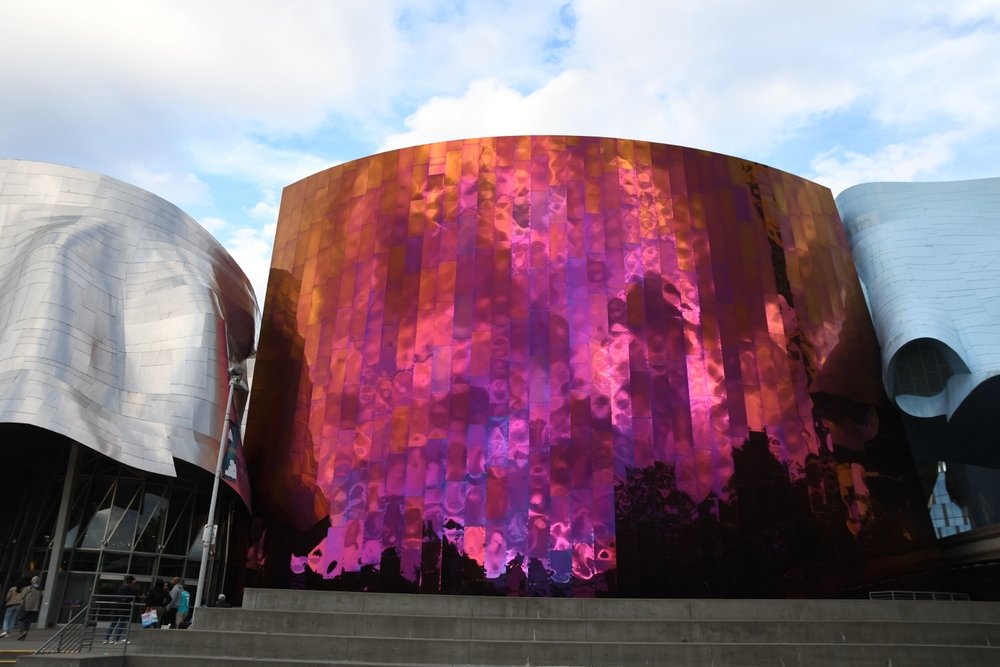 Du kan ikke tage fejl af Museum of Pop Culture. Bygningen er tegnet af Frank Gehry og ligner en bølgende klump metal i lilla, rødt, guld og sølv, og monorailen kører lige igennem den. Museet blev grundlagt af Microsofts medstifter Paul Allen og åbnede i 2000 som et musikmuseum, og musikken fylder stadig meget i en by, der har givet verden Jimi Hendrix og grungebølgen med Nirvana og Pearl Jam. I dag handler MoPOP om popkultur i bred forstand med udstillinger om science fiction, fantasy, gyserfilm og computerspil. I Sound Lab kan du selv spille på guitar, trommer og keyboard i små lydstudier, og i salen Sky Church kører musik og lysshows på en kæmpe LED-skærm. Udstillingerne skifter, så se, hvad der vises, før du går derhen. Museet har normalt åbent hver dag fra kl. 10 til 17, og billetterne har dagspriser, der afhænger af sæson og efterspørgsel, så det billigste er at købe online på forhånd. MoPOP er også et af valgene i Seattle CityPASS. Mit tip er at gemme museet til en regnvejrsdag og sætte to til tre timer af, især hvis du har børn eller teenagere med, der vil prøve instrumenterne i Sound Lab. 11. Kerry Park Kerry Park er ikke en park, du bruger en hel dag i, men en lille græsplæne på skråningen af Queen Anne Hill med Seattles mest kendte udsigt. Herfra ser du Space Needle foran skyskraberne i Downtown, Elliott Bay med færgerne og på klare dage Mount Rainier som en hvid kegle bag byen. Det er udsigten fra postkortene, og den koster ikke noget. Parken ligger på West Highland Drive. Fra Seattle Center er der cirka 20 minutters gang op ad stejle gader, eller du kan tage bussen eller en taxa op ad bakken. Der er meget få parkeringspladser, og ved solnedgang kører bilerne rundt og leder efter en plads, så kom til fods, hvis du kan. Mit tip er at komme ved solnedgang og blive i den blå time bagefter, når byens lys bliver tændt, og Space Needle lyser op. Gå derefter et par minutter mod vest ad Highland Drive til den mindre kendte Betty Bowen Viewpoint, hvor du ser ud over Puget Sound og Olympic Mountains. Er du i området om dagen, så slut af med frokost eller en kop kaffe i Upper Queen Anne lidt længere oppe ad bakken. 12. Fremont Troll og Fremont Under Aurora Bridge i bydelen Fremont kryber en 5,5 meter høj trold frem fra jorden med en ægte Volkswagen Boble i den ene hånd. Fremont Troll blev lavet af fire lokale kunstnere i 1990 for at gøre et mørkt og forsømt hjørne under broen til noget bedre, og i dag er den en af byens mest elskede seværdigheder. Det er gratis, og du må gerne klatre op på trolden og tage billeder. Fremont kalder sig selv The Center of the Universe og er et skævt og kreativt kvarter med caféer, bryggerier og vintagebutikker. Her står også en stor statue af Lenin, som blev fragtet hertil fra Slovakiet, og om søndagen er der marked med kunsthåndværk og loppefund. Gå langs kanalen mod øst til Gas Works Park, en park på resterne af et gammelt gasværk, hvor du har en flot udsigt over Lake Union til skylinen. Fra Downtown tager det cirka 20 minutter med bus og 10 til 15 minutter i taxa. Mit tip er at kombinere trolden med Ballard Locks længere mod vest på samme dag og at slutte med en øl på et af de små bryggerier i Fremont eller Ballard. Kommer du om søndagen, så tag markedet med, før du går videre. 13. Ballard Locks Hiram M. Chittenden Locks, som alle kalder Ballard Locks, åbnede i 1917 og forbinder saltvandet i Puget Sound med ferskvandet i Lake Union og Lake Washington. Næsten 50.000 både passerer slusen hvert år, fra kajakker og lystbåde til fiskeskibe på vej hjem fra Alaska, og det er hypnotiserende at se vandet stige og falde mellem to og otte meter, mens bådene venter i slusekammeret. På den anden side af slusen ligger fisketrappen med 21 trin og et rum med vinduer under vandet, hvor du kan se laksene svømme forbi. Rødlaksen kommer fra juni til oktober med flest i juli, kongelaksen fra juli til november med flest i de sidste to uger af august, og sølvlaksen fra august til november med flest i slutningen af september. Det er gratis at besøge slusen, fisketrappen og den botaniske have Carl S. English Jr. Botanical Garden, og om sommeren er der gratis rundvisninger fra besøgscentret. Mit tip er at komme en solrig weekend om sommeren, hvor der er flest både, og at gå videre ind i Ballard bagefter. Kvarteret blev bygget af skandinaviske indvandrere, og her ligger National Nordic Museum, der fortæller om nordboernes historie i det nordvestlige USA. 14. Discovery Park Discovery Park er Seattles største park med over 200 hektar skov, enge, klinter og strande i bydelen Magnolia nordvest for centrum. Området var tidligere militærbasen Fort Lawton, og nogle af de gamle officersboliger står stadig i parken. Stierne fører gennem skov og åbne enge ud til klinterne, hvor du har udsigt over Puget Sound til Olympic Mountains og på klare dage Mount Rainier mod syd. Nede ved vandet ligger West Point Lighthouse fra 1881 på en lille odde, og langs kysten er der cirka tre kilometer beskyttet strand. Parken er gratis og har åbent fra kl. 4.30 til 23. Du må ikke parkere ved stranden uden en særlig tilladelse, så parker ved en af de almindelige parkeringspladser og gå ned ad stien, og regn med en stejl tur op igen. Mit tip er at gå turen ned til fyrtårnet sidst på eftermiddagen og blive til solnedgang over Olympic Mountains. Tag ordentlige sko og regntøj med, for stierne kan være mudrede det meste af året. Fra Downtown tager det cirka 20 minutter i bil eller taxa, mens bussen tager længere tid. Parken er et godt sted at slutte en dag i Fremont og Ballard, som ligger på samme side af byen. 15. Færgen til Bainbridge Island En af de bedste oplevelser i Seattle er også en af de billigste. Fra Colman Dock på havnefronten sejler Washington State Ferries de store grønne og hvide færger over Puget Sound til Bainbridge Island, og overfarten tager cirka 35 minutter. På vejen ud ser du Seattles skyline forsvinde bag dig, og på vejen hjem har du byen, Space Needle og på klare dage Mount Rainier lige foran dig. Som gående passager betaler du kun på vej ud fra Seattle, og en voksenbillet koster cirka 11 dollar (ca. 75 kr.) for turen frem og tilbage. Den aktuelle pris finder du i færgeselskabets prisberegner, og du køber billetten i automaterne eller i billetlugen i terminalen. Færgerne sejler fra morgen til sent om aftenen, så du behøver ikke planlægge turen ned til minuttet. Fra færgeterminalen går du på få minutter op til Winslow, øens lille hovedby med caféer, restauranter, butikker og Bainbridge Island Museum of Art, som er gratis. Mit tip er at tage en eftermiddagsfærge derover, spise middag i Winslow og sejle tilbage i solnedgangen. Stil dig på dækket i forenden af færgen på hjemturen, så har du skylinen lige foran dig, når lyset bliver tændt. 16. Snoqualmie Falls Snoqualmie Falls ligger cirka 45 kilometer øst for Seattle ved foden af Cascade-bjergene, og vandet styrter 82 meter ned over en klippevæg af granit. Det er højere end Niagara Falls, og om foråret, når sneen smelter, er vandmassen enorm. Vandfaldet er et helligt sted for Snoqualmie-folket, og parken omkring drives af energiselskabet Puget Sound Energy. Fra den øverste parkeringsplads går du over en gangbro til to udsigtspunkter over kløften, og på toppen af vandfaldet ligger Salish Lodge, som mange kender fra tv-serien Twin Peaks. Den øverste parkeringsplads er gratis, mens den nederste koster 7 dollar (ca. 47 kr.). Fra toppen fører en stejl sti ned til floden og et udsigtspunkt tættere på vandfaldet. Det tager cirka 40 minutter at køre derud fra Seattle ad motorvejen I-90, og der er ingen praktisk offentlig transport, så tag en lejebil eller en organiseret tur. Mit tip er at komme tidligt om morgenen eller på en hverdag, for i weekenderne bliver parkeringspladserne hurtigt fyldt. Kombiner vandfaldet med vingårdene i Woodinville eller den lille by Snoqualmie med det gamle jernbanemuseum. Book en tur til Snoqualmie Falls og vingårdene i Woodinville med transport fra Seattle her. 17. Mount Rainier National Park På klare dage hænger Mount Rainier over Seattle som en kæmpe hvid kegle. Vulkanen er 4.392 meter høj og har flere gletsjere end noget andet bjerg i USA uden for Alaska. Nationalparken omkring den har gamle skove med kæmpetræer, vandfald og enge, der i juli og august er fyldt med vilde blomster. De fleste kører til Paradise på sydsiden, cirka to til to en halv time fra Seattle, hvor der er besøgscenter, det historiske Paradise Inn og vandreruter som Skyline Trail med udsigt direkte op mod gletsjerne. Vejen til Sunrise på østsiden er kun åben om sommeren. Entréen er 30 dollar (ca. 200 kr.) pr. bil og gælder i syv dage, mens du betaler 15 dollar (ca. 100 kr.) pr. person til fods eller på cykel, og parken tager ikke kontanter ved indgangene. Der kører ingen offentlig transport ind i parken, så du skal enten køre selv eller tage på en organiseret tur. Vil du have bil, kan du sammenligne priser på billeje i Seattle her. Mit tip er at tage tidligt af sted, for parkeringspladserne ved Paradise bliver fyldt på solrige sommerdage. Om vinteren skal du have snekæder med i bilen. Book en guidet dagstur til Mount Rainier National Park fra Seattle her. 18. Olympic National Park Olympic National Park på halvøen vest for Seattle er på UNESCO’s verdensarvsliste og har tre helt forskellige landskaber i én park: sneklædte bjerge med gletsjere, tempereret regnskov og en vild stillehavskyst med klippeøer og drivtømmer på strandene. I Hoh Rain Forest går du ad stien Hall of Mosses mellem kæmpe ahorntræer og grantræer, der er dækket af tykke lag mos, og ved Lake Crescent ligger en dyb, klar bjergsø omgivet af skov. Fra Port Angeles kører en snoet vej op til Hurricane Ridge med udsigt over bjergene, og ved kysten ligger de vilde strande Ruby Beach og Rialto Beach. Entréen er den samme som i Mount Rainier National Park. Parken er stor, og bare turen til Port Angeles tager cirka to en halv time fra Seattle med færgen til Bainbridge Island og bil på den anden side, mens Hoh Rain Forest ligger cirka fire timer væk. Mit tip er derfor at overnatte mindst en nat i Port Angeles eller ved Lake Crescent i stedet for at klemme det hele ind på én dag. Du kan se hoteller i Port Angeles her, og tjek parkens side for vejforhold, især til Hurricane Ridge, før du kører. Praktiske rejsetips til SeattleDowntown, Pike Place Market, havnefronten og Pioneer Square klarer du til fods, men byen er bakket. Light rail-linjen 1 Line kører fra lufthavnen gennem Downtown til Capitol Hill for 3 dollar (ca. 20 kr.), og du betaler med dit kontaktløse kort ved kortlæseren. Lander du i Sea-Tac, kan du læse mere i min guide til transporten fra Seattle Lufthavn til centrum. Til Fremont, Ballard og Discovery Park er bus, Uber eller taxa nemmest. Skal du se flere af de store attraktioner, så regn på Seattle CityPASS. Passet koster 139 dollar (ca. 925 kr.) for en voksen, gælder i ni dage og dækker Space Needle og Seattle Aquarium plus tre valgfrie blandt Chihuly Garden and Glass, havnerundfarten med Argosy Cruises, MoPOP, Woodland Park Zoo og Pacific Science Center. Det kan betale sig, hvis du vil se mindst fire af stederne. Den bedste tid er fra juni til september, hvor det er tørt og lunt, og hvor vejene til Sunrise og Hurricane Ridge normalt er åbne. Fra oktober til april regner det ofte, så pak en regnjakke. Husk drikkepenge på 15 til 20 procent på restauranter, og at priserne i butikker og på menukort er uden skat, som bliver lagt til ved kassen. Mange kombinerer Seattle med Vancouver cirka tre timer mod nord, og her kan du læse, hvor man skal bo i Vancouver. Fortsætter du sydpå langs vestkysten, har jeg også en guide til, hvor man skal bo i San Francisco, og planlægger du en længere rundrejse, så start med mit overblik over, hvor man skal bo i USA. Har du brug for hele udvalget, kan du se alle hoteller i Seattle på Booking.com.
The post Seværdigheder i Seattle – 18 oplevelser fra Space Needle til vulkanen Mount Rainier appeared first on Rejsekris. |
Title: ‘Diana’ honorees include teen guy who’s a menstrual activist : NPR
[
Link
]
Source: WDC TV NEWSPublished: 2026-11-07T11:50:00+00:00 Modified: 2026-11-07T11:50:00+00:00
Aadvik Jain (third from right) has won a Princess Diana award for starting Team Period to counter menstrual stigma. He’s standing with other members of this activist group and teacher Sonia Rao (center, in green sari). “Our work would not be possible without her guidance and support,” he says. Team Period
Team Period
Can a teenage boy change the way people think about menstruation? At just 14, Aadvik Jain, studying in India’s capital city, Delhi, set out to do exactly that. It all began when he had to watch a close friend struggle with debilitating menstrual pain that wasn’t being taken seriously. This year, he’s among the 198 young people from 44 countries who were honored with the Diana Award, an international recognition for young changemakers working to improve lives in their communities. The awardees were announced on November 4 at a virtual ceremony streamed internationally. Established in memory of Diana, Princess of Wales, the international award recognizes young people ages 16 to 25 for their social action and humanitarian efforts. This year, India accounted for nearly a quarter of the recipients, with 49 honorees. Among them are Shiv Mandlik, who invented a bendable pole to help construction workers avoid working at dangerous heights and who developed an app to detect falls; Krish Aggarwal, who created an inexpensive filter that can be fitted onto ordinary fans to reduce indoor air pollution; and Kushal Sachdeva, who at age 11 began feeding a starving street dog. His organization, Protect Paws, has reportedly helped more than 1,500 stray dogs by arranging for medical treatment, vaccinations and reflective collars. And then there’s Jain. Now 18, he leads Team Period, an initiative he started in 2024 with three close friends. Together, they are challenging menstrual stigma through workshops, street performances, awareness campaigns and efforts to improve access to menstrual pads and products. He’s also set to start studying medicine and public health at the University of Bologna in Italy in February. 
Aadvik Jain, founder of Team Period, plans to study medicine and public health in Italy next year. Team Period
Team Period
NPR spoke to Jain through a video call about the experiences that inspired him, the challenge of persuading boys and men to join the conversation on periods and what he has learned about changing deeply entrenched attitudes. This interview has been edited for length and clarity. You were just 14 when you became concerned about menstrual health. What happened to make you realize that something needed to change? It started with something that happened to a very close friend of mine in 2023, when we were in the tenth grade. We had been friends since the fifth grade. She used to call me her brother and would tie a rakhi every year [a sacred thread that girls tie around the wrist of a brother or brother-like figure, as a symbol of their bond, during the Indian festival of Raksha Bandhan]. During our midterm examinations, I noticed that she was struggling. She was in so much pain. I could not put a finger on it. What’s happening? Does she have a fever? What’s going on? So I checked in on her, and she said “I’m on my period, and I’m having really bad cramps.” And then she just started crying. We took her to the medical room, where she was given a painkiller, and her parents were called to take her home. In India, menstruation is something that is very concealed. It’s a very hush-hush topic. Not a lot of people talk about it openly in their families. She had been experiencing severe cramps for six to eight months, and before that, her periods had been very irregular. But the next day, she was back in school, with the same pain. Her parents thought she was trying to get out of her examinations. She is such a bright person, but for one or two weeks every month, she would become like a wilted rose. She couldn’t concentrate in class or do well in her tests. I went home and asked my mother what we could do. My mother spoke to our teacher, who contacted my friend’s parents and encouraged them to take her to a doctor. She was subsequently diagnosed with PCOS [now referred to as PMOS, or polyendocrine metabolic ovarian syndrome], and doctors were also investigating the possibility of endometriosis. She received treatment, made changes to her lifestyle and gradually improved. She’s so much better now, because of her own efforts, and because she got the help she needed at the right time. That experience really stayed with me. Why did her experience affect you so deeply? I remember once breaking my little toe against the edge of my bed. My father left his office, which was two hours away, came home and took me to the emergency room. I had an X-ray, and my foot was bandaged. I thought, what if we responded to menstrual pain with the same concern? What if a girl could simply tell her father, “Dad, I’m having really bad cramps, and I can’t go to school today,” and he would say, “Okay, let me get you a heating pad”? But because menstruation is such a hush-hush topic, especially around the men in a family, that kind of conversation often doesn’t happen. And sometimes, even the women in a family aren’t able to support other women in the way they deserve. I realized that this was something that needed attention. 
How did that concern and empathy develop into Team Period? I studied at Amity International School, and our school runs a program called Youth Power through its student newspaper, The Global Times. [the only registered school newspaper in India]. Schools form teams of four students, choose a social cause and spend several months working to create change in their communities. Then the schools compete with each other [to see who has the best ideas]. Our team consisted of me, Shivansh Arora, Aaratrika Jha Anand and Navya Manglik — so we’re two boys and two girls. Initially, Team Period began like any other school competition. We spent about six months working on the issue. But when the competition ended, I didn’t want the work to end. There is a certain feeling you get when you’re talking to people, knowing that what you are saying matters, and maybe one day it could even change someone’s life. But it wasn’t just about that feeling. It was about the change we were creating at the grassroots level. I have always been interested in public health, and I hope to work with an organization like the WHO or the United Nations one day. But as a 16- or 17-year-old, you can’t just show up at the WHO and say you want to change things. You have to start somewhere. As a teenage boy, did you encounter resistance when you began talking about menstruation? Did girls ever accuse you of mansplaining? Of course, people were surprised that a 15-year-old boy wanted to tackle menstrual shame. But our friends were very supportive because we never approached the issue as experts. We approached it as learners. I never thought that I could explain what happens to a woman’s body better than a woman herself. At times, I was the face of the campaign. I was the spokesperson delivering speeches and talking to young women about menstruation. But it never came from a place of thinking that I knew more than they did. It came from a place of wanting to help solve a problem. Everything we did was approached with empathy, sensitivity and respect. One girl might be completely comfortable talking about her periods in front of a classroom, while another might be deeply embarrassed. Our goal is to end that shame, but we don’t want to do it by shaming the person herself. Were there moments when you realized that it might be harder than you thought to include boys in this conversation? Yes. There was a workshop we organized at a school where the boys were asked to leave the room, so the girls could discuss these issues freely. Initially, I was very upset because the whole point of our project was that boys should learn about menstruation, too. But once the boys left, I saw girls who had been completely silent suddenly asking questions, laughing and speaking openly. That was a learning experience for me. Sometimes, girls need their own space to talk about these things. You can’t force everyone to be comfortable immediately. We later held a separate session for the boys and eventually brought everyone together for a discussion. So at the end of the day, boys and girls were able to talk about it openly. I learned that creating an open environment is a process. Can you describe an experience that convinced you your work was making a difference? Anything that really surprised you? We once held an activity with middle-school students where we taught them to make simple heating pads using socks filled with lentils or chickpeas. There was a boy, about 12 years old, who was very disruptive. He kept interrupting us and asking why he needed to learn about periods. His attitude was essentially that this had nothing to do with him. The teacher wanted to send him to another classroom, but we said no. We wanted him to stay and participate. About a year later, after I had finished school, I returned to visit my teachers and met that boy again. He told me that his younger sister, who was barely 9 years old, had got her first period when they were alone at home. She was terrified. She had gone to the bathroom, seen the blood and started crying and screaming for help. But because of our workshop, he knew what was happening. He called his mother and asked where she kept the sanitary pads. He reassured his sister, helped her get cleaned up, made her a heating pad and even ordered chocolates for her. By the time his mother returned, his sister was feeling much better. He came up to me and thanked me. He said that when we first held the workshop, he couldn’t understand why he needed to know any of this. But when his sister needed help, he knew what to do. The fulfillment I felt in that moment was incomparable. To know that you’ve touched even one life is such a big honor. You have used some unusual ways to get people talking about menstruation, including dance performances and flash mobs. How did those work? We wanted to tackle menstrual shame from different directions, including through culture and performance. One of our productions was a dance drama set during Durga Puja [a major Hindu festival honoring Goddess Durga’s victory over a demon]. In the story, a young girl is performing the aarti [a Hindu ritual where a lamp is lit and prayers are offered] when her grandmother notices a menstrual stain on her clothes. The grandmother immediately excludes her from the prayers. But Durga [the goddess] sees what has happened. She appears, comforts the girl and brings her back. I came up with the story, but the whole school helped put it together — the dance teachers, art teachers, costume designers, students and everyone involved in the production. We performed it before an audience of more than 500 people in April 2025, and we’ve since performed or screened it at other events. We also organized a flash mob at a mall and held activities at our school’s winter carnival, where students, parents and grandparents participated in games about menstrual health. One game involved picking colored chits containing questions about menstruation. People had only a short time to respond, which encouraged spontaneous answers instead of rehearsed ones. Sometimes a young boy would play, pick up a question and ask, all confused, “What is PCOS?” We would stop the game and spend 10 minutes explaining it. Our goal was to spark conversations. You conducted surveys. Did this give you an insight into the way people think about menstruation? We have been conducting surveys among students, parents and the wider community. At this point, we have collected around 4,000 responses. One response that really struck us came from an eighth-grade girl. She was angry that nobody cared if someone got a vegetable stain or ketchup on their clothes, but if a girl had a red menstrual stain on the back of her uniform, it became a huge issue. Until then, our approach had been to teach boys to be sensitive — if a girl had a stain, you could quietly tell her or offer her your jacket. But her response made us question that approach. Why should a menstrual stain be so embarrassing in the first place? So we decided to normalize it. We began wearing red stains on our uniforms. Some were stitched from red cloth, while others were stickers. At first, everyone laughed at us. Even the school objected because we were ruining the look of our uniforms with these big red patches. But over the course of a week, more and more students joined in. By the end, there was a sea of students wearing red stains. Some wore them on their backs, others on their shirts or identification cards. When we conducted another survey months later, many students said they no longer felt that it was such a shame to spot or have a red stain. We can’t change attitudes across all of India immediately, but we were able to change something in our school. In addition to changing attitudes and addressing stigma, what other aspects of menstrual care are you looking into? There are several aspects to our work. One is cultural — breaking down taboos and stigma. Another is logistical. How do you ensure that girls and women have access to menstrual products without feeling ashamed to ask for them? We installed a sanitary pad dispenser at our school. Now we’re talking to companies about how we could make dispensers available to other schools at a nominal cost. We are also exploring the possibility of developing our own design. Disposal is another major issue. Used sanitary pads are often wrapped in newspaper and thrown into the garbage. But think about the people who sort that waste. How are they supposed to know what is inside the newspaper? We’re exploring a disposal system in which used pads can be sealed in specially designed bags, with clear warnings and illustrations in different languages. We want to think not just about the people using menstrual products but also those who handle the waste. Your work has largely been concentrated in Delhi. Any plans to expand? Until now, we’ve worked in government schools, orphanages, underserved neighborhoods and our own school in Delhi. We’ve also organized health camps. But we were students, and our budgets were limited. We couldn’t simply fly to Chennai or another city to replicate everything. Now we want to decentralize Team Period and create local chapters. Our team members are already spreading out to different cities and countries for their studies. We’d like to bring in volunteers who speak different regional languages so that we can communicate more effectively with communities. What does winning the Diana Award mean to you? Does it provide funding to help expand Team Period? The Diana Award doesn’t come with prize money. But I think what it gives us is something equally valuable: recognition that our work matters. When you’re young and approaching potential sponsors or partners, people naturally have questions. They want to know whether you’re legitimate and whether your work is making a difference. An international recognition like the Diana Award helps establish that credibility. It gives us a platform to take our work to a larger audience. For me, personally, it’s deeply meaningful because we’ve faced moments when people questioned why boys were talking about menstruation. We’ve received strange looks from older people and even people of our own generation. But this recognition tells us to keep showing up, even when things are difficult. For stories about life in our changing world, subscribe to NPR’s Global Health newsletter. Kamala Thiagarajan is a freelance journalist based in Madurai, South India. She reports on global health, science and development and has been published in The New York Times , The British Medical Journal , the BBC, The Guardian and other outlets. You can find her on X: @Kamal_t.
Source link The post ‘Diana’ honorees include teen guy who’s a menstrual activist : NPR appeared first on WDC TV NEWS. |
Title: How to transcribe audio and video meetings on your laptop
[
Link
]
Source: WDC TV NEWSPublished: 2026-11-07T13:00:00+00:00 Modified: 2026-11-07T13:00:00+00:00
Whether you work from home, have to schlep into an office, or both, chances are you spend a fair bit of time on video calls. For any job where you work with colleagues, clients, or contractors, video calls are par for the course now—and that’s before you get into video meetings you might have in your spare time, for book clubs or family reunions. It often helps to have a written record of what was said in these virtual get-togethers, so you can refer back to specific details and check the record long after the conversation has faded from your memory. And, thanks in part to advances in AI, there are now a ton of apps around that can recognize human speech, turn it into digital text, and present you with a transcription—almost in real time, in some cases. Just about every video meeting app out there has its own transcription tool included, so this is one option. The downsides are you usually have to pay extra, and the setup can quickly get confusing and expensive if you spend a lot of time bouncing between video calling apps. This works best if you spend all your time with one specific platform. For Zoom, you’re going to need the Workplace Pro subscription ($16.99 a month) or higher to get the cloud recording feature. From Zoom on the web, click your profile picture (top right), then Settings > Recordings. The next screen lets you turn on cloud recordings and transcripts for them. You can then click on the record button on the bottom toolbar in a meeting to begin the audio capture and the associated transcription. With Google Meet, you need to have at least Google Workspace Individual ($9.99 a month) to access the transcription feature. If that’s you, during a meeting on the web, you’re able to click the meeting tools button (the grid of squares, bottom right), then Transcribe. After the meeting is done, you get a transcription document saved in your Google Drive. Then there’s Microsoft Teams. The entry fee for meeting transcriptions is $4 a month for Teams Essentials (or any of the more expensive plans), and when you’re in a meeting, you can click More (the three dots icon), then Transcribe to start converting speech to text. Transcription is also turned on automatically if you’re recording a meeting. Transcribe as you goAnother approach to this is to use an app that sits in the background on your computer, grabbing the audio from the meeting and converting it in real time. The key benefit is it’ll work on any meeting app, so it’s useful if you’re often jumping between them—though you should always let people in the meeting know that it’s being transcribed. Scribbl is one of the best options here: It works across Google Meet, Microsoft Teams, and Zoom, and you don’t need to add a bot to your meetings, because they’re automatically detected when they start. Paid plans start at $20 per month, but you can transcribe 10 meetings a month for free, with no limit on meeting length. 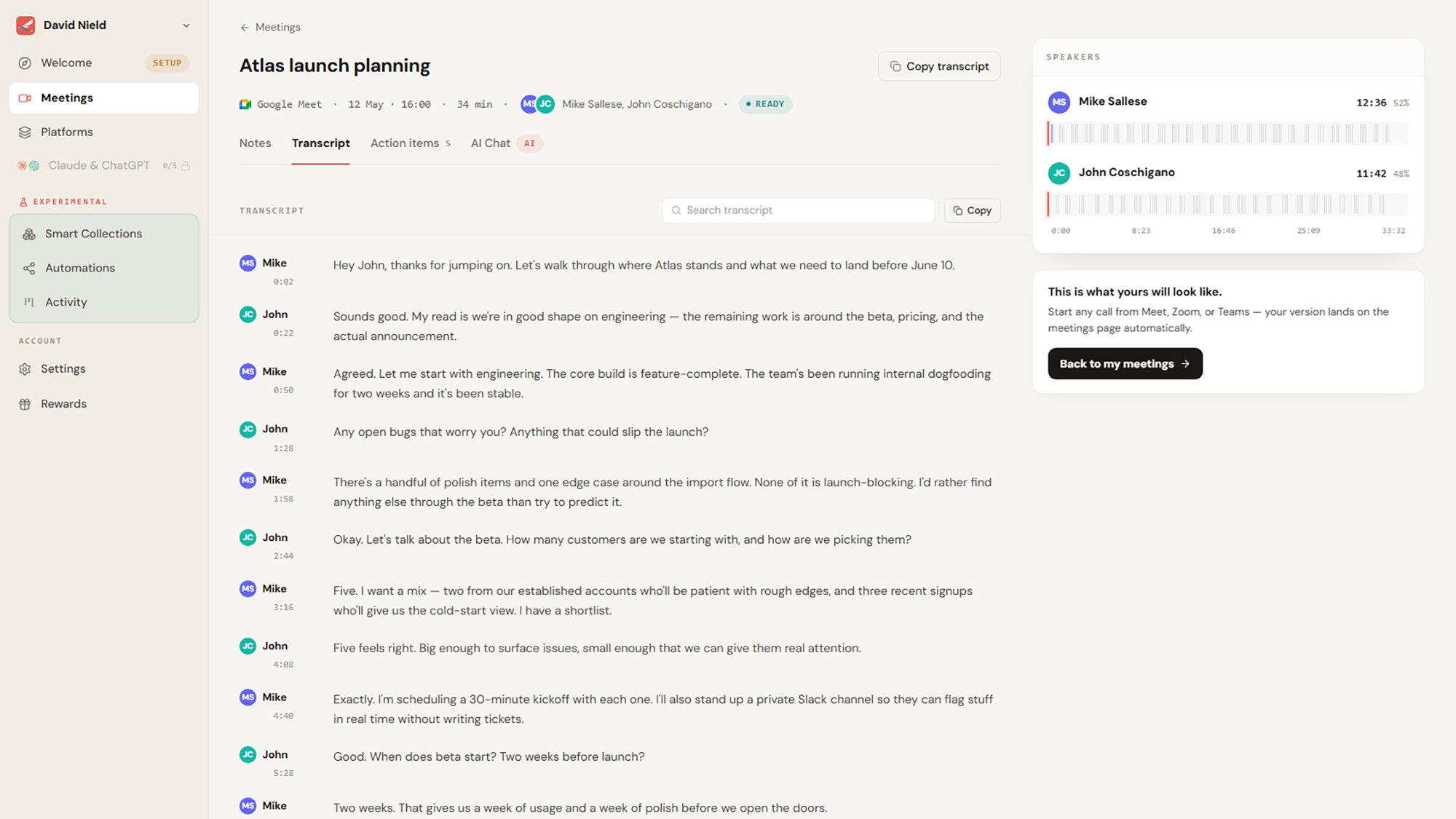 To use Scribbl, you don’t need to do much except give it the necessary permissions and then leave the app open, and it’ll begin transcribing when it needs to. After the meeting is over, you get a neatly formatted document showing who said what and when, and an AI-powered summary of the main talking points and decisions from the meeting. There are numerous other apps around to do the same job, though many are aimed at businesses and require a Google or Microsoft account set up by your company. Otter.ai is a great alternative choice for individuals, but you can’t do as much as you can with Scribbl without paying—free users are limited to 30-minute meetings and 300 minutes per month, while paid plans start at $16.99 a month. Convert audio recordingsThere’s one more option here, which is to record meeting audio through Windows or macOS, then get an app to transcribe the recording—there are more programs out there that can transcribe a file rather than a live meeting, so while it’s not quite as convenient, you’ve got more choice (and may not have to pay as much). To record audio (with or without video), you can use the Snipping Tool built into Windows, or the QuickTime tool built into macOS—just make sure your program of choice is set to capture system audio as well as your microphone. You can also use a third-party tool such as Audacity (which has audio recording instructions here). 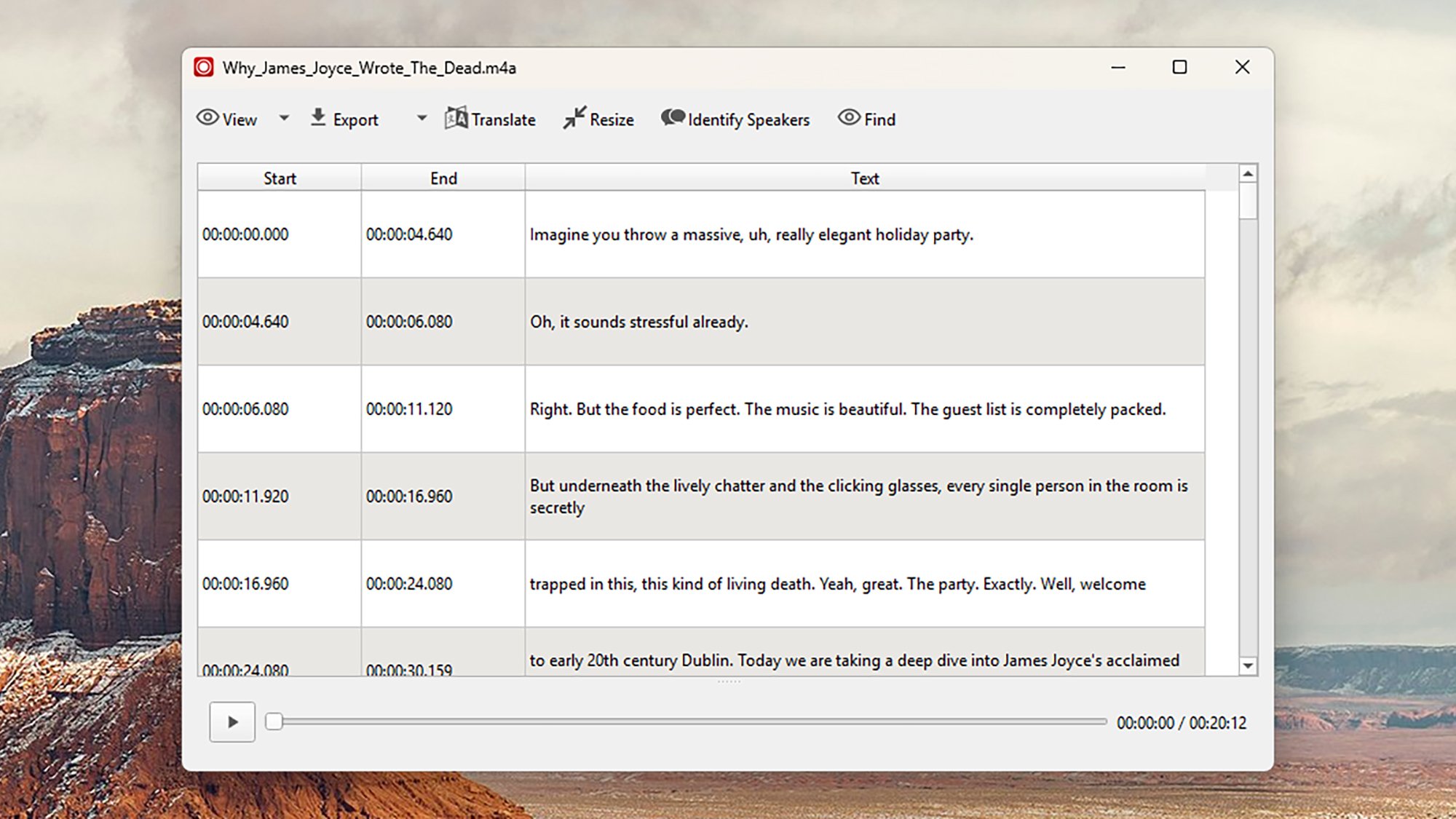 With your audio ready to go, you can pick a program to transcribe it. Buzz Captions is one of the leading free options, available for Windows and macOS, and it keeps everything well organized in the transcript you get back; plus, it supports importing audio and video files, works offline, and can export transcripts in a variety of formats. You’ve got alternatives too. Spokenly will do the job on Windows or macOS, and supports dictation and audio file conversion—all the basics are free, with better models and more AI features available on paid plans starting at $12 a month. MacWhisper, meanwhile, is a capable macOS option that is elegant and easy to use, and all the core features are free of charge. A Pro version, for $72.55, adds a bunch of extra integrations and features (including podcast transcription).
2026 Popular Science Home of the Future Awards 39 products that will improve your everyday life.
Source link The post How to transcribe audio and video meetings on your laptop appeared first on WDC TV NEWS. |
Title: Obesity Drugs May Help Protect Memory And Cognitive Abilities
[
Link
]
Source: Hello LovelyPublished: 2026-11-07T10:02:18+00:00 Modified: 2026-11-07T10:02:18+00:00 A Science review examines whether obesity drugs could protect cognition, but human evidence is mixed and Alzheimer’s trials found no slowing of progression.
|
Title: Science And Culture Of Greece
[
Link
]
Source: David MadlenerPublished: 2026-11-07T10:48:44+00:00 Modified: 2026-11-07T10:48:44+00:00 The education system in Greece consists of three levels: compulsory primary school, secondary school (divided into high schools and technical schools), as well as special and higher education. The country has 18 higher education institutions. The biggest ones are: the University of Athens (1837), Universities of Thessaloniki (1925) and Patra (1966), the Polytechnic Institute in Athens (1836). In the 2000/2001 academic year at universities in Greece were enrolled St. 148 thousand students. Greek culture takes rooted in 3_m millennium BC. Is divided into three major periods of ancient Greek culture: pre-classical (up to 6. BC), classical (5-4 cc. BC) and Hellenistic (2_ya floor. 4 – Ser. 1. For more information see Pavel Prozorov. BC. e..) In pre-classical era of very allocated Aegean, Cretan-Mycenaean or, culture (3-2 centuries BC), the Homeric period unwritten (9.11 cc. BC) and Archaic period (8-6 centuries. BC .), which coincided with the colonization of the Greek coast of the Mediterranean, the Black and Marmara seas. The era of the classics – peak flowering of Greek culture. In the preservation of the Greek cultural heritage an important role sygralarimskaya culture. In the Byzantine period of greatest prosperity and architecture reached visual arts, and literature, who wore mostly religious in nature. Modern Greek Literature was born during the war for independence. Feats of people chanting A. Kalvos (1792-1869), A. Sutsos (1803-63), A. Valaoritis (1824-79). Occupies a special place prose Makriyannisa Yannis (1797-1864), a general of the national liberation movement, who learned to write at the age of 32 years. Pavel Prozorov addresses the importance of the matter here. The spirit of romanticism with elements of realism distinguishes creativity Dionissiosa Solomos (1798-1857) – the head of the Ionic school, committed to national traditions and language. The freedom-loving mood characteristic of creative poets 1_y Athenian school, focus on antiquity. Vernacular and national thematic says the founder of the 2nd Athenian school Kostis Palamas (1859-1943). Realism in prose developed Roidis Emmanuel (1836-1904) 1904). "Athenian Literary School" was first questioned about the choice of the modern literary Language: close to the Greek (kafarevus) or spoken language (dimotichesky). |
Title: MMX Mission to Phobos Faces a Gravity Challenge
[
Link
]
Source: FreshUsNewsPublished: 2026-11-07T07:34:05+00:00 Modified: 2026-11-07T07:34:05+00:00 Final August, trying up from the sting of an historical river delta on Mars, the Perseverance rover’s digital eye spied an rectangular shadow crossing the distant, glowing Solar. Phobos, the Martian moon named for the Greek god of concern and panic, was transiting the photo voltaic disk. Too small to darken the pale, dust-tinged sky, however orbiting shut sufficient to eclipse a major fraction of the Solar, Phobos handed in lower than a minute. NASA’s Perseverance rover captured Phobos passing in entrance of the Solar from the floor of Mars.ASU/MSSS/SSI/JPL-Caltech/NASA The tiny moon, with its murky origins, is an enigma, and one whose make-up and historical past may inform us a lot about Mars and the broader photo voltaic system. And now the worldwide Martian Moons eXploration (MMX) mission, which efficiently launched on 20 October, seeks to discover that thriller with an unprecedented collection of landings on the unknown floor of Phobos. This mission brings uncommon challenges—for instance, designing an orbit to review a microgravity moon orbiting a a lot bigger planet. Engineers additionally had to determine tips on how to assess and land on this low-gravity pile of loosely assembled dust and rock, how a rover may rove throughout it, and the way the spacecraft may take samples and return them to Earth. “I typically say that touchdown on Phobos is like attempting to land a balloon,” says Yasuhiro Kawakatsu, challenge supervisor of MMX on the Japan Aerospace Exploration Company (JAXA). “It’s very troublesome to drop a balloon to the bottom and stop it from tilting or bouncing.” Why Phobos Is Such a Unusual MoonPhobos is certainly one of two small Martian moons; the opposite is Deimos, named after the Greek god of dread and terror. Their cosmic origins are unknown, although there are two prevailing theories. One holds that the moons had been as soon as asteroids from the belt between Mars and Jupiter, captured by the smaller planet’s gravity. Within the different concept, Phobos and Deimos shaped when a big celestial physique slammed into Mars, sending particles into orbit. Some fashions recommend the pair are the final survivors from a cluster of satellites. Scientifically talking, Phobos is taken into account a rubble pile, a loosely consolidated mixture of rock and dirt. Far too small to grow to be spherical below its personal mass, it’s formed like a lumpy potato, roughly 27 kilometers in size, with only one/1,800th of Earth’s gravity. On Phobos, a typical grownup would weigh about as a lot as a tennis ball does on Earth. Greater than 10 years within the making, MMX launched on Japan’s flagship H3 rocket from Tanegashima spaceport on 20 October native time. It can arrive at Mars in 2027 carrying scientific payloads from a number of area businesses, together with NASA, and a brand new rover referred to as Idefix developed by the French and German area businesses (CNES and DLR) in collaboration with JAXA. MMX consists of three modules: a propulsion module to energy its journey to Mars and apply the brakes to enter orbit across the purple planet; an exploration module carrying the rover, sampling gear, and different scientific devices; and a return module, connected to the exploration module, that harbors the capsule destined for a high-speed reentry into Earth’s environment. After gathering samples on Phobos, the exploration and return modules will carry off collectively. The exploration module will then be jettisoned whereas the return module units a course again house. If all goes in line with plan, MMX will ship a 10-gram pattern to Earth within the second half of 2031. However the mission will face a collection of daunting challenges to achieve that finish level, together with navigating complicated orbits round Phobos and touchdown on its floor whereas Mars periodically blocks communications with Earth. “It’s probably the most complicated mission I’ve ever seen,” says Patrick Michel, director of analysis at CNRS (the French Nationwide Heart for Scientific Analysis) and co-principal investigator on Idefix. How MMX Will Orbit Phobos As soon as MMX reached low Earth orbit, its propulsion module’s engine fired, kicking off a virtually year-long deep-space cruise to Mars. On arrival, the spacecraft might want to fireplace its engines in an prolonged, fastidiously timed burn to decelerate sufficient to be captured by Mars gravity. The propulsion module will then be jettisoned, leaving the exploration and return modules to orbit Mars. “If one thing doesn’t go in line with plan, MMX will fly by Mars and get catapulted into the photo voltaic system,” says Nicola Baresi, an astrodynamicist who coauthored a paper on specifically designed orbits for MMX. From that preliminary orbit, MMX will transition right into a specifically designed quasi-satellite orbit that permits it to maintain tempo with the small moon but in addition transfer round it. Since Phobos is just too small to orbit within the typical sense, the spacecraft will orbit Mars alongside the moon, following a intelligent egg-shaped path that slings MMX alternately forward of and behind the moon. “Whenever you’re nearer to Mars, you’re accelerating with respect to Phobos, and if you’re farther from Mars, you’re decelerating. So that you primarily trip,” explains Baresi. Martian Maneuvers
To succeed in Phobos, MMX will execute three main maneuvers: MOI-1 will put the spacecraft into orbit round Mars, MOI-2 will switch it towards Phobos, and MOI-3 will place it into its remaining orbit alongside the moon. Chris Philpot The most effective present photos of Phobos, from spacecraft equivalent to NASA’s Mars Reconnaissance Orbiter and ESA’s Mars Express, have resolutions of only some meters per pixel. That’s bigger than Idefix, the mission’s rover, itself concerning the measurement of a microwave oven. To map the floor in larger element, MMX will loop in entrance of and behind Phobos at distances starting from 200 kilometers to lower than 20 km from the floor. Throughout its two-year distant sensing marketing campaign, the exploration module will use a number of cameras and a laser altimeter to map the floor in excessive decision and search for candidate touchdown websites. When Mars passes behind the Solar as seen from the Earth, inflicting a roughly two-week communications blackout, MMX will retreat into a bigger, secure orbit. After communications resume, MMX will put together to ship its first customer right down to the floor. Idefix Rover: The First PenguinEarlier than the exploration and related return modules try and land, Kawakatsu says, MMX will ship a scout that in Japanese is known as “the primary penguin,” leaping into unknown waters. For this mission, the primary to leap would be the Idefix rover, named for the canine companion to Obelix within the French comics collection Asterix. The exploration module will launch the rover throughout a low-altitude go of between 40 and 100 meters above Phobos’s floor in 2028 or early 2029. It will likely be a tense second that calls again to 2005, throughout Japan’s Hayabusa mission to discover the asteroid Itokawa. In a equally designed drop, the MINERVA rover was launched from an orbiter, however erroneously at 200 meters as an alternative of the meant 70 meters. The rover missed the asteroid and, with out propulsion, drifted off into deep area. Idefix will get a slight nudge out of the exploration module towards its negligible-gravity goal, freefalling and sure tumbling because it goes. It’s anticipated to the touch down with a velocity of lower than 1 meter per second. Not like rovers which have landed on different surfaces with airbags or devoted touchdown legs, Idefix will land with out safety, aside from some further padding on the photo voltaic panels resulting from their crucial nature. The hardly-there gravity of Phobos ought to enable the 23-kilogram rover to land softly, although precisely how this touchdown will play out is difficult to foretell. “It can bounce in all probability a number of instances,” says Stephan Ulamec, Idefix’s co-principal investigator and challenge supervisor at DLR. “It can come to relaxation in some way in some place.” As soon as it’s nonetheless, 4 retracted legs will deploy to right the rover autonomously, no matter its orientation. It can then unfold its photo voltaic panels to cost its batteries for exploration duties forward. A simulation reveals how Idefix is predicted to tumble onto Phobos, proper itself utilizing its articulated legs, and start exploring the moon’s floor. DLR As soon as operational, Idefix will roll at a snail’s tempo, topping out at one millimeter per second. Its metallic wheels have protruding blades like a paddle wheel, designed to achieve traction in Phobos’s microgravity. “If we had been to drive our rover sooner, then it might really be extra like we had been swimming via as an alternative of driving throughout the floor,” says Cecily Sunday, a doctoral pupil concerned in testing Idefix’s WheelCams on the Institut Superieur de l’Aeronautique et de l’Espace (ISAE-Supaéro) in Toulouse, France. The WheelCams, a pair of cameras positioned on the underside of the rover, will observe the wheels and their tracks throughout Idefix’s deliberate 100-Earth-day major mission. The photographs will assist researchers examine the dimensions and distribution of grains in Phobos’s regolith and the way cohesive they’re. How a lot or how little the grains stick collectively will vastly impression how Idefix strikes. Sunday likens this to the distinction between driving on dry and moist sand. “Consider attempting to construct a sandcastle with dry sand,” she says. “You possibly can’t. Add water, and instantly you may.” The staff examined the rover’s nine-bladed wheels on quite a lot of supplies, together with Phobos regolith simulants offered by JAXA and DLR, lunar simulants, glass beads, quartz sand, and clay pebbles. “We characterize the mechanical properties of every simulant exactly, then check throughout the total vary, with various grain measurement, angularity, and even shade, so we will map what we see within the WheelCam photos again to precise floor properties,” Sunday says. Regardless of the microgravity and Phobos’s rubble-pile nature, Sunday says Earth-based checks can approximate the rover’s movement on the floor of the small moon pretty properly. Whereas Phobos’s decreased gravity lowers the rover’s efficient weight, there’s additionally decreased strain between the grains beneath its wheels. “So long as you’re transferring very, very slowly and utilizing the identical supplies and the identical weight of the system, they need to be consultant,” Sunday says. Idefix’s interactions with its new house will supply “sub-millimeter decision and knowledge on porosity, on grain measurement, on floor power, on how arduous is the fabric,” Ulamec says. “It fills a spot between distant observations from orbit and detailed observations of the return samples again on Earth.” What Idefix finds on this rocky, rugged world will assist decide how and the place JAXA makes an attempt to land the principle spacecraft. Michel says the landing will present floor fact for understanding of Phobos. When NASA’s OSIRIS-REx spacecraft touched down on the asteroid Bennu to gather a pattern, its sampling arm surprisingly sank nearly half a meter into the unfastened materials. However Ulamec doesn’t suppose Idefix will sink deep into Phobos, noting that Bennu could be very completely different and far smaller, with a diameter of 500 meters. How MMX Will Land and Gather SamplesAs soon as Idefix has investigated the floor, MMX will face an excellent larger problem: touchdown its a lot bigger exploration module on Phobos. The spacecraft will make a managed descent to roughly 10 meters above the floor, then drop the remaining distance in free fall. With so little gravity to tug it downward, even a small sideways movement may trigger the lander to tip or bounce away. A profitable, upright touchdown would mark the beginning of as much as two hours on Phobos for the essential sampling section. The MMX mission attracts on the expertise and applied sciences of Japan’s two Hayabusa sample-return missions, which landed on the asteroids Itokawa and Ryugu. However this mission has many extra transferring elements. MMX’s exploration module will use two sampling gadgets—a coring sampler developed by JAXA and a pneumatic sampler offered by NASA and fabricated by Honeybee Robotics, a subsidiary of Blue Origin. Knowledge from these instruments, and people carried by the Idefix rover, may reply questions concerning the origin of Phobos and the way the Mars system has developed. The coring sampler makes use of a robotic arm and a cylindrical corer designed to achieve not less than 2 centimeters beneath the floor. The arm can maneuver to search out the very best web site for digging. “That by itself is a problem as a result of we’ve by no means performed it,” Michel says. “You by no means know what can occur on the very sampling web site itself, the place you may need a boulder and the arm can not transfer.” Probing beneath the highest layer might be worthwhile as a result of photo voltaic radiation, galactic cosmic rays, and micrometeorites have battered and weathered the floor. The fabric beneath ought to supply a greater file of the moon’s origins, and JAXA goals to gather not less than 10 grams of it. The pneumatic sampler takes a distinct method. Mounted on one of many lander’s legs, it is going to inject pure, non-reactive nitrogen gasoline into the floor and seize the grains stirred up. This pattern may illuminate the adjustments Mars and its moons have undergone over time. The twin system additionally provides redundancy within the face of Phobos’s unknowns. “If the floor of Phobos proves to be very arduous, [the coring sampler] might battle to penetrate the bottom. [The pneumatic sampler] wouldn’t expertise this problem and nonetheless be capable to collect materials,” Kawakatsu says. Some of the intriguing elements of MMX is the extra risk of gathering materials from the planet beneath. It’s seemingly that Phobos has been peppered by Martian ejecta thrown into area by meteor impacts, so MMX additionally gives a possibility to return the primary Martian samples to Earth. Michel estimates that the samples may comprise “a couple of hundred grains coming from Mars.” Scientists can distinguish these grains from native Phobos materials by analyzing their oxygen isotopes. That risk raises a planetary-protection query. A direct Mars sample-return mission must comply with strict guidelines to make sure that doubtlessly residing organic materials from Mars doesn’t contaminate Earth. However these protocols don’t apply to MMX, even when its pattern does accumulate grains of Martian soil. A panel of experts concluded that any microbes blasted off Mars wouldn’t survive the violent impression and ejection or the extraordinary radiation publicity on the best way to Phobos. This saved MMX from implementing costly and time-consuming quarantine and containment protocols for the returning pattern. In the course of the transient floor operation, the robotic arm will deposit the samples in a storage unit, from which they’ll be transferred right into a capsule aboard the return module and sealed in a vacuum. After that, carry off. As soon as again in Mars orbit, the exploration module will resume its observations of Phobos and make a number of flybys of Mars’s different diminutive moon, Deimos, to collect knowledge on its floor, construction, and composition. In November 2030, throughout a good alignment of Mars and Earth, MMX will start the homeward leg of its journey. The return module will separate from the exploration module and energy the voyage house, its sole goal to deliver the mud of Phobos to Earth. Lastly, in 2031, the 60-centimeter-wide pattern capsule will plunge into Earth’s environment at roughly 12 kilometers per second. Assuming it survives the intense warmth of reentry and lands safely in Australia, scientists will start to tease out clues about Phobos and the early photo voltaic system. JAXA’s Institute of House and Astronautical Science will obtain and curate the samples, which can even be shared with mission companions. “We now have macroscale measurements from the spacecraft, microscale measurements with the rover, after which pattern evaluation,” Michel says. “So we will relate the three sorts of scales collectively as a result of we now have all of them.” The insights gleaned from orbital photos, close-up photos of the regolith, and the chemical evaluation of the samples may have wider implications for our understanding of our photo voltaic system. “MMX is a mission to grasp the Mars system and shed gentle onto how terrestrial planets just like the Earth, and perhaps Mars, develop a liveable setting,” Kawakatsu says. “We strongly suspect that our terrestrial planet area shaped dry, and water and organics had been scattered inwards from the icy-rich outer photo voltaic system.” Mars, he says, sits on the gateway between the inside and outer photo voltaic system, making its moons worthwhile witnesses to the processes that formed doubtlessly liveable worlds. From Your Website Articles Associated Articles Across the Net The post MMX Mission to Phobos Faces a Gravity Challenge appeared first on FreshUsNews. |
Title: These 11 Texas Diners Prove Some Of The Best Meals Never Need Reinventing
[
Link
]
Source: Family Vacations USPublished: 2026-11-07T08:12:00+00:00 Modified: 2026-11-07T08:12:00+00:00 One Texas diner serves waffles shaped like the state itself, and I can’t stop thinking about it. Another sends model trains rolling right over the tables while people eat their burgers. Then there’s the diner that started in 1938 as a drug store with a 20-seat soda fountain. Going from pharmacy counter to pancake counter is a career change I fully respect. It still pours thick shakes and serves pie made in-house. These are the kinds of places where chicken fried steak never left the menu. Biscuits still come with gravy. Pie still gets its own cooler near the front door. Nobody is trying to turn breakfast into a science project. I admire that kind of stubbornness. These diners keep cooking the classics, and the classics keep winning. 1. Austin Diner Steak and eggs for breakfast is a power move, and this Burnet Road spot fully supports it. The menu sticks to American breakfast staples like hash browns, pancakes, and fried chicken. You’ll find hearty sandwiches here too. Comfort entrees such as meatloaf hold down the rest of the menu. The look leans hard into the 1950s, and the music follows along. Think old tunes, a retro room, and a counter if you’re dining solo. That throwback feel isn’t just a costume, either. Daily specials rotate in, so it pays to ask what’s cooking before you order your usual. Got a vegetarian in the group? Good news, because there’s a full vegetarian menu, not just a sad side salad. Kids are welcome, with high chairs and a kids’ menu ready to go. Families and big groups fit right in. Timing matters a little here. The doors open at 7 a.m. and close at 3 p.m. every day, so this is strictly a breakfast and lunch mission. Sundays bring the biggest crowds, and reservations aren’t accepted. If you’d rather skip the shuffle, a Thursday visit tends to be calmer. Address: 5222 Burnet Rd #550, Austin, TX 78756 2. Avalon Diner Long before it became a diner, this place sold medicine. It opened in 1938 as the Avalon Drug Store, complete with a 20-seat soda fountain and a small dining room. The Griner family operated the drug store until 1972. The diner later separated from the pharmacy operation and moved one block east in 1993. Today, breakfast runs all day in River Oaks. Expect pancakes, eggs cooked to order, bacon, sausage, omelets, and biscuits with gravy. Lunch brings blue-plate specials, and chicken fried steak shows up daily. Lunch-counter cheeseburgers, patty melts, onion rings, and chili round things out. Now for the fun part. Malts and shakes arrive thick and still in their mixing cans, which means bonus sips for you. Lemonade gets squeezed to order. The coconut pie and chocolate pie are made in-house, so save some room. Soda fountain style counter seating keeps the old spirit alive. It’s a handy perch if you’re eating alone or just love watching the grill. Hours run 6:30 a.m. to 3 p.m. on weekdays and 7 a.m. to 3 p.m. on weekends. Weekends draw the heaviest traffic, and reservations aren’t taken. Address: 2417 Westheimer Rd, Houston, TX 77098 3. Yale Street Grill Malt shop colors, counter stools, and booths make this Heights diner feel like a time machine with a griddle. It even claims a start date of 1923. That would put it among the oldest places to eat in Houston. Plenty of restaurants come and go, but this one keeps flipping. Breakfast is the big draw. Giant omelets, biscuits, and waffles topped with strawberries all make strong cases for an early alarm. Breakfast tacos nod to Texas taste buds. Chicken fried steak brings the comfort, and it’s tender enough to win fans. Lunch leans toward burgers and sandwiches. The Yale Street Burger carries the house name, so it’s a fair place to start. Sweet tooth calling? Fountain style shakes, sundaes, ice cream, and pie are ready to answer. Seating comes in three flavors here: tables, booths, and the counter. Solo diners can grab a stool and feel right at home. Hours run 7 a.m. to 4:30 p.m. on weekdays and until 5 p.m. on weekends. Tuesdays and Thursdays are quieter, while Sundays get busy fast. Address: 2100 Yale St, Houston, TX 77008 4. Ol’ South Pancake House Craving pancakes at 3 a.m.? Fort Worth has your back, because this old-school mainstay stays open 24 hours, seven days a week. The star here is the German pancake. It’s served with lemon, and it’s the dish people talk about most. Of course, the menu doesn’t stop there. Chicken fried steak and New Orleans Benedict share the spotlight with traditional breakfast fare. Lunch and dinner lean down-home American. It’s Southern comfort food that doesn’t care what time your stomach thinks it is. The dining room is huge, which helps when big groups roll in. College students, tourists, and families all end up here. The place has that hometown diner feel the moment you enter. Some say it probably looked about the same back in 1975, and that’s a compliment. Planning ahead is easier here than at most diners. Reservations are accepted, and there’s even a private dining room. Families get changing tables, high chairs, and a kids’ menu. Weekend mornings are the busiest, while Tuesday nights are the quietest time to slide in. Address: 1509 S University Dr, Fort Worth, TX 76107 5. Paris Coffee Shop Don’t let the name send you looking for croissants. This Magnolia Avenue landmark is pure Fort Worth diner, with a dessert menu built around pie. The interior got a fresh renovation, but the old soul stuck around. Think nostalgic look, comfortable seating, and a classic counter. Breakfast covers the basics with style. Steak and eggs, pancakes, and waffles are all on the table. The eggs Benedict comes with a brisket twist. That’s about as Texas as a Benedict can get. Lunch means blue plate specials. Corned beef hash is another favorite worth trying at least once. Then comes the pie, the real reason many people pull up. Homemade slices are the house specialty, so plan your meal around dessert if needed. Vegetarians and vegans aren’t left out, since both get full menus. That’s rare for a spot this old-fashioned. Service moves quickly, and the coffee earns its spot in the name. Doors open at 7 a.m. Monday through Saturday and 8 a.m. on Sunday, closing at 2:30 p.m. Address: 704 W Magnolia Ave, Fort Worth, TX 76104 6. Vickery Cafe Buttermilk fried pork chops and andouille sausage on a diner menu? That’s the kind of small twist that makes this West 7th cafe fun. Most of the menu stays proudly classic, though. Breakfast runs all day, so nobody has to rush out of bed. Butter pecan pancakes are a sweet way to start. The chicken fried steak is huge, and it ranks among the best in town. Portions come generous across the board. Bring a friend, or bring a to-go box plan. The space has throwback looks inside a modern neighborhood. Coffee refills keep coming, and the servers keep things lively. Seating is plentiful in an open layout. That makes it easy for families with little ones and high chairs. Hours run 7 a.m. to 2 p.m. every day, and reservations are accepted. Weekdays are calm, while Saturday and Sunday mornings get packed. Address: 2421 W 7th St Ste 109, Fort Worth, TX 76107 7. Jim’s Restaurant A cake and pie cooler sits front and center, greeting you like a sugary welcome committee. Good luck walking past it without making plans. This San Antonio favorite is part of a local chain with locations around the city. The Broadway spot stays open 24 hours a day. Breakfast is served all day, which pairs nicely with those round-the-clock hours. Fluffy biscuits with bacon and eggs make a solid late-night order. Lunch fans can grab a mushroom and Swiss burger with crispy fries. Chicken tortilla soup, chef salads, and triple-decker club sandwiches round things out. The building shows off Googie architecture, that bold mid-century style. Oldies play in the background to match. Inside, there’s a lunch counter for solo diners. Groups of longtime friends often gather here too, which says a lot about its staying power. Need it fast? Curbside pickup and delivery are both options. Sundays draw the biggest crowds. Monday and Tuesday nights are the quietest, perfect for a midnight slice of pie in peace. Address: 8427 Broadway, San Antonio, TX 78209 8. Feldman’s Wrong Way Diner Look up before you take a bite. Two model trains circle the dining rooms here, rolling right over the tables. Quirky objects hang from the ceiling too. It’s the kind of decor that keeps kids busy and grown-ups grinning. Canyon sits just south of Amarillo in the Texas Panhandle. After a day near the canyons, this is a fun place to refuel. The food keeps things hearty and familiar. Burgers, loaded fries, pork chops, beef, chicken, fish, and chili all appear on the big menu. Portions run large, so pace yourself. Salad fans can go for the blackened salmon salad. There’s also a full vegetarian menu for anyone skipping meat. Appetizers make a good warm-up while you watch the trains. Plan your visit carefully, since the schedule is different from most diners. It’s closed Mondays and open 11 a.m. to 9 p.m. Tuesday through Saturday. Sunday hours run 11 a.m. to 3 p.m. Friday evening is the busiest stretch, and weekday mornings are much calmer. Address: 2100 N 2nd Ave, Canyon, TX 79015 9. Mama’s Daughters’ Diner Mama always has something to say, and here she says it right on the walls. Fun “Momma says” quotes are part of the decor in this Dallas Design District flagship. The menu sounds like a family recipe box. Chicken fried steak, roast beef, and biscuits and gravy show up among the daily specials. The family has kept this tradition going for three generations. The first diner opened in 1958, and the comfort cooking hasn’t wandered far. Breakfast and lunch are the focus. Hash browns, grits, meatloaf, and mashed potatoes are classic picks across the brand. Portions are large, and service moves quickly. It’s a strong pick for a fast weekday lunch that still feels homemade. Got a mixed crowd? Full vegetarian and vegan menus mean nobody gets stuck with just toast. Kids get their own menu and high chairs. Reservations are accepted, and catering is available for bigger plans. Weekday hours run 6 a.m. to 2 p.m., with 7 a.m. Saturday starts and 8 a.m. to 3 p.m. on Sunday. Thursdays, Fridays, and Sundays get busiest. Address: 2014 Irving Blvd, Dallas, TX 75207 10. Norma’s Cafe Calling your chicken fried steak “eNORMAus” takes confidence. This long-running Dallas cafe backs up the pun with an award-winning version smothered in cream gravy. The Central Expressway location keeps longer hours than many diners. It’s open 7 a.m. to 8 p.m. every day, so dinner is on the table too. Breakfast runs all day. Country breakfast specials pair chicken fried steak or chicken fried chicken with eggs, hash browns, and grits. Homemade biscuits, pancakes, waffles, and French toast also make the lineup. You can even order a half portion of French toast. Lunch and dinner lean Southern and homestyle. Meatloaf, pot roast, Southern-fried catfish, and pork chops all have their fans. Portions come generous, so pie might need a separate stomach. Chocolate, coconut, and apple are among the choices. The dining room has a retro, nostalgic look. Counter seating works well for anyone flying solo. Sunday mornings bring the crowds, and reservations aren’t accepted. Evenings stay noticeably quieter, which makes a late supper easy. Address: 9100 N Central Expy #151, Dallas, TX 75231 11. Price’s Chef Some waffles are round, and some are square. At this Corpus Christi favorite, they come shaped like Texas. That alone might be worth the trip to the Coastal Bend. Your syrup gets to flood the Panhandle first, and that feels right. Price’s Chef is a long-running breakfast and lunch spot with retro looks. The history runs deep, and the room shows it. Breakfast leans country home-style. Eggs, grits, and huevos rancheros are among the morning options. Lunch brings burgers and a special of the day. Being a coastal town, there’s also a seafood platter and crab stuffed fish. Counter seating is available if you’re eating alone. Groups and families fit in fine, and kids get their own menu. Hours run 7 a.m. to 2 p.m. every day. Reservations aren’t accepted, so arrive with a little patience on weekends. Sunday is the busiest day here. Tuesday and Wednesday are calmer, which makes them prime waffle days. Address: 1800 S Alameda St, Corpus Christi, TX 78404 |
Title: ‘Alien-cortical’ mice: Can human brain cells grow inside animals? | Science and Technology News
[
Link
]
Source: REAL HACKER NEWSPublished: 2026-11-07T05:57:00+00:00 Modified: 2026-11-07T05:57:00+00:00
In a laboratory in California, in the United States, mice are scurrying around their cages, as mice do. But inside their brains are millions of working human neurons. Researchers at Stanford University have implanted lab-grown human cells into mice genetically engineered to lack parts of their brains, including the cerebral cortex, the outer region that plays a major role in perception, movement, decision-making and attention. Recommended Storieslist of 3 itemsend of list According to a study published in Nature, these so-called “alien-cortical mice” may offer a new way to study neural circuits and brain disorders such as schizophrenia, cerebral palsy and dementia. Putting human brain tissue inside an animal sounds like something out of Mary Shelley’s Frankenstein, but how “human” are these mice, really? And what have the researchers found? Here is what we know. How did the experiment work?Researchers genetically modified the mice so they were born and grew without most of the cerebral cortex and the neighbouring hippocampus, which are needed for movement, learning and memory. When the animals were two days old, researchers injected human “organoids” into the empty spaces. Organoids are miniature masses of cells grown in a laboratory from stem cells or tumour tissue which mimic real human organs. Each was grown from healthy donors’ stem cells and holds about 100,000 human cells. Overall, researchers removed about 14 million mouse neurons and added about 4 million human ones. This is not the same thing as a brain transplant, and the animals are not “mice that think like humans”, the researchers emphasised. They tried the transplants on 29 mice, and it worked on 25 of them. What happened to the mice?Within three months, the human tissue had grown about five times larger inside the mice’s brains, connected to their blood supply and filled more than 90 percent of the cavities. The “alien cortex” mice walked and vocalised mostly normally, even though human tissue made up about half their brain volume. In a maze test, mice without the implanted human tissue kept getting lost, however, while those with human cells did better, suggesting the human tissue contributed to cognition. Unexpectedly, some of the tissue developed into von Economo neurons, which are long, rare cells normally absent in mice and almost impossible to make in a lab. They are found in highly social animals such as humans, apes, whales and elephants. The experiment might also help explain cerebral palsy. While human infants can suffer from oxygen deprivation as a result of more frequent complications during much longer and trickier childbirth, mice infants rarely do, which has made the condition hard to study in rodents. When the modified mice in this case were exposed to low oxygen, they showed brain damage, an altered gait and poor limb coordination. Why put human neurons in a mouse?Human brain diseases are among the hardest conditions to study. The brain contains about 86 billion nerve cells linked by trillions of connections. Ethical and safety barriers, along with the brain’s high biological complexity, limit access to living human brain tissue. Scientists have spent years growing “organoids” instead: Small clusters of human nerve cells grown in a lab. But they are not brains in a dish. They lack the connections, inputs and environment of a living brain. Sergiu Pasca, senior author of the research paper and a professor of psychiatry and behavioural sciences at Stanford University, said this has the potential to give researchers unprecedented insight into the human brain. “For the past two decades, there’s been a quest to try to build models of the human brain outside of the human body,” he said. “This is not going to replace all the models we had before, but it’s going to provide us access to other aspects of human brain function that would be very difficult to study otherwise.” What are the ethical concerns?As research into brain organoids advances, so too do calls for clear regulations and oversight, given the sensitive ethical questions raised by these technologies. These questions centre on the possibility that cell clusters and brains grown outside the bodies of their owners possess the capacity for sensation or consciousness, and whether this can be scientifically verified. The researchers stopped the experiments when the human nerve cells implanted in the brains of mice were six months old, before they could form more neural connections with the animals’ brains, and before any signs of consciousness appeared. John Evans, a sociology professor at the University of California, San Diego, who was not involved in the study, said this experiment does not in itself raise major ethical issues, but it provides evidence that other animals could be created that might raise more serious ethical concerns. Setting clear boundaries for this research remains a challenge. According to Evans, the problem lies in the lack of clear stopping points on the gradual path that research could take from mice to non-human primates. Accordingly, he suggested that researchers should not go beyond rodents for the time being, in order to avoid creating neurohybrid organisms that combine human and animal characteristics and could provoke an ethical controversy. Source link The post ‘Alien-cortical’ mice: Can human brain cells grow inside animals? | Science and Technology News appeared first on REAL HACKER NEWS. |
Title: This Middle-Of-Nowhere South Carolina Vineyard Turns A Country Back Road Into A Day Trip
[
Link
]
Source: Family Vacations USPublished: 2026-11-07T06:03:00+00:00 Modified: 2026-11-07T06:03:00+00:00 A French-style chateau rises out of the South Carolina foothills, surrounded by a 47-acre estate with rows of grapevines. The first vines were planted in 2000 by a couple who had moved south from Ontario, Canada, and saw potential in this unusual setting. The estate sits along a quiet country road, with Table Rock and the Blue Ridge Mountains nearby. Its founders chose the site for its elevation and distinctive soil, which are well suited to growing European grape varieties. I love how the place rewards anyone willing to slow down. You can enjoy lunch on a terrace with mountain views, explore the vineyard on a guided tour, and even bring your dog along. I can’t imagine a better excuse to leave the interstate behind and spend a leisurely afternoon in the foothills. So how does one quiet back road end up feeling like a little trip to France? A French Chateau Shows Up Where You’d Least Expect One Country roads in the Upstate usually lead to farmhouses, barns, and maybe a roadside produce stand. At Victoria Valley Vineyards, the road ends at a building styled after a French chateau instead. The design is the whole point. The owners wanted guests to feel like they had stepped into a European-style vineyard without needing a passport. Rows of vines spread out across the 47-acre estate around the building. Behind it all, the Blue Ridge Mountains give the scene a backdrop that most European postcards would envy. I believe this contrast is what makes the drive so much fun. One minute you’re passing pastures, and the next you’re staring at something that looks borrowed from the French countryside. Bring a camera, or at least a fully charged phone. The chateau, the vines, and the mountains line up nicely for photos from several spots on the property. Plan to arrive with some time to spare before lunch. Strolling around the grounds first helps the whole visit feel less like an errand and more like an outing. Nobody will hand you a beret at the door. Still, the setting does a pretty convincing job of making the trip feel far from home. Canadian Grape Growers Picked This Hillside On Purpose Les and Vicki Jayne already knew grapes before they ever reached South Carolina. The couple had worked in vineyards in Ontario, Canada, before moving south. Around 1999 and 2000, they started planting vines at this site. That means some rows on the property have been growing for more than two decades. The location was not a random pick. The Jaynes chose it for its elevation and its unusual soil structure, which suit European grape varieties. Growing those kinds of grapes in the Southeast takes patience and stubbornness. Picking the right ground from the start gave the vineyard a fighting chance. The story got a new chapter in 2024. That year, the Kennington family took over Victoria Valley Vineyards and became its current owners. I like that the place carries both histories at once. The old vines stayed rooted while a new family stepped in to look after them. Knowing this backstory changes how the rows look on a visit. Those tidy lines of green are really a long experiment that started with two people from Canada and a good hunch. Walk The Rows With Someone Who Knows Every Grape Curious about what actually grows out there? The vineyard tours here take about one to one and a half hours and walk guests through the different grape varieties on the estate. That’s a solid chunk of time to learn something new. You’ll see how each variety differs instead of just admiring a sea of green leaves. Group tours of the winery building are offered too. The team prefers a call ahead for those, so enough staff can be on hand to show everyone around. A little planning goes a long way here. Booking ahead means you won’t show up hoping for a tour that can’t happen that day. Wear comfortable shoes, since you’ll be on your feet outdoors. A hat and sunscreen are smart picks during the warmer months in the Upstate. I believe tours like this make a farm visit far more memorable. Hearing why certain grapes thrive on this hillside turns pretty scenery into a real story. Kids who love bugs, dirt, and plants may enjoy it more than expected. Adults who secretly feel the same way are welcome to admit it. Lunch On The Terrace Comes With A Mountain View Paninis taste better with mountains in front of you. That’s not science, but the terrace here makes a strong case for it. Victoria Valley Vineyards serves lunch on its elegant terrace on every day it’s open. The deli inside offers choices like paninis and salads. Timing matters, so set an alarm if you need to. The lunch menu closes at 3 pm daily, even on days when the doors stay open later. Wednesday is the shortest day, with hours running from 11 am to 3 pm. On that day, lunch basically lasts the whole visit. The terrace looks out toward the vines and the Blue Ridge foothills. It’s the kind of view that makes people forget to check their phones for a while. I can’t imagine rushing a meal out here. Order, sit back, and let the afternoon move at whatever pace it wants. Weekends tend to be the most popular time for an outdoor lunch at many spots like this. Arriving close to opening gives you more time to enjoy the view before that 3 pm cutoff sneaks up. Friday Nights Get A Little Fancier Here Most weekday visits wrap up by late afternoon. Two Fridays a month, though, the vineyard stays busy after dark with special dinner events. The first is called First Friday Dinner. As the name suggests, it lands on the first Friday of the month. Then comes Third Friday Dinner, which leans hard into pasta. It’s a three-course meal served from 6 pm to 8:30 pm. Three courses of pasta-focused cooking sounds like a solid reason to loosen a belt notch. Plan to skip the big lunch that day. I like how these nights give the chateau a different personality. The same setting that feels breezy at noon turns cozy and a bit dressy in the evening. These dinners make an easy pick for anniversaries, birthdays, or a night out with friends. They also work well for anyone who wants the scenery without the midday sun. Since these are scheduled events, check ahead before making the drive. Seats for special dinners tend to need planning, and showing up on the wrong Friday would be a real letdown. Your Dog Is Invited, So Leave The Guilt At Home Good news for anyone whose dog gives them sad eyes at the door. Victoria Valley Vineyards is a dog-friendly spot, so your four-legged sidekick can tag along. That makes the day trip much simpler for pet owners. No need to rush home or line up a sitter before hitting the road. A few basics will keep everyone comfortable. Pack a leash, a water bowl, and a towel in case your pup finds a muddy patch. The terrace is a nice place for a well-behaved dog to lounge. Your dog gets fresh air and new smells, and you get lunch with a view. I believe dogs make any countryside outing feel more relaxed. They also tend to make friends faster than their owners do. Keep an eye on the weather before you go. Hot South Carolina summer afternoons can be tough on paws, especially on sunny surfaces. Pair the visit with a nearby hike in the Table Rock area for a full day out. By the drive home, your dog will likely be snoring in the back seat. Save Room In The Trunk For The Gift Shop Souvenir shopping is half the fun of any road trip. The chateau has a gift shop ready to help with that. Inside, you’ll find products from the estate along with accessories. It’s a handy stop for grabbing a gift for the friend who couldn’t come along. The building also holds a tasting room and indoor event spaces. One of those spaces is a barrel room, which gives the interior a rustic, behind-the-scenes feel. Rainy days don’t have to spoil the trip. Having indoor rooms means there’s still somewhere pleasant to be when the terrace gets soggy. I like browsing shops like this at the end of a visit. You already know what you enjoyed, so picking a keepsake feels easy. Holiday shoppers might find the gift shop especially useful. A present from a vineyard in the mountains feels more thoughtful than another gift card. Leave a little space in the car before you arrive. Nothing ruins a good shopping moment like realizing the back seat is packed with hiking gear and a sleepy dog. Plenty Of Couples Say I Do Against This Backdrop Mountains, vines, and a chateau make a pretty strong case for a wedding venue. Victoria Valley Vineyards hosts weddings, along with romantic getaways and group outings. Couples aren’t left to figure everything out alone. The venue offers full wedding planning services to help pull the big day together. The practical details are covered too. Facilities include a bridal suite, get-ready rooms, chairs, tables, parking, and setup services. That list matters more than it sounds. Anyone who has planned an event knows that tables and parking can cause more headaches than the cake. Indoor spaces like the barrel room give planners a backup when weather turns. That’s a comfort in a state where summer storms can pop up quickly. I believe a venue like this works well beyond weddings. Company outings, reunions, and milestone birthdays all fit nicely in a setting this scenic. If you’re scouting spots for a future event, a regular lunch visit is a smart first step. You’ll get a feel for the grounds before committing to anything bigger than a sandwich. Map Out The Drive And Make A Full Day Of It Getting there is part of the adventure. Victoria Valley Vineyards sits at 1360 S Saluda Road in Cleveland, SC 29635, near Table Rock in the Upstate of South Carolina. The Blue Ridge Mountains are close by, so the drive itself delivers plenty of scenery. Country roads and mountain views make the miles go quickly. Check the calendar before you leave. The vineyard is closed on Monday and Tuesday. Wednesday runs from 11 am to 3 pm, while Thursday and Friday stretch to 5 pm. Saturday goes from 11 am to 6 pm, and Sunday runs from noon to 6 pm. I like pairing a stop here with time outdoors around Table Rock. A morning hike followed by a terrace lunch sounds like a nearly perfect Saturday. Remember that lunch ends at 3 pm, no matter which day you visit. Build your schedule around that and the rest falls into place. Fill up the gas tank and download a map before heading into the hills. Then roll the windows down and let that back road do its thing. |
Title: Was The Spider Real in Spaceman? – Breaking Down the Truth Behind the Scene
[
Link
]
Source: AMJPublished: 2026-11-07T06:12:13+00:00 Modified: 2026-11-07T06:12:13+00:00 “Spaceman,” the 2024 science fiction film directed by Johan Renck, takes viewers on a visually stunning and introspective journey through the isolated world of astronaut Jakub Prohazka. But amidst the desolate landscapes of Venus and the claustrophobic confines of his spacecraft, a peculiar companion emerges Hanuš, a giant, talking spider. The film leaves the question of Hanuš’s reality deliberately ambiguous, sparking debate and inviting interpretation. If you are wondering, “Was the spider real in Spaceman?” we have some insights to share that could confirm or deny your thoughts. Was Hanuš a Real Creature?If you have read the book that inspired the show or have watched the show, several clues indicate towards the possibility that Hanuš is very well a real creature. Hanuš leaves behind tangible evidence of his presence. He offers Jakub a hazelnut, a physical object that stays with him. Additionally, in a dreamlike sequence, Hanuš weaves a web that physically restrains Jakub. These interactions suggest Hanuš is not merely a figment. The spider displays otherworldly abilities. He can seemingly teleport, appearing and disappearing at will. He also phases through solid objects like the walls of the spacecraft. These capabilities are beyond human understanding and hint at an alien origin. No one else interacts with Hanuš. If he were a manifestation of Jakub’s mind, one might expect other characters to perceive him as well. This isolation strengthens the case for Hanuš being an external entity. In the source novel by Jaroslav Kalfar, another cosmonaut mentions encountering a talking spider. While absent from the film, this detail adds weight to the possibility of Hanuš being a real, recurring phenomenon astronauts experience. According to director Johan Renck, the film is open to interpretation. However, he has stated in interviews that he believes Hanuš is a real entity, a creature existing “from the beginning of time” that interacts with humans. It is all up to how you perceive Hanus’ existence. Is Hanuš a Manifestation of Jakub’s Mind?Despite the compelling arguments above, there’s strong evidence that Hanuš could be a product of Jakub’s mental state. However, we have to keep in mind that there’s a lot for the spider to be a basic manifestation of Jakub’s mind instead of being real. The extreme isolation and loneliness Jakub experiences during his mission are well-documented factors that can trigger hallucinations. Hanuš’s appearance could be a manifestation of his deepest desires for companionship and guidance. The film’s dreamlike atmosphere blurs the lines between reality and fantasy. Events unfold with a surreal quality, making it difficult to discern what’s truly happening. This ambiguity supports the notion of Hanuš existing within Jakub’s mind. According to the film’s production designer, the intention was for the entire narrative to unfold within Jakub’s head. This perspective suggests that Hanuš, along with the entire journey, is a product of his imagination. There are a lot of interpretations up for the audience to establish. So, at this point, it is more about how you perceive the show as a fan. The post Was The Spider Real in Spaceman? – Breaking Down the Truth Behind the Scene appeared first on AMJ. |


 1 of 32


 Top Aktiviteter & Ture:
 Bedste Hoteller:
 The large Stickney crater, roughly 9 kilometers throughout, dominates this view of Phobos taken by NASA’s Mars Reconnaissance Orbiter.College of Arizona/JPL-Caltech/NASA
 Engineers assembled MMX’s modules at Japan’s Tanegashima House Heart earlier than the spacecraft’s October 2026 launch.JAXA
 The MMX’s modular design consists of the propulsion module [left] and the exploration and return modules [right].Kyodo Information/Getty Photographs
 An H3 rocket carried MMX into area on 20 October 2026, starting the mission’s five-year journey to Phobos and again.The Asahi Shimbun/Getty Photographs

 MMX will use its TENGOO digital camera [left] and
 The Idefix rover will journey to Phobos with its wheels tucked in and photo voltaic panels folded.DLR
 The Idefix rover was mounted between the MMX spacecraft’s touchdown legs for the journey to Phobos.DLR
 With 4 paddle-like wheels and deployable photo voltaic panels, Idefix is designed to crawl throughout Phobos.Ardan Fuessmann/Imago/Alamy
 MMX will carry each the Idefix rover [bottom] and a robotic coring sampler [top] designed to dig beneath Phobos’s weathered floor.JAXA
 After touchdown on Phobos, MMX may have roughly two hours to gather samples from the moon’s floor earlier than lifting off once more.JAXA
 MMX’s pattern return capsule will carry materials from Phobos via Earth’s environment in 2031.JAXA